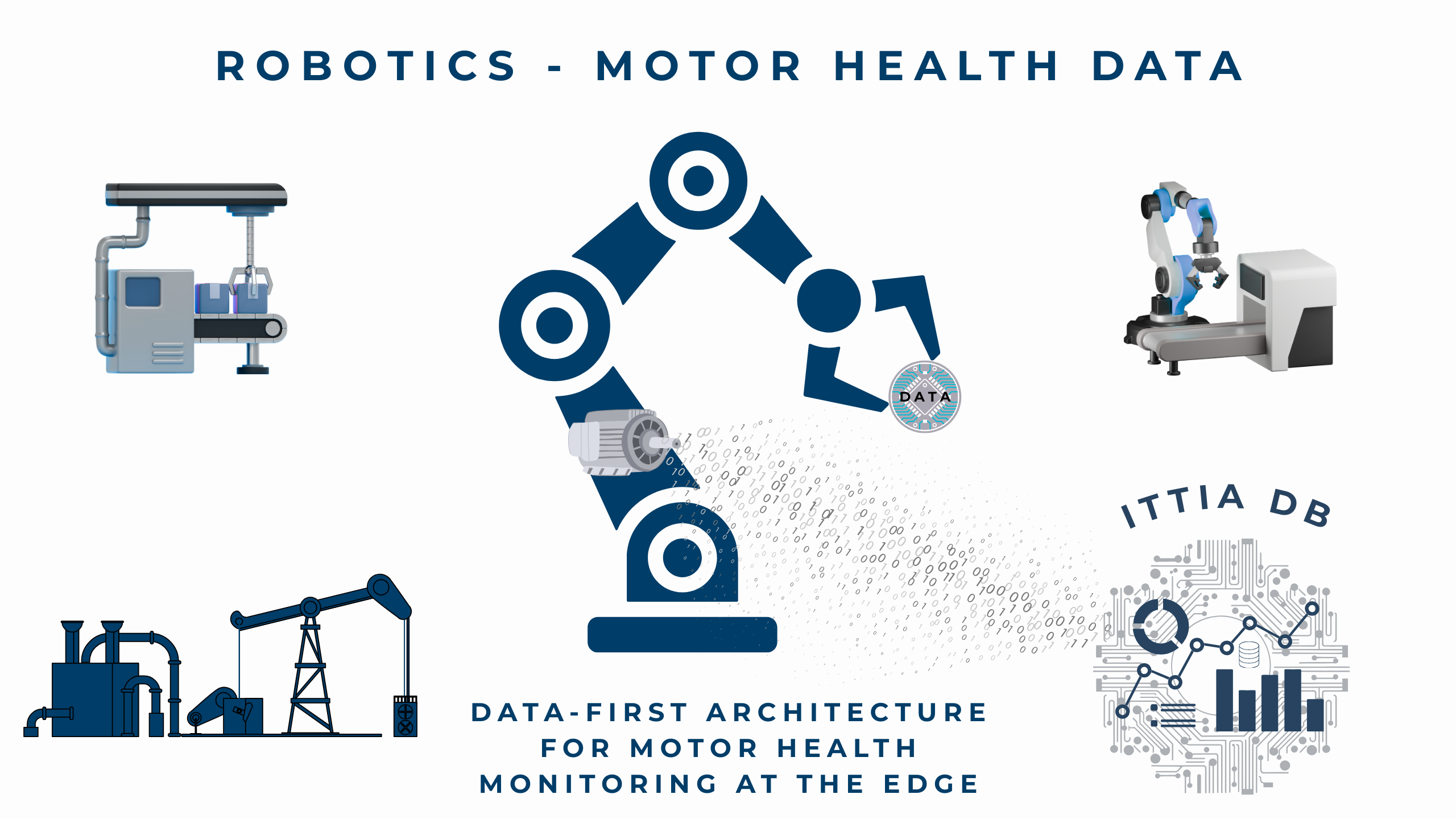
Robotics — Motor Health Data
Data-First Architecture for Motor Health Monitoring at the Edge
Are you ready to build and manage your robot’s data directly on the device? Modern robotics demands more than control algorithms. it requires deterministic, structured, and power-fail-safe data management at the edge. From sensor fusion and time-series logging to feature extraction and real-time AI inference, robots must capture, store, reason over, and act on data locally with precision and reliability. When data is managed intelligently on-device, robots become autonomous, explainable, and resilient, able to operate safely even without constant cloud connectivity.
Let’s start with motors and data. In industrial automation and robotics, motors are not just components, they are the mechanical heartbeat of production. Robotic arms execute precision movements, conveyor systems drive throughput, CNC spindle motors define machining accuracy, and industrial pumps and compressors sustain continuous operations. When these motors degrade or fail, the consequences are immediate: downtime, safety incidents, regulatory exposure, and financial loss.
This is where data-centric Edge AI becomes mission-critical, and where the ITTIA DB Platform, including ITTIA DB Lite, ITTIA DB, ITTIA Analitica, and ITTIA Data Connect, delivers a deterministic foundation for motor health intelligence.
Why Motor Health Data Is a Core Embedded Edge AI Component
Motors Are Electromechanical Assets with Wear Data
Motors are electromechanical assets with wear data embedded in every rotation. As bearings age, windings heat, shafts misalign, and loads fluctuate, these physical changes generate measurable signals, current harmonics, vibration patterns, temperature shifts, and speed variations. Wear is progressive and detectable, but only if data is captured deterministically, preserved with integrity, and analyzed over time. By treating motors as data-generating assets rather than simple actuators, organizations can transform raw signals into actionable insights, enabling predictive maintenance, extended asset life, and safer, more reliable operations.
Motors continuously generate rich operational signals:
- Current signatures
- Vibration harmonics
- Temperature gradients
- Rotational speed fluctuations
- Torque deviations
Unlike static components, motors degrade over time. Bearings wear. Insulation breaks down. Imbalance increases. Misalignment evolves.
This means motor health is not binary, it is a data progression problem. Detecting subtle patterns before catastrophic failure requires structured, historical, high-integrity data.
Failures Create Safety and Regulatory Risk
Lack of attention to motor data doesn’t just cause unexpected downtime, it creates serious safety and regulatory risk. Motors drive critical systems in energy, manufacturing, transportation, and healthcare, and when their data is ignored, early warning signs like abnormal vibration, rising temperature, or current distortion go undetected. This leads to sudden failures, equipment damage, and potentially hazardous situations for people and infrastructure.
In regulated industries, the inability to trace sensor data, explain failure conditions, or demonstrate proper monitoring can result in compliance violations, liability exposure, and costly penalties. Proper, deterministic motor data management is not optional, it is foundational to operational safety and regulatory readiness.
In industrial robotics:
- A servo motor fault in a robotic arm can cause uncontrolled motion.
- Conveyor motor degradation can halt entire production lines.
- CNC spindle instability affects tolerances and product quality.
- Pump and compressor failures may trigger environmental or safety violations.
Regulatory frameworks increasingly demand traceability:
- What signal changed?
- When did the anomaly start?
- What feature crossed threshold?
- What inference triggered shutdown?
Without deterministic on-device data capture and traceability, compliance and root-cause analysis become impossible.
Why Deterministic Data Capture Is Non-Negotiable
Edge AI for motor health is only as reliable as the data pipeline beneath it. Even the most advanced anomaly detection or remaining useful life (RUL) models will fail if the underlying data is inconsistent, incomplete, or corrupted. Deterministic ingestion, time-synchronized sampling, structured on-device storage, and power-fail-safe persistence form the foundation that ensures signals are trustworthy before they ever reach an AI model. Clean feature windows, traceable transformations, and explainable data lineage enable accurate inference and defensible decisions. Without a disciplined data pipeline, Edge AI becomes guesswork; with it, motor health monitoring becomes precise, resilient, and production ready.
In real-time control environments:
- Missed samples distort feature windows
- Flash latency spikes create jitter
- Power interruptions corrupt logs
- Non-deterministic writes break explainability
ITTIA DB Lite (MCU) and ITTIA DB (MPU) provide:
- Deterministic ingestion
- Transactional time-series storage
- Power-fail-safe persistence
- Flash-aware I/O (NOR / NAND / SD)
- Structured feature storage
This ensures that motor signals are captured exactly when they occur, not when the system happens to be available. Determinism is what transforms raw signals into trustworthy intelligence.
Why Cloud-Only Monitoring Is Too Slow, and Too Risky
Cloud analytics is valuable, but insufficient on its own for motor device data processing and management. While the cloud excels at fleet-wide aggregation, long-term trend analysis, and model optimization, motors operate in real time where latency, connectivity gaps, and safety constraints cannot be ignored.
Critical signals such as vibration spikes, current anomalies, or thermal excursions must be captured, processed, and acted upon instantly at the device level. Relying solely on cloud pipelines risks delayed response, lost data during outages, and limited explainability at the point of failure.
Effective motor intelligence requires a balanced architecture: deterministic, on-device data management and Edge AI for immediate control, complemented by cloud analytics for broader insight and continuous improvement.
Also, in industrial environments:
- Network connectivity may be intermittent.
- Latency may exceed control-loop requirements.
- Data volume may be too high for continuous streaming.
- Regulatory constraints may restrict external transmission.
Most critically:
A robotic arm cannot wait 300 milliseconds for a cloud inference to decide whether to shut down. Edge AI must operate locally, in real time.
On-Device AI: Real-Time Anomaly Detection + RUL Estimation
Time-series data management for motor devices is essential because motors generate continuous streams of timestamped signals, current, vibration, temperature, speed, and torque, that reflect their real-time condition and long-term wear.
Proper management means deterministically capturing these signals at precise intervals, synchronizing them across sensors, and storing them in structured, power-fail-safe formats directly on the device. It also involves efficiently materializing feature windows for analytics and AI, preserving historical context for trend analysis, and enabling traceability from raw signal to health metric. Without disciplined time-series management at the edge, critical patterns can be missed, anomalies misinterpreted, and predictive maintenance models rendered unreliable.
Time series data is the foundation of Remaining Useful Life (RUL) estimation because RUL is inherently about how a system changes over time. Motors do not fail instantly, degradation is progressive. Vibration amplitude increases gradually, temperature baselines drift, current harmonics shift, and efficiency declines. These trends are only visible when signals are captured as structured, timestamped sequences.
RUL models analyze time-series data patterns to detect degradation rates, acceleration of wear, and deviation from normal operating baselines. By extracting features from rolling time windows, such as RMS vibration, kurtosis, temperature slope, or frequency-domain energy, AI models can learn how quickly the motor is deteriorating and estimate how long it can continue operating before reaching a failure threshold.
Without clean, synchronized, and historically preserved time-series data, RUL becomes guesswork. With deterministic time-series management, RUL becomes a measurable, explainable projection grounded in the motor’s actual degradation trajectory.
By integrating structured time-series data with on-device AI frameworks, ITTIA DB Platform enables:
- Real-time anomaly scoring
- Remaining Useful Life (RUL) estimation
- Confidence tracking
- Drift monitoring
- Inference logging
Instead of reacting to failure, systems can:
- Detect bearing degradation early
- Predict spindle imbalance progression
- Schedule pump maintenance proactively
- Reduce unplanned downtime
Motor health shifts from reactive repair to predictive control.
The Complete Data Journey with ITTIA DB Platform
- Deterministic Ingestion
Motor signals are timestamped and stored with guaranteed integrity. - Structured Persistence
Time-series data and feature windows are materialized on-device. - AI Inference
Edge models compute anomaly scores and RUL metrics locally. - Local Action
Controllers adjust torque, trigger alerts, or safely halt operation. - Fleet Intelligence
Through ITTIA Data Connect, structured data can be securely exported for fleet-level analysis.
Operational Visibility
Developers need to visualize motor device data because raw signals alone do not reveal insight, patterns do. Time-series plots of vibration, current, temperature, and speed allow engineers to see drift, spikes, harmonics, and correlations that indicate wear or abnormal behavior.
Visualization bridges the gap between embedded data capture and AI inference, helping developers validate sampling accuracy, confirm feature extraction, tune thresholds, and verify anomaly scores or RUL estimates. It also supports explainability, showing how a specific event evolved over time and why a model triggered an alert. Without clear visualization of on-device motor data, debugging, optimization, and trust in the system become significantly harder.
With ITTIA Analitica, developers can visualize:
- Feature windows
- Anomaly trends
- Accuracy curves
- Model drift
- Motor health trajectories
This closes the loop between embedded determinism and enterprise intelligence.
Industrial Automation & Robotics: Where It Matters Most
In robotic arms powered by servo motors, precision and safety depend on continuous awareness of motor condition. Conveyor and production motors directly impact uptime and throughput, where even minor failures can halt entire lines. CNC spindle motors demand tight accuracy to maintain product quality, while industrial pumps and compressors must operate reliably to meet performance and regulatory requirements. In these environments, safety, uptime, and deterministic control are not optional features, they are operational mandates that require disciplined, real-time motor data management.
From Raw Signals to Explainable Edge Intelligence
Motor health is fundamentally a data problem before it is an AI problem.
Without:
- Deterministic capture
- Structured time-series storage
- Persistent feature windows
- Traceable inference logs
AI models become opaque, fragile, and non-compliant. With ITTIA DB Platform, embedded systems gain:
- Data autonomy
- On-device reasoning
- Regulatory-grade traceability
- Production-grade reliability
Conclusion
Industrial motors generate wear data continuously, embedding early warning signals in every rotation. When ignored, failures don’t just cause downtime, they create serious safety and regulatory risk. Cloud-only intelligence is too slow for environments that demand immediate response and deterministic control. The foundation of next-generation motor health systems is deterministic, on-device data management combined with real-time Edge AI. ITTIA DB Platform transforms raw motor signals into structured, explainable, safety-ready intelligence directly at the edge. From robotic precision to production uptime, this is Motor Intelligence where it matters most.
