Motor Health — Energy & Utility Devices
From Data to Decarbonization: Edge Data AI for Green Energy
In the Energy & Utilities sector, motors are not background components, they are mission-critical infrastructure. From turbine generators to oil & gas pump motors, from water treatment pumps to power plant cooling systems, continuous motor operation is directly tied to safety, uptime, environmental compliance, and revenue stability.
In these environments, poor data management leads to failure, and failure is not merely inconvenient. It is operationally disruptive, financially costly, and in some cases, dangerous.
This is where data-centric Embedded Edge AI, powered by ITTIA DB Platform provides the deterministic foundation for next-generation motor health monitoring.
Energy & Utilities: Where Motor Health Is Infrastructure Health
Wind Turbine Generators
Turbine generators operate in remote, harsh environments where vibration imbalance, bearing wear, and electrical harmonics can evolve gradually before resulting in catastrophic failure. In such settings, remote connectivity is often unreliable or intermittent, making local intelligence essential.
Equally critical is robust on-device data management: sensor signals must be captured deterministically, time-stamped accurately, and stored in a power-fail-safe manner to preserve historical trends and enable reliable anomaly detection. Without structured, persistent device-level data management, early warning patterns may be lost, diagnostic traceability compromised, and predictive maintenance efforts rendered ineffective.
Oil & Gas Pump Motors
Pump motors in upstream and midstream operations run continuously under high load, often in demanding and remote environments. A single failure can halt production, cause significant financial loss, or trigger environmental and safety risks.
In these conditions, robust on-device data management is essential. Operational signals such as pressure, vibration, current, and temperature must be captured deterministically, stored reliably, and preserved across power interruptions to maintain a complete performance history. Structured, persistent device-level data enables early anomaly detection, accurate trend analysis, and defensible root-cause investigations, ensuring predictive maintenance decisions are based on trustworthy, traceable data rather than incomplete or delayed cloud reports.
Water Treatment Plant Pumps
Municipal infrastructure depends on uninterrupted pump operation, where even brief downtime can compromise water quality, public health, and regulatory compliance. In these environments, data is not merely operational telemetry, it is a critical asset for safety, accountability, and performance assurance.
Continuous monitoring of flow rates, pressure levels, motor current, vibration, and temperature must be captured accurately and managed reliably at the device level. Deterministic, power-fail-safe data storage ensures that no events are lost, even during outages or transient faults.
Proper on-device data management preserves historical trends, supports real-time anomaly detection, enables predictive maintenance, and provides traceable records for audits and regulatory reporting. Without structured and persistent device-level data, municipalities risk delayed response, incomplete diagnostics, and exposure to compliance violations.
Power Plant Cooling Systems
Cooling pumps and fan motors directly affect plant efficiency and safe operation. Even gradual motor degradation can cascade into system-level instability, reducing thermal control performance and increasing operational risk.
In such safety-critical environments, data becomes a foundational asset for maintaining stability and compliance. Continuous monitoring of temperature, vibration, current, and flow dynamics must be captured deterministically and preserved reliably at the device level. Robust on-device data management ensures power-fail-safe storage, accurate time-stamping, and structured historical records that enable early anomaly detection and precise root-cause analysis. Without persistent, trustworthy device-level data, subtle degradation patterns may go unnoticed until they escalate into costly or dangerous failures.
In each of these cases, motor health is not optional, it is operational continuity, and that continuity depends on disciplined, deterministic data management at the edge.
Why Motor Health Data Is a Core Embedded Edge AI Component
Motors Are Electromechanical Assets with Wear Data
Motors are dynamic electromechanical systems that generate continuous operational signals reflecting their mechanical and electrical condition. Vibration signatures, current harmonics, temperature gradients, torque fluctuations, and speed variations all contain measurable indicators of wear and degradation over time. Because this wear progresses gradually rather than occurring instantaneously, the ability to capture, structure, and preserve this data is essential.
Effective data management transforms raw sensor signals into meaningful, traceable operational intelligence. Deterministic ingestion, accurate timestamping, structured time-series storage, and power-fail-safe persistence ensure that degradation patterns are not lost due to missed samples, storage latency, or system interruptions.
Without disciplined device-level data management, early warning indicators may be obscured, anomaly detection models may be unreliable, and predictive maintenance efforts may lack evidentiary support. Properly managed data enables consistent trend analysis, explainable AI inference, and defensible maintenance decisions, turning motor wear signals into actionable operational continuity insights.
Motors generate continuous wear signatures:
- Current distortions
- Harmonic patterns
- Bearing vibration signatures
- Thermal gradients
- Speed instability
Wear is progressive. It is detectable, but only if the data is captured correctly, structured properly, and preserved with integrity at the device level. Motor health monitoring is fundamentally a time-series data problem before it becomes an AI problem. Without disciplined edge data management, including feature window materialization, historical persistence, and traceable inference logging, even the most advanced AI models cannot produce reliable or explainable results. Proper Edge AI data architecture ensures that reconstruction errors, anomaly scores, and predictive metrics are derived from trustworthy, complete, and context-rich datasets, transforming progressive wear signals into actionable, safety-grade intelligence.
Failures Create Safety and Regulatory Risk
Energy and utility systems operate within strict regulatory frameworks where operational transparency, traceability, and safety compliance are mandatory. Improper device-level data management increases the likelihood of failure, and failure in these environments extends far beyond operational inconvenience. It can result in safety incidents, environmental violations, regulatory penalties, and significant financial liability.
When device data is not captured deterministically, preserved reliably, and maintained with historical integrity, critical early warning indicators may be lost. Incomplete or corrupted records undermine root-cause investigations, audit readiness, and compliance reporting. Failures in energy and utility infrastructure therefore create both safety risk and regulatory exposure, making disciplined, power-fail-safe device data management an essential foundation for operational continuity and legal defensibility.
Energy & utility systems are heavily regulated.
Failure can lead to:
- Environmental violations
- Safety incidents
- Equipment damage
- Regulatory penalties
- Audit exposure
When an event occurs, operators must answer:
- What changed in the signal?
- When did degradation begin?
- What feature crossed threshold?
- Why did the model issue an anomaly?
- Was the shutdown decision justified?
Without deterministic, structured on-device data capture, these answers cannot be trusted.
Deterministic Data Capture: The Foundation of Reliable Edge AI
In energy infrastructure, unpredictability is unacceptable. Systems must operate with precision, stability, and full operational visibility at all times. In this context, data is not simply informational, it is foundational to safety, compliance, and performance assurance.
Deterministic data capture gives Edge AI a new level of operational credibility. When sensor signals are ingested without loss, accurately time-stamped, and preserved in a power-fail-safe manner, AI models can rely on complete and trustworthy time-series histories. This transforms Edge AI from an experimental enhancement into a dependable decision-support system. Deterministic data capture becomes the foundation of reliable Edge AI, ensuring that anomaly detection, predictive maintenance, and Remaining Useful Life estimations are built on consistent, traceable, and auditable device-level data.
In energy infrastructure, unpredictability is unacceptable and embedded systems must handle:
- Power interruptions
- Harsh environmental conditions
- Flash storage limitations
- Real-time control constraints
- Intermittent connectivity
ITTIA DB Lite (for MCUs) and ITTIA DB (for MPUs) provide:
- Deterministic sensor ingestion
- Transactional time-series storage
- Power-fail-safe commits
- Flash-aware I/O management (NOR, NAND, SD)
- Persistent feature window storage
This ensures:
- No dropped samples
- No corrupted logs
- No jitter in control loops
- No loss of forensic traceability
Deterministic data capture transforms noisy signals into reliable intelligence.
Why Cloud-Only Monitoring Is Often Too Slow, or Too Risky
Cloud analytics has value for fleet-level optimization. But relying on cloud-only decision-making is insufficient in energy infrastructure.
Limitations include:
- Remote site connectivity instability (wind farms, offshore rigs)
- Latency incompatible with control loops
- High cost of streaming raw high-frequency vibration data
- Cybersecurity and regulatory constraints
A cooling pump in a power plant cannot wait for cloud approval to shut down. A wind turbine cannot depend on a network round-trip to detect imbalance. Intelligence must reside at the edge.
On-Device AI: Real-Time Anomaly Detection + RUL Estimation
By combining deterministic data management with embedded AI frameworks, ITTIA DB Platform enables:
- Real-time anomaly scoring
- Remaining Useful Life (RUL) estimation
- Confidence scoring
- Model drift detection
- Inference logging for auditability
Instead of reacting to catastrophic failure, systems can:
- Detect early bearing degradation
- Identify cavitation in pumps
- Track harmonic distortion growth
- Predict failure windows
- Schedule maintenance proactively
This shifts operations from reactive repair to predictive infrastructure resilience.
Closing the Loop: From Edge Intelligence to Fleet Insight
ITTIA Data Connect
Securely synchronizes structured motor health data from remote edge devices to enterprise systems without flooding networks with raw streams.
ITTIA Analitica
Provides visualization and operational AI insight:
- Feature trends
- Anomaly evolution
- Accuracy curves
- RUL projections
- Fleet-wide comparisons
This enables operators to move from isolated device monitoring to intelligent fleet orchestration.
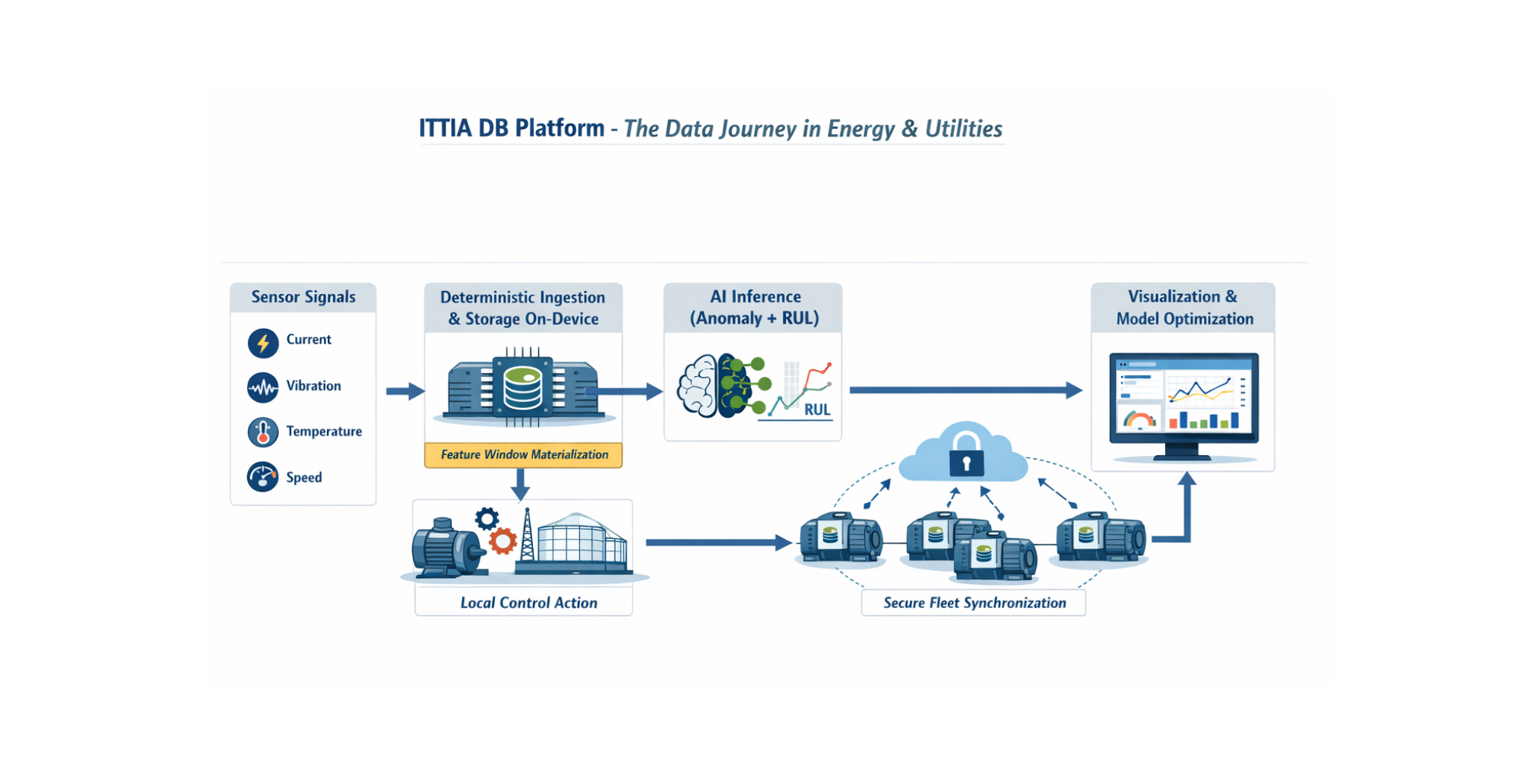
The Data Journey in Energy & Utilities
- Sensor signals (current, vibration, temperature, speed)
- Deterministic ingestion and storage on-device
- Feature window materialization
AI inference (anomaly + RUL) - Local control action
- Secure fleet synchronization
- Visualization and model optimization
Every step is data-centric. Every step is deterministic.
The Bottom Line
In Energy & Utilities:
- Motors are infrastructure assets.
- Wear is detectable, if data is captured correctly.
- Failures create safety, environmental, and regulatory risk.
- Cloud-only intelligence is insufficient.
Deterministic, structured, power-fail-safe data management, combined with on-device Edge AI, is the only way to deliver safety-grade, uptime-driven motor health monitoring. ITTIA DB Platform turns raw motor signals into explainable, real-time intelligence where it matters most: at the edge. From wind farms to water plants, this is data-centric motor resilience engineered for the modern energy grid.
