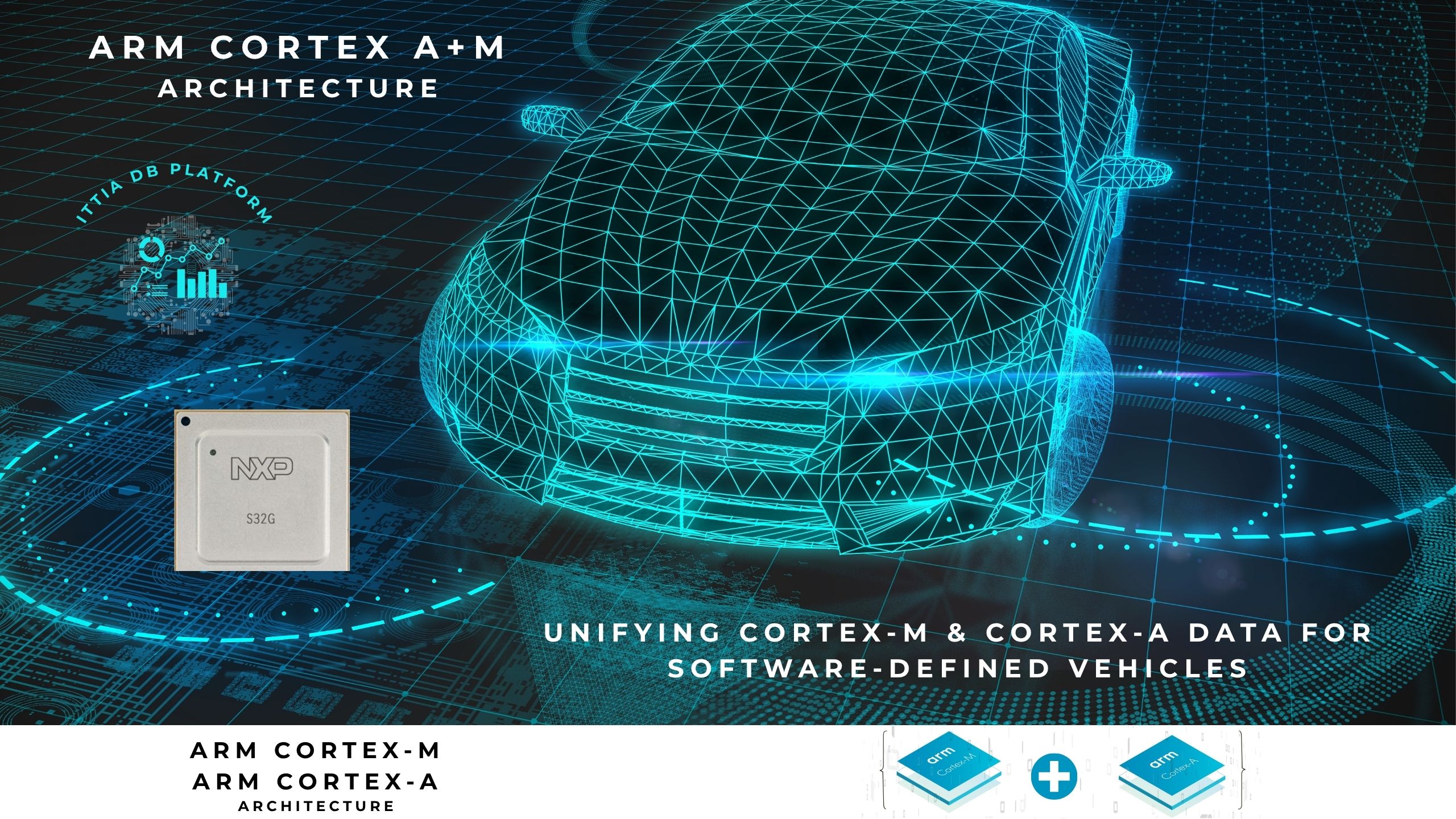
Unifying Cortex-M and Cortex-A Data for Software-Defined Vehicles
One Data Platform for SDV with ITTIA DB and S32G
Software-defined vehicles require multiple classes of processors working together. No single processor architecture can efficiently manage every workload, from real-time sensor acquisition and local AI inference to vehicle networking, data aggregation, diagnostics, cybersecurity, and centralized applications.
A scalable SDV architecture can combine Cortex-M processors for constrained ECUs and local intelligence with NXP S32G Cortex-A processing for vehicle gateways, higher-level data aggregation, and centralized vehicle services.
These processing environments should not duplicate one another. Instead, they should cooperate through a layered data architecture in which intelligence begins close to the sensor and expands into a broader vehicle-wide understanding.
The ITTIA DB Platform provides the data management, data processing, communication, AI enablement, and observability required to connect these environments into one coordinated system.
The Role of Cortex-M
Cortex-M processors operate close to sensors, actuators, and vehicle networks. They are commonly used in battery-management systems, motor controllers, body electronics, zonal I/O, sensor modules, access-control systems, and low-power monitoring applications.
Their value comes from deterministic response, low power consumption, efficient use of constrained memory, direct peripheral access, local control, and the ability to perform immediate Edge AI processing.
ITTIA DB Lite supports structured data ingestion, transactional and time-series data management, rolling historical windows, local queries, event retention, and power-failure resilience in these environments.
ITTIA DB Lite AI extends this foundation with historical feature engineering, AI-ready data preparation, and the ability to maintain the data context required for local inference.
The Cortex-M data path can become:
Sensor or CAN Input → ITTIA DB Lite → Historical Window → ITTIA DB Lite AI → AI Inference → Local Action
This allows an ECU to remain autonomous and respond immediately without depending on a vehicle gateway or cloud connection.
The Role of NXP S32G Cortex-A
The NXP S32G platform provides a higher-performance Cortex-A environment required for vehicle-level aggregation, connectivity, data processing, and software services.
Within a software-defined vehicle, an S32G-based system can serve as a vehicle gateway and higher-level computing environment, bringing together selected information from distributed Cortex-M ECUs and creating a broader understanding of vehicle behavior.
At this layer, the system may support vehicle networking, domain coordination, diagnostics, cybersecurity monitoring, OTA software management, centralized data analytics, cloud connectivity, service-oriented applications, and fleet-data preparation.
ITTIA DB provides the relational, transactional, streaming, and time-series data-management foundation for this higher-performance environment.
Rather than collecting every raw sample generated throughout the vehicle, an S32G system can receive selected information from local ECUs, including anomalies, fault records, health indicators, AI inference results, confidence values, diagnostic summaries, aggregated statistics, and selected historical windows.
This creates a clear division of responsibilities:
Cortex-M provides local intelligence, NXP S32G Cortex-A provides vehicle intelligence.
A Layered SDV Data Architecture
A complete ITTIA architecture can create a continuous data path from the vehicle edge to higher-level intelligence. Sensors and vehicle networks feed real-time data into Cortex-M processors, where ITTIA DB Lite manages local data and ITTIA DB Lite AI performs feature engineering and prepares data for AI inference and immediate ECU action. ITTIA Data Connect then selectively moves relevant events, AI results, and historical context to an NXP S32G Cortex-A vehicle gateway, where ITTIA DB aggregates and correlates information across ECUs for broader analytics. ITTIA Analitica completes the architecture by providing visualization, diagnostics, observability, and integration with vehicle services and cloud applications.
Each processing layer manages the data appropriate to its responsibilities.
Cortex-M retains detailed local context and supports immediate device-level decisions. NXP S32G brings selected information together across many ECUs and creates a broader operational view of the vehicle.
The architecture, therefore, avoids unnecessary movement of raw data while still allowing important events and insights to become available at the vehicle level.
Example: Intelligent Electric Powertrain
Consider an electric vehicle in which a battery-management ECU continuously monitors cell voltage, current, temperature, State-of-Charge, and balancing activity.
ITTIA DB Lite stores relevant recent history, while ITTIA DB Lite AI calculates features such as voltage variation, thermal gradients, charge-rate behavior, and changes between operating cycles. An AI model may then identify an abnormal battery or motor-related condition and take immediate local action. The local ECU does not need to send every measurement to the central vehicle system.
Instead, ITTIA Data Connect can send selected information to an NXP S32G Cortex-A gateway, including battery-health indicators, motor anomalies, thermal conditions, vehicle operating states, software versions, diagnostic events, and AI results.
ITTIA DB running at the S32G level can correlate those records across time and subsystem boundaries. For example, the vehicle-level system may determine that a motor anomaly occurs only when battery voltage is low, thermal load is high, and a particular software version is active.
That conclusion would be difficult for an individual ECU to produce independently because the local controller does not have visibility into the broader vehicle environment.
The Cortex-M ECU detects the local condition. The S32G Cortex-A environment determines its broader meaning.
Data Processing Across Cortex-M and S32G Cortex-A
Cortex-M processing is well-suited for signal validation, rolling statistics, lag and delta calculations, local thresholds, event detection, MCU-level feature engineering, anomaly detection, and immediate inference.
The NXP S32G Cortex-A environment can perform broader processing that requires more memory, historical context, and access to information from multiple subsystems. This can include cross-ECU correlation, complex queries, longer historical analysis, vehicle-wide diagnostics, model-performance evaluation, cybersecurity analytics, fleet-data preparation, and centralized software-service coordination.
The value comes from allowing each processor environment to perform the work that fits its resources and responsibilities. Local processing reduces latency and network traffic. Vehicle-level processing adds context and correlation.
Distributed AI from the ECU to the Vehicle
AI does not need to operate entirely on one processor. Cortex-M devices can perform TinyML inference, anomaly detection, sensor classification, low-power condition monitoring, feature extraction, and immediate local decisions.
The S32G Cortex-A environment can then use the results from many ECUs for more complex inference, cross-domain analytics, AI-model monitoring, vehicle-level decision support, and interaction with fleet or cloud systems. The ITTIA DB Platform provides the historical and operational context required across both environments.
For an AI inference, the system can preserve the original sensor measurements, historical windows, data-quality status, calculated features, model identity and version, inference output, confidence value, local action, and eventual vehicle-level interpretation.
This creates traceability from the original sensor measurement to the final vehicle-level decision.
ITTIA Data Connect as the Communication Layer
ITTIA Data Connect provides selective movement of information between distributed Cortex-M devices and the NXP S32G Cortex-A environment.
Rather than transmitting every raw sensor sample, local ECUs can share information that carries greater operational value, such as anomalies, fault records, health indicators, AI results, confidence values, summaries, diagnostic windows, and security events.
This reduces bandwidth and storage requirements while allowing the local device to remain autonomous.
If communication to the S32G gateway is temporarily interrupted, the Cortex-M ECU can continue collecting, processing, and storing data locally. Selected records can then be transferred after communication is restored.
This is an important characteristic of software-defined vehicle architectures because critical device operation should not depend on continuous connectivity to a higher-level system.
ITTIA DB on NXP S32G
ITTIA DB provides the vehicle-level data-management foundation within the Cortex-A environment.
On an NXP S32G platform, it can organize information from many ECUs into structured relational and time-series datasets rather than leaving information distributed across disconnected messages, log files, and application-specific storage.
ITTIA DB can manage ECU histories, vehicle operating conditions, diagnostic sessions, AI results, cybersecurity events, OTA information, software versions, health indicators, and aggregated sensor statistics.
Applications can then query this information across time, subsystem, ECU, event type, software version, AI model, fault condition, or operating state.
The result is a vehicle-wide data environment that gives applications and engineers a broader understanding of how the vehicle is operating.
Cross-ECU Intelligence on S32G
One of the most important advantages of vehicle-level data aggregation is the ability to correlate information that originated independently.
An S32G gateway may determine relationships between motor-health indicators and battery state, battery temperature, and environmental conditions, network faults and OTA updates, AI anomalies and vehicle operating modes, cybersecurity events and network behavior, or diagnostic faults and software versions.
This additional context can dramatically increase the value of local ECU information.
A local anomaly is an observation.
A correlated vehicle-level anomaly can become an explanation.
ITTIA Analitica for End-to-End Observability
ITTIA Analitica provides visibility across the distributed SDV data architecture.
Engineers can observe live and historical measurements, Cortex-M events, S32G aggregated information, calculated features, AI inference results, confidence values, device actions, communication status, storage behavior, and processing performance.
A particularly valuable capability is the ability to trace the complete lineage of an important event, from the original sensor measurement and its historical data context, through feature engineering, AI model execution, inference results, and local ECU action. With ITTIA Data Connect, that information can then move selectively to the NXP S32G environment, where additional vehicle-level context is added and correlated with data from other systems. This creates a complete and explainable path from sensor data to vehicle-level decision, helping engineers understand not only what happened, but also why the system reached a particular conclusion.
An engineer can therefore determine which sensor changed first, what historical data was available, which features were calculated, which AI model produced the result, what action occurred locally, and what additional context was discovered at the S32G vehicle level. This provides far greater observability than examining isolated ECU logs.
The Combined Value of the ITTIA DB Platform
ITTIA DB Lite provides structured transactional and time-series data management close to the sensor, enabling constrained Cortex-M devices to retain historical context and operate reliably.
ITTIA DB Lite AI extends that local data foundation toward Edge AI by supporting feature engineering, AI-ready historical data, model-input preparation, inference context, and AI-result traceability.
ITTIA Data Connect selectively moves the most valuable information between local ECUs and the NXP S32G vehicle gateway while minimizing unnecessary data traffic.
ITTIA DB provides the higher-level data-management environment on Cortex-A, supporting aggregation, relational and time-series analysis, cross-domain event correlation, longer historical retention, and vehicle-level applications.
ITTIA Analitica completes the architecture by providing data visualization, AI observability, diagnostics, performance monitoring, and end-to-end event traceability.
Together, these technologies establish a common data strategy across the distributed vehicle.
From Cortex-M Intelligence to NXP S32G Vehicle Intelligence
Software-defined vehicles require local intelligence and centralized intelligence to work together.
Cortex-M provides efficient, deterministic data acquisition, local processing, immediate AI inference, and autonomous ECU operation.
NXP S32G Cortex-A provides the higher-level processing environment required to aggregate those distributed insights, correlate information across vehicle domains, support diagnostics and cybersecurity, coordinate vehicle services, manage longer histories, and prepare selected information for cloud and fleet applications.
The ITTIA DB Platform connects these environments through one coordinated data architecture.
Local real-time data becomes structured vehicle intelligence.
By combining ITTIA DB Lite, ITTIA DB Lite AI, ITTIA Data Connect, ITTIA DB, ITTIA Analitica, and NXP S32G, developers can build software-defined vehicles in which intelligence begins at the ECU, moves selectively through the vehicle, and becomes increasingly meaningful as additional context is added.
Cortex-M creates intelligence at the device. NXP S32G Cortex-A transforms distributed device intelligence into vehicle-wide intelligence.
