Building the Data Intelligence Layer for Software-Defined Vehicles
NXP S32 Cortex-A + ITTIA DB, Vehicle Data, and Centralized Intelligence
Part Two - Software-defined vehicles require more than intelligence within individual ECUs. They also require higher-performance computing environments that can aggregate information from many controllers, correlate events across vehicle domains, coordinate software services, retain longer data histories, and create a vehicle-wide understanding of operational behavior.
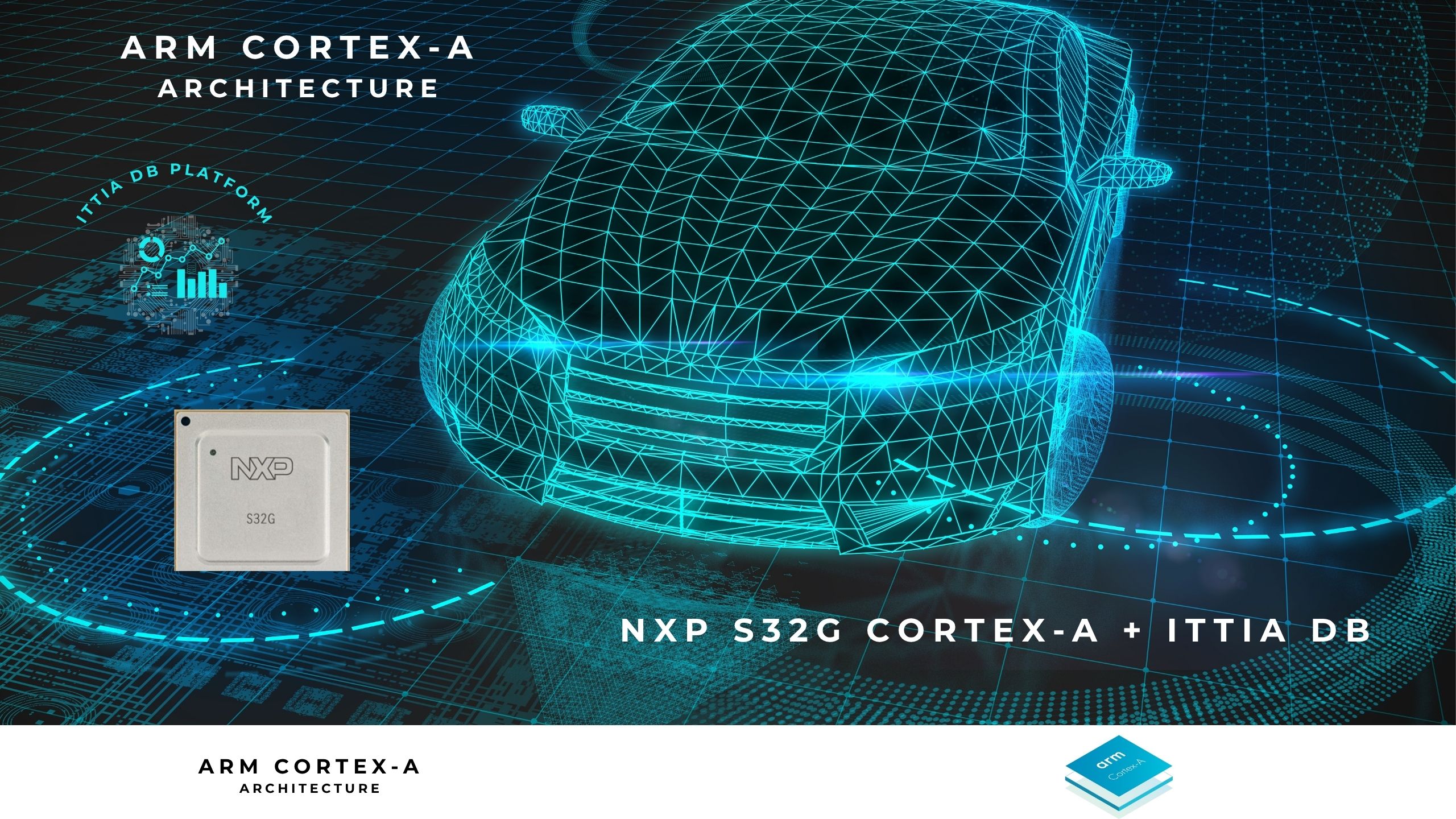
The NXP S32 automotive processing platform, including S32G processors with Cortex-A application-processing capabilities, is well-suited for this higher-level role. These processors provide the computing performance, memory capacity, networking capabilities, operating-system support, and software environment required to move beyond individual ECU intelligence toward centralized vehicle coordination.
Within an SDV architecture, NXP S32 Cortex-A processing can support vehicle gateways, domain and zonal controllers, central vehicle computers, diagnostics, cybersecurity monitoring, over-the-air software management, data analytics, cloud connectivity, fleet-data preparation, and service-oriented vehicle applications.
By combining the NXP S32 processing architecture with the ITTIA DB Platform, vehicle manufacturers can establish a structured data foundation that connects distributed ECU intelligence with vehicle-level processing, analytics, observability, and services. ITTIA DB supports the Cortex-A environment, while ITTIA DB Lite and ITTIA DB Lite AI can operate within lower-level Cortex-M and other resource-constrained ECUs.
NXP S32G as a Vehicle Data and Service Platform
Within a modern SDV architecture, an NXP S32G-based system can operate as an intelligent vehicle gateway, data aggregation point, and coordination platform. Information may arrive from battery management, traction motors, braking, steering, thermal management, body electronics, powertrain, radar and perception systems, zonal controllers, cybersecurity systems, and diagnostics.
The value of the S32G platform is not simply its ability to receive this information. Its greater value comes from the ability to coordinate, contextualize, correlate, and process selected information from across the vehicle.
Rather than moving every raw sample from every ECU, local controllers can process information near its source and forward the information that has greater vehicle-level value. This may include detected anomalies, fault records, aggregated statistics, AI inference results, health indicators, selected historical windows, security events, diagnostic summaries, data-quality indicators, and model confidence values.
ITTIA Data Connect can support the selective movement of this information from distributed ITTIA DB Lite and ITTIA DB Lite AI environments into an S32G Cortex-A system running ITTIA DB.
The resulting architecture can follow a data path such as:
Sensors → Cortex-M / Real-Time ECUs → ITTIA DB Lite / ITTIA DB Lite AI → ITTIA Data Connect → NXP S32G Cortex-A → ITTIA DB → ITTIA Analitica → Vehicle and Cloud Services
High-Throughput Data Aggregation on NXP S32G
A vehicle gateway based on NXP S32G may receive information from dozens of distributed systems simultaneously. The challenge is not simply transporting the data. The system must determine what information should be retained, correlated, analyzed, transmitted, summarized, or discarded.
For example, an S32G gateway may receive battery State-of-Charge and State-of-Health information, motor anomaly events, temperature trends, braking events, diagnostic trouble codes, network-health information, cybersecurity alerts, ECU software versions, AI model outputs, and zonal-controller status.
ITTIA DB can organize these diverse data streams into related and queryable datasets rather than leaving them as disconnected files, messages, or logs. This transforms the S32G from a communications gateway into a vehicle data intelligence platform.
ITTIA DB as the Vehicle-Level Data Platform
ITTIA DB provides relational, transactional, streaming, and time-series data management for higher-performance embedded environments such as Cortex-A. Within an NXP S32G system, ITTIA DB can manage ECU event histories, vehicle operating conditions, diagnostic sessions, software versions, AI results, cybersecurity events, cross-domain health indicators, OTA update information, maintenance records, and aggregated sensor statistics.
Applications can then query this information across time ranges, vehicle subsystems, ECU identifiers, fault codes, operating states, AI results, software versions, security events, and maintenance outcomes.
Instead of examining individual ECU logs independently, engineers and applications gain a structured vehicle-wide view of what occurred, when it occurred, what other systems were affected, and under what operating conditions.
From ECU Intelligence to Vehicle Intelligence
An individual Cortex-M ECU may detect a local condition very effectively, but it typically has limited knowledge of what is occurring elsewhere in the vehicle. An NXP S32G Cortex-A environment can provide a broader context. For example, a motor-control ECU may detect unusual vibration and current behavior. The ECU can use ITTIA DB Lite AI to retain relevant data, calculate features, run an AI model, and identify an abnormal operating condition.
That result can then be sent through the ITTIA Data Connect to the S32G environment. At the vehicle level, ITTIA DB can correlate the motor anomaly with battery voltage, State-of-Charge, cooling-system status, vehicle speed, ambient temperature, road load, previous maintenance history, and earlier motor events.
The system may determine that the anomaly appears only under a specific combination of low battery voltage, high thermal load, and heavy vehicle operation. That conclusion carries significantly more engineering and operational value than the original anomaly by itself.
The local ECU provides device intelligence. The S32G Cortex-A platform provides vehicle intelligence.
Richer Data Processing on Cortex-A
The additional memory and processing resources available in Cortex-A environments enable more advanced correlation and analytics than are practical on many constrained controllers.
An NXP S32G system can correlate motor-health indicators with battery state, battery temperature with ambient conditions, network faults with software updates, braking events with road conditions, AI anomalies with vehicle operating modes, ECU faults with power disturbances, cybersecurity alerts with network behavior, and thermal conditions with vehicle workload.
This cross-domain correlation adds context to individual events. In software-defined vehicles, this context is increasingly important because a fault detected by one ECU may actually be caused or influenced by conditions elsewhere in the vehicle. ITTIA DB provides the structured data environment required to represent and analyze these relationships systematically.
Managing Perception and ADAS Metadata
Camera, radar, and lidar systems can generate very large volumes of raw data. Specialized accelerators and memory pipelines are normally responsible for processing these raw streams.
ITTIA DB does not need to replace those pipelines to provide significant value. Instead, it can manage the operational metadata generated around perception and ADAS systems, including detected objects, classifications, confidence scores, tracking identifiers, radar targets, sensor-fusion results, perception faults, frame references, environmental conditions, and AI model versions.
This information can then be correlated with braking, steering, vehicle speed, driver-assistance events, map information, vehicle operating state, and diagnostic events.
The result is that ITTIA DB manages the meaning, context, relationships, and traceability of perception results while specialized hardware continues to process high-volume raw sensor data.
Longer Historical Retention
Compared with many MCU-based ECUs, NXP S32 Cortex-A systems can operate with significantly greater memory and persistent-storage resources, including technologies such as eMMC, UFS, SSD, NAND, filesystems, and dedicated data partitions.
ITTIA DB can use these resources to retain longer histories of cross-ECU events, vehicle-health information, AI inference results, diagnostic sessions, software updates, security events, operational statistics, and selected raw-data windows.
However, even with larger storage, intelligent retention remains important. The objective should not be to preserve every sensor sample indefinitely. Routine data can be summarized or expired, while detailed information surrounding important events can be retained for engineering analysis, diagnostics, maintenance, safety investigation, AI validation, or fleet services.
ITTIA Data Connect for Distributed S32 Architectures
A software-defined vehicle is inherently distributed. Data may originate from Cortex-M ECUs, Cortex-R real-time controllers, sensor modules, domain controllers, zonal controllers, gateways, and higher-level Cortex-A computers.
ITTIA Data Connect provides the data-distribution layer between these environments. It can selectively move important events, summaries, anomalies, AI results, health indicators, diagnostic windows, security events, and operational statistics without requiring the transfer of all raw device data.
This approach can reduce network traffic, limit unnecessary storage consumption, and preserve the information that carries the greatest engineering and operational value.
It also supports disconnected operation. Local ECUs can continue collecting, processing, and storing information even when communication with the S32G gateway is temporarily unavailable, and selected records can be transferred after connectivity is restored.
This is particularly important in automotive systems where local functions must continue operating independently of higher-level connectivity.
ITTIA Analitica for Vehicle Observability
Once vehicle information is aggregated and organized in ITTIA DB, ITTIA Analitica can provide visualization and observability across the vehicle architecture.
Developers and engineers can examine live event streams, historical trends, vehicle-health indicators, ECU status, AI classifications, confidence scores, diagnostic events, communication behavior, storage performance, cybersecurity events, and sensor-to-feature-to-inference lineage.
A particularly valuable capability is the ability to select an abnormal event and reconstruct its complete history:
Raw Sensor Data → Historical Window → Feature Engineering → AI Model → Confidence Score → Anomaly → Vehicle Context → Resulting Action
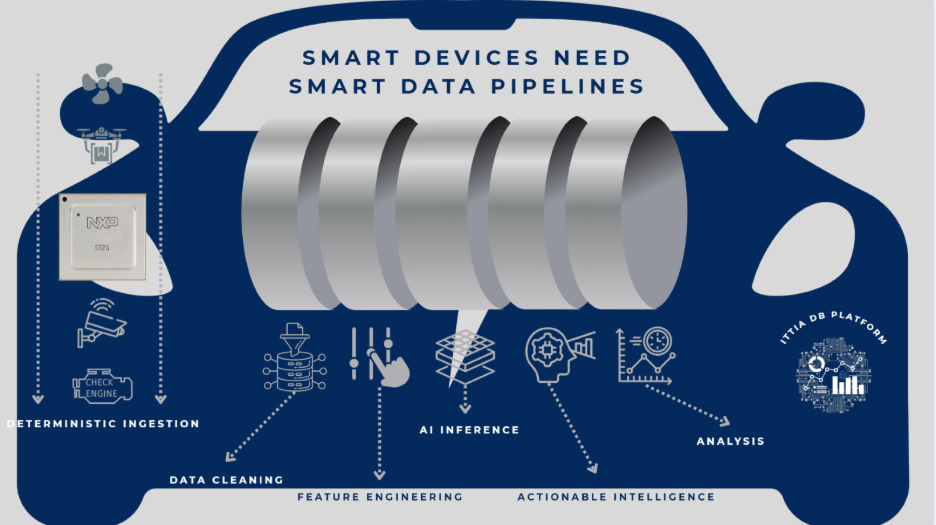
This can help engineers determine whether an abnormal result originated in the sensor, signal quality, local ECU, feature preparation, AI model, communication system, vehicle operating condition, or vehicle-level application.
NXP S32 Cortex-A and the ITTIA DB Platform
NXP S32 Cortex-A environments provide the processing, memory, networking, storage, operating-system support, and centralized computing capabilities required for higher-level SDV functions. The ITTIA DB Platform adds the data infrastructure required to make that computing environment data-driven.
Together, ITTIA DB, ITTIA Data Connect, and ITTIA Analitica provide structured vehicle-level data management, transactional integrity, time-series processing, cross-ECU correlation, historical retention, selective data movement, relational querying, AI-result management, diagnostic analysis, visualization, observability, and vehicle-to-cloud data preparation.
This enables a layered vehicle architecture in which local ECUs continue to provide deterministic control and immediate intelligence, while the NXP S32G Cortex-A environment combines those distributed insights to create a broader understanding of vehicle behavior.
With the ITTIA DB Platform, NXP S32G becomes more than a gateway or application processor. It becomes a central data coordination, observability, and intelligence platform for the software-defined vehicle.
This version is more article-like and marketing-friendly, with bullets largely replaced by connected technical narrative.
