AI Inference on NXP S32 Processors with ITTIA DB Platform
Edge AI Maturity for SDV Through Relational Data Management
Artificial intelligence at the automotive edge is rapidly changing how vehicles perceive conditions, analyze behavior, detect anomalies, and make decisions. However, running an AI model on a processor is only one part of building an intelligent automotive system.
Before inference can occur, data must be collected, organized, processed, correlated, and transformed into the precise inputs required by the AI model. After inference, the resulting predictions and decisions must often be preserved for diagnostics, traceability, continuous improvement, and explainability.
This is where a relational data management model becomes a powerful foundation for Edge AI.
The ITTIA DB Platform, combined with the scalable architecture of NXP S32 automotive processors, provides developers with a structured data infrastructure for building data-centric automotive Edge AI applications, from resource-constrained Cortex-M microcontrollers to higher-performance Cortex-A-based vehicle computing platforms.
Relational Data Management: A Foundation for Mature Edge AI
The relational data model remains one of the most mature and trusted foundations for managing operational data because it brings structure, consistency, queryability, and traceability to complex systems. For Edge AI applications, especially in software-defined vehicles and embedded devices, this maturity is essential.
AI inference depends not only on models, but also on reliable access to sensor history, events, features, metadata, and system context.
A relational approach enables developers to organize data into meaningful relationships, apply deterministic queries, preserve historical records, and connect raw observations to AI-ready features and inference results. This makes Edge AI systems easier to validate, explain, maintain, and scale from prototype to production.
AI Inference Requires More Than an AI Model
An inference engine receives input data, executes a trained machine learning model, and produces a prediction, classification, or decision based on current and historical operating conditions. In automotive applications, AI inference can be used to estimate Battery State of Health (SoH) and Remaining Useful Life (RUL), predict motor failure risk, analyze driver behavior, detect component anomalies, evaluate thermal conditions, identify sensor faults, and determine vehicle operating states. The quality and reliability of these results depend heavily on the data provided to the inference engine, making structured, timely, and context-rich data management an essential foundation for mature automotive Edge AI. But where does the inference input come from?
In a production vehicle, an AI model may depend on voltage, current, temperature, vibration, speed, torque, historical events, operating modes, previous inference results, environmental conditions, and configuration information. These data elements may arrive at different rates and from different ECUs, sensors, and vehicle networks.
Without a structured data foundation, developers frequently rely on custom memory buffers, files, queues, and application-specific data pipelines. As system complexity grows, this approach becomes increasingly difficult to manage, validate, query, and maintain.
A relational data management model provides a different approach: organize device data into structured tables with defined relationships that can be efficiently queried, processed, and preserved.
Why Relational Data Management Matters for Edge AI
The relational model allows different types of vehicle data to be organized logically while preserving their relationships.
For example, an Edge AI application can maintain structured relational tables for raw sensor measurements, vehicle operating conditions, CAN messages, time-series signals, diagnostic events, engineered features, AI model versions, inference outputs, confidence scores, and resulting vehicle actions. By organizing these different data elements within a relational model, developers can preserve the complete context and history surrounding every AI decision, from the original sensor observation and operating condition to feature generation, model execution, inference result, confidence level, and final system response. This structured data foundation improves AI traceability, explainability, validation, and lifecycle management, helping transform isolated inference into a mature, production-ready Edge AI system.
Instead of treating each measurement as an isolated value, the application can establish relationships between the data that led to an inference and the resulting decision.
The result is a data pipeline such as:
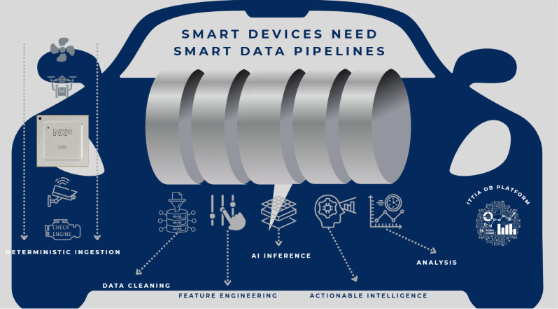
Sensor Data → Operational Context → Historical Data → Feature Engineering → AI Inference → Decision → Action → Traceability
This structured approach transforms an inference engine from an isolated algorithm into part of a reliable, data-driven automotive system.
Bringing Context to AI Inference
AI inference often becomes more valuable when the model understands not only what is happening now, but also what happened before. Consider predictive maintenance for an electric traction motor, where an AI model may require current vibration measurements, recent temperature history, motor speed, torque, historical RMS vibration, changes over time, previous anomaly scores, and the current vehicle operating mode.
A relational data model allows these different data elements to be associated, filtered, and queried together, providing the exact historical and contextual information needed to generate AI-ready features. Rather than manually maintaining separate arrays, buffers, and custom data structures throughout the application, developers can use structured queries to retrieve the relevant data across multiple signals and time periods. This is particularly important for automotive Edge AI applications, where meaningful intelligence often depends not on a single measurement, but on the relationships between multiple signals, historical trends, operating states, and environmental conditions.
Supporting Edge AI Across the NXP S32 Platform
NXP's S32 Automotive Platform includes Arm Cortex-A, Cortex-M, and Cortex-R-based processors designed for different levels of vehicle computing, networking, real-time processing, safety, and control. NXP positions the S32 platform as a scalable foundation for automotive Edge AI across vehicle domains.
The ITTIA DB Platform can provide a corresponding scalable data architecture across these computing environments.
Cortex-M: Data Management Close to Sensors and Control
NXP S32K automotive microcontrollers are based on Arm Cortex-M cores, with the S32K3 family offering scalable Cortex-M7 configurations designed for demanding automotive applications.
At this level, an intelligent ECU may need to continuously acquire sensor data, maintain recent operational history, calculate sliding-window features, generate statistical and temporal values such as RMS, mean, minimum, maximum, delta, and lag, prepare model inputs, execute local AI inference, store inference results, and preserve diagnostic evidence.
Bringing these capabilities together within a structured data-management architecture helps transform a traditional ECU into an intelligent, data-driven edge system that can make timely decisions while maintaining the historical context, traceability, and reliability required for production automotive AI.
ITTIA DB Lite and ITTIA DB Lite AI can provide the embedded data infrastructure required for resource-constrained automotive environments, giving developers a structured foundation for collecting, processing, querying, and preserving the data used by AI models.
Instead of building and maintaining custom storage layers, historical buffers, and feature-processing logic, development teams can use a unified data architecture to manage sensor measurements, operational history, engineered features, inference results, and diagnostic evidence directly on the device.
This approach can be especially valuable for applications such as battery management, motor health monitoring, smart actuation, thermal management, zone control, predictive maintenance, virtual sensors, and intelligent diagnostics, where reliable access to current and historical data is essential for producing timely, explainable, and production-ready AI decisions.
S32G: Combining Real-Time and Application Processing
NXP S32G vehicle network processors combine Arm Cortex-A53 application processing with Cortex-M7 real-time processing. NXP positions S32G for applications including service-oriented gateways, domain controllers, zonal processors, safety processing, and vehicle computing. This heterogeneous architecture creates an important opportunity for a distributed data model.
At the Cortex-M level, the system can collect real-time signals and perform local processing close to the vehicle network or control function. At the Cortex-A level, a more capable data management environment can correlate information from multiple sources, execute advanced queries, preserve larger histories, support visualization, and prepare data for more sophisticated AI inference.
For example:
Cortex-M real-time environment:
Sensor and CAN data → Local storage → Sliding windows → Feature generation → Local inference
Cortex-A application environment:
Multiple ECU data streams → Historical database → Cross-signal correlation → Advanced analytics → AI applications → Visualization and connectivity
With the ITTIA DB Platform, these environments can become part of a broader data architecture rather than independent islands of information.
From Raw Vehicle Data to AI-Ready Features
An AI model typically does not consume raw sensor streams directly; the data must first be transformed into meaningful features such as mean, RMS, variance, minimum and maximum values, delta, rate of change, lag values, rolling statistics, frequency-domain characteristics, and anomaly scores.
A relational data management model helps preserve the relationship between the original source data, the historical context used for calculation, and the resulting engineered features, creating a more structured and traceable feature-engineering pipeline. With ITTIA DB Lite AI, developers can build a continuous processing path in which incoming operational data is organized, historical windows are maintained, features are generated, and AI-ready inputs are delivered to the inference engine. Rather than treating feature engineering as a collection of disconnected algorithms, it becomes part of a managed data pipeline that improves consistency, explainability, reproducibility, and production readiness for Edge AI applications.
Preserving the Complete AI Decision Chain
In automotive applications, knowing the inference result alone may not be enough; engineers often need to understand exactly how and why that result was produced. For example, if an AI model determines that a battery module is showing signs of abnormal degradation, it may later be necessary to identify which measurements were used, the battery temperature and State of Charge at the time, the historical window that was analyzed, the features that were generated, the version of the AI model that was running, the confidence score that was produced, and the action ultimately taken by the ECU.
A relational database can preserve these relationships, creating a traceable connection from raw measurements and operating conditions through feature engineering and model inference to the final system response. This supports greater explainability, reproducibility, diagnostics, validation, and confidence in production automotive AI systems.
For example:
Raw sensor data → Window ID → Feature set → Model version → Inference result → Confidence score → Vehicle action
This creates an auditable chain from data to decision. For automotive AI, this can contribute to better diagnostics, explainability, testing, validation, and engineering analysis.
Relational and Time-Series Data Working Together
Automotive Edge AI requires more than conventional relational records because much of the data is time-series information generated continuously by sensors, vehicle networks, and control systems. An effective Edge AI data architecture therefore combines the strengths of time-series data management with the contextual power of the relational model. Time-series management efficiently handles continuously generated measurements such as voltage, current, temperature, pressure, vibration, speed, and torque, while relational management preserves the broader context involving vehicle identity, ECU configuration, operating mode, component information, AI model versions, diagnostic events, inference results, and maintenance records.
Together, these two models allow intelligent automotive applications to ask far more meaningful questions. Instead of simply asking, “What was the temperature?”, the system can ask, “What was the battery temperature during high-current operation when the previous three inference cycles detected abnormal degradation using model version 4.2?” This ability to connect measurements, history, system context, and AI outcomes is where structured data management becomes especially valuable for mature, explainable, and production-ready automotive Edge AI.
ITTIA DB Platform as the Data Foundation for Automotive Edge AI
The ITTIA DB Platform provides a family of data management technologies designed to support intelligent systems across different embedded and edge processing environments. ITTIA DB Lite provides embedded data management for resource-constrained microcontrollers, while ITTIA DB Lite AI extends this foundation for Edge AI applications by supporting historical data management, feature engineering, and AI inference pipelines.
ITTIA DB supports richer data management requirements on application processors and operating systems, ITTIA Data Connect enables the selective movement and distribution of information between embedded devices and higher-level computing environments, and ITTIA Analitica provides visualization and observability for operational data, engineered features, AI results, and overall system behavior.
Together, these components can establish a scalable end-to-end data path, such as Sensors and CAN Networks → ITTIA DB Lite → Feature Engineering → AI Inference → ITTIA Data Connect → ITTIA DB → ITTIA Analitica, creating an architecture that can evolve from local ECU intelligence to vehicle-level data processing, correlation, and observability.
Consider, for example, an AI-enabled battery management system built on the NXP S32 platform. At the ECU level, the application may continuously collect cell voltage, pack voltage, current, cell temperature, charge and discharge cycles, State of Charge, and State of Health. ITTIA DB Lite AI can organize this incoming information, preserve historical operating windows, and generate features such as rolling temperature averages, voltage deviation, current RMS, rate of change, and historical deltas.
These features can then be supplied to an AI inference framework to estimate State of Health, Remaining Useful Life, thermal anomaly risk, cell imbalance, and early failure indicators. The resulting inference can be stored together with the underlying measurements, engineered feature values, AI model version, timestamp, and confidence score, creating a traceable record of how each AI decision was produced.
At a higher vehicle-compute level, such as an NXP S32G-based platform, information from multiple ECUs can be correlated, analyzed, visualized, and selectively communicated to external systems. The result is not simply an AI model running inside a vehicle, but a complete data-driven intelligence architecture in which sensing, historical context, feature engineering, inference, data distribution, visualization, and observability work together as part of a unified system.
The Data Foundation Is Part of the AI Architecture
The future of automotive Edge AI will not be determined only by faster processors or more sophisticated neural networks. It will also depend on how effectively devices can acquire, organize, process, query, preserve, and understand their own operational data.
The NXP S32 Automotive Platform provides scalable computing capabilities ranging across Cortex-M, Cortex-R, and Cortex-A processing environments, supporting real-time control, vehicle networking, and automotive Edge AI.
The ITTIA DB Platform complements this processing architecture with a scalable data foundation for managing the journey from raw vehicle signals to intelligent decisions.
By bringing relational data management, time-series processing, feature engineering, historical context, inference traceability, and distributed data connectivity together, developers can build Edge AI applications that are not only intelligent but also structured, explainable, maintainable, and ready for production.
The AI model makes the prediction. The data infrastructure makes the intelligent system possible.
