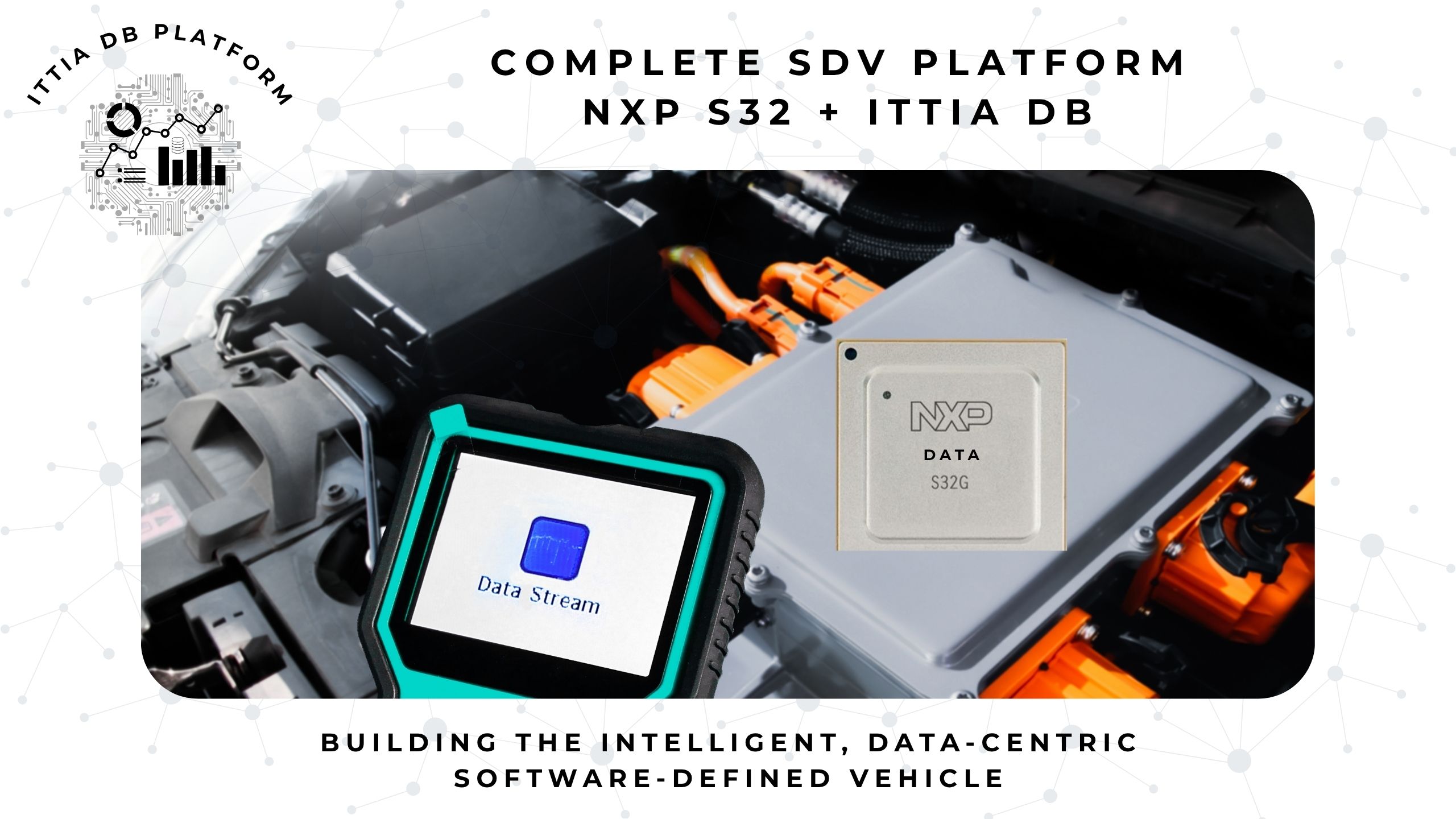
Building the Intelligent, Data-Centric Software-Defined Vehicle
Complete SDV Platform: NXP S32 + ITTIA DB
Software-defined vehicles increasingly depend on distributed computing environments in which different processors must work together continuously. High-performance Cortex-A processors may support vehicle-level applications, analytics, connectivity, visualization, and centralized services, while resource-constrained Cortex-M processors operate closer to sensors, actuators, battery cells, and real-time control systems.
The challenge is not simply connecting these processors. Automotive developers must create a dependable data architecture that allows Cortex-M, Cortex-R and Cortex-A environments to collect, manage, process, exchange, and analyze vehicle data as part of a coordinated system. This becomes especially important when the vehicle must support real-time data campaigns, artificial intelligence, predictive maintenance, diagnostics, and continuous software improvement.
The ITTIA DB Platform provides the data infrastructure needed to support this complex environment. It enables data to be captured and managed close to the source on Cortex-M processors while also supporting richer analysis, visualization, and vehicle-level processing on Cortex-A environments.
A Data Foundation for Cortex-M, Cortex-R and Cortex-A Collaboration
In an NXP S32-based software-defined vehicle architecture, Cortex-M and Cortex-R processors may be responsible for collecting time-sensitive information from CAN networks, sensors, and electronic control units. Cortex-A processors can then support more advanced workloads, including centralized analytics, service-oriented applications, AI orchestration, communication, and vehicle-level decision-making.
The ITTIA DB Platform creates a structured data layer across these processing environments.
ITTIA DB Lite can run close to the sensors and real-time applications on Cortex-M or Cortex-M processors. It provides embedded data ingestion, storage, querying, time-series processing, and preparation of data for AI inference. On the Cortex-A side, ITTIA DB can support larger datasets, more advanced queries, application services, and integration with higher-level vehicle software.
ITTIA Data Connect can support the selective movement of information between processors and systems, while ITTIA Analitica can provide visualization and observability for sensor measurements, calculated features, AI results, and system behavior.
Together, these technologies allow Cortex-M, Cortex-R and Cortex-A processors to participate in a common data architecture without forcing every processor to perform the same role.
Real-Time Data Ingestion Is the Starting Point
Every intelligent automotive application begins with data ingestion. The data may arrive from CAN, CAN FD, Ethernet, sensors, controllers, or vehicle subsystems. It may include measurements collected at different frequencies, from different sources, and under different timing requirements.
In a battery management system, for example, the embedded application may continuously collect:
- Individual cell voltage
- Pack voltage
- Current flow
- Cell temperature
- Temperature distribution
- Charge and discharge cycles
- State-of-charge estimates
- State-of-health indicators
- Fault and diagnostic events
This information must be captured reliably before it can be used for analysis or artificial intelligence. Missing records, inconsistent timestamps, duplicated measurements, or corrupted data can reduce the accuracy of battery models and create unreliable vehicle behavior.
ITTIA DB Lite provides a local data-management layer on the Cortex-M/ Cortex-R processor so that incoming measurements can be organized, timestamped, stored, queried, and prepared for downstream processing. Instead of treating sensor data as temporary values moving through application buffers, developers can create a managed historical record directly within the embedded system.
Setting Up ITTIA DB Lite on Cortex-M/Cortex-R
A practical software-defined vehicle lab can begin by setting up ITTIA DB Lite within the Cortex-M environment of the NXP S32G platform.
Using NXP S32 Design Studio as the development toolchain, developers can integrate ITTIA DB Lite into the embedded application and define the data structures required for vehicle measurements. Tables can be created for cell voltage, battery current, temperature, operating state, faults, and other relevant signals.
The application can then ingest CAN and sensor data directly into the embedded database. Each record can contain the measurement value together with timestamps, cell identifiers, operating modes, diagnostic information, or quality indicators.
This creates an architecture that combines: NXP S32G Cortex-M for real-time computing, NXP S32 Design Studio for software development, and ITTIA DB Lite as the embedded data layer.
The Cortex-M processor remains responsible for time-sensitive collection and local processing, while ITTIA DB Lite provides the structured foundation needed to make the data reliable, queryable, and reusable.
Cleaning and Analyzing Automotive Data with Queries
Raw automotive data is rarely ready for analysis or AI inference. Sensor values may contain noise, missing samples, invalid ranges, timing gaps, duplicate records, or abnormal measurements.
Database queries can help developers examine and clean the data before it is used by an AI model. For example, queries may be used to:
- Identify cell-voltage measurements outside an acceptable range
- Detect missing samples or irregular collection intervals
- Compare temperatures across battery cells
- Calculate minimum, maximum, average, or rate-of-change values
- Locate abnormal current spikes
- Analyze data during specific charging or driving conditions
- Correlate fault events with historical sensor behavior
This query-driven approach makes data preparation part of the embedded architecture rather than an external process that occurs only after data has been uploaded to a cloud system.
By managing historical information directly on the device, developers can investigate system behavior, validate algorithms, and prepare consistent data for AI inference close to the source.
Hands-On Battery State-of-Charge AI on NXP S32G
Battery State-of-Charge estimation provides a strong example of how the NXP S32G platform, NXP eIQ Auto, GoldVIP, and the ITTIA DB Platform can work together.
State of Charge represents the estimated amount of usable energy remaining in the battery. It cannot always be measured directly with sufficient accuracy. Instead, it may be estimated from combinations of voltage, current, temperature, historical usage, charging behavior, and battery characteristics.
Traditional methods may use fixed equations or lookup tables. AI-enabled approaches can analyze historical and real-time measurements to improve estimation under changing operating conditions.
A hands-on lab can establish the following architecture:
NXP S32G provides the compute platform. GoldVIP provides an integrated automotive software environment. NXP S32 Design Studio provides the development toolchain. ITTIA DB Platform provides the data-management layer. NXP eIQ Auto provides machine-learning inference.
Within this environment, ITTIA DB Lite can continuously ingest battery measurements from CAN and sensor sources. The data can then be queried, filtered, transformed, and prepared as features for the machine-learning model.
Building a Continuous AI Pipeline
AI inference should not be treated as an isolated function that receives one measurement and produces one answer. Production AI applications require a continuous pipeline that manages the complete flow of information.
A battery State-of-Charge pipeline may include:
- Collection of cell voltage, current, and temperature
- Timestamping and storage of incoming measurements
- Validation and cleaning of sensor data
- Construction of historical windows
- Calculation of features such as averages, rates of change, deltas, and temperature variation
- Delivery of prepared features to an NXP eIQ Auto model
- Storage of the inference result
- Comparison of the estimate with subsequent battery behavior
- Visualization and monitoring of model performance
ITTIA DB Platform helps connect these stages. ITTIA DB Lite manages real-time and historical information on the embedded processor. The database can provide the windows and features required by the AI model. NXP eIQ Auto can execute the trained model, and the resulting State-of-Charge estimate can be written back into the data-management environment.
This creates a traceable data path from the original sensor measurement to the AI-generated result.
Such traceability is important in automotive systems because engineers may need to determine why a model produced a particular estimate. They may need to examine the input measurements, calculated features, model version, operating conditions, and resulting decision.
Querying and Visualizing Results with ITTIA Analitica
Once battery data and AI results are managed in a structured form, developers can use ITTIA Analitica to query, analyze, and visualize system behavior.
A battery dashboard may display:
- Individual cell voltages
- Battery current
- Temperature distribution
- State-of-Charge estimates
- State-of-Health indicators
- Charging and discharging activity
- Prediction confidence
- Fault conditions
- Difference between predicted and observed behavior
- Trends across time or operating cycles
Visualization provides more than a presentation layer. It gives developers an observability environment for understanding the complete embedded AI pipeline.
Engineers can examine whether the data was collected correctly, whether features were calculated as expected, whether the AI model produced stable results, and whether the system responded appropriately.
This capability becomes especially valuable during prototype development, validation, fleet testing, and data campaigns.
Supporting Automotive Data Campaigns
Automotive data campaigns collect information from vehicles or development platforms to improve software, validate features, identify faults, and train or refine AI models.
A successful data campaign requires more than recording raw signals. Developers must decide:
- Which data should be collected
- How frequently it should be captured
- How long it should be retained
- Which events should trigger additional collection
- How data should be filtered
- Which information should remain local
- Which records should move to a higher-level processor or external system
- How the data should be associated with software versions, vehicle states, faults, and AI results
The ITTIA DB Platform provides a consistent data-management foundation for implementing these requirements across Cortex-M, Cortex-R and Cortex-A processors.
The Cortex-M environment can capture high-value information close to the physical system. Selected data can then be moved to the Cortex-A environment for larger-scale analysis, aggregation, visualization, or transmission outside the vehicle.
This reduces unnecessary data movement while preserving the information needed for engineering analysis and AI improvement.
Battery Management Is Only One Example
Although battery State-of-Charge is a valuable demonstration, the same architecture can support many other software-defined vehicle applications.
Examples include:
- Battery State-of-Health estimation
- Thermal-management optimization
- Traction-motor predictive maintenance
- Brake-system monitoring
- Tire and wheel-health analysis
- Power-electronics diagnostics
- Vehicle energy optimization
- Driver-behavior analysis
- Sensor-fusion applications
- Gateway and network-health monitoring
- Anomaly detection
- Remaining-useful-life estimation
- Predictive diagnostics
- Intelligent charging
- Vehicle cybersecurity monitoring
Each of these applications depends on the same fundamental capabilities: dependable ingestion, historical data management, real-time queries, feature engineering, AI inference, traceability, and visualization.
The measurements and models may change, but the need for a robust data layer remains.
From Raw Vehicle Signals to Intelligent Decisions
The complexity of software-defined vehicles makes data management a core architectural requirement. Cortex-M processors, Cortex-R processors, Cortex-A processors, vehicle networks, AI engines, and visualization tools must operate as parts of a coordinated system.
NXP S32G provides the heterogeneous compute environment required for modern automotive applications. GoldVIP helps integrate software-defined vehicle capabilities. NXP S32 Design Studio supports application development, and NXP eIQ Auto enables machine-learning inference.
The ITTIA DB Platform provides the data foundation that connects these technologies.
By deploying ITTIA DB Lite close to real-time CAN and sensor sources, developers can collect and manage data directly on Cortex-M/ Cortex-R processors. By combining that data with Cortex-A applications, ITTIA DB, ITTIA Data Connect, ITTIA Analitica, and NXP eIQ Auto, teams can build continuous, observable, and AI-enabled automotive pipelines.
The result is an architecture that transforms vehicle data into trusted information and trusted information into intelligent automotive decisions.
The blog can also be shortened into a technical workshop article or expanded with a detailed architecture diagram and lab workflow.
