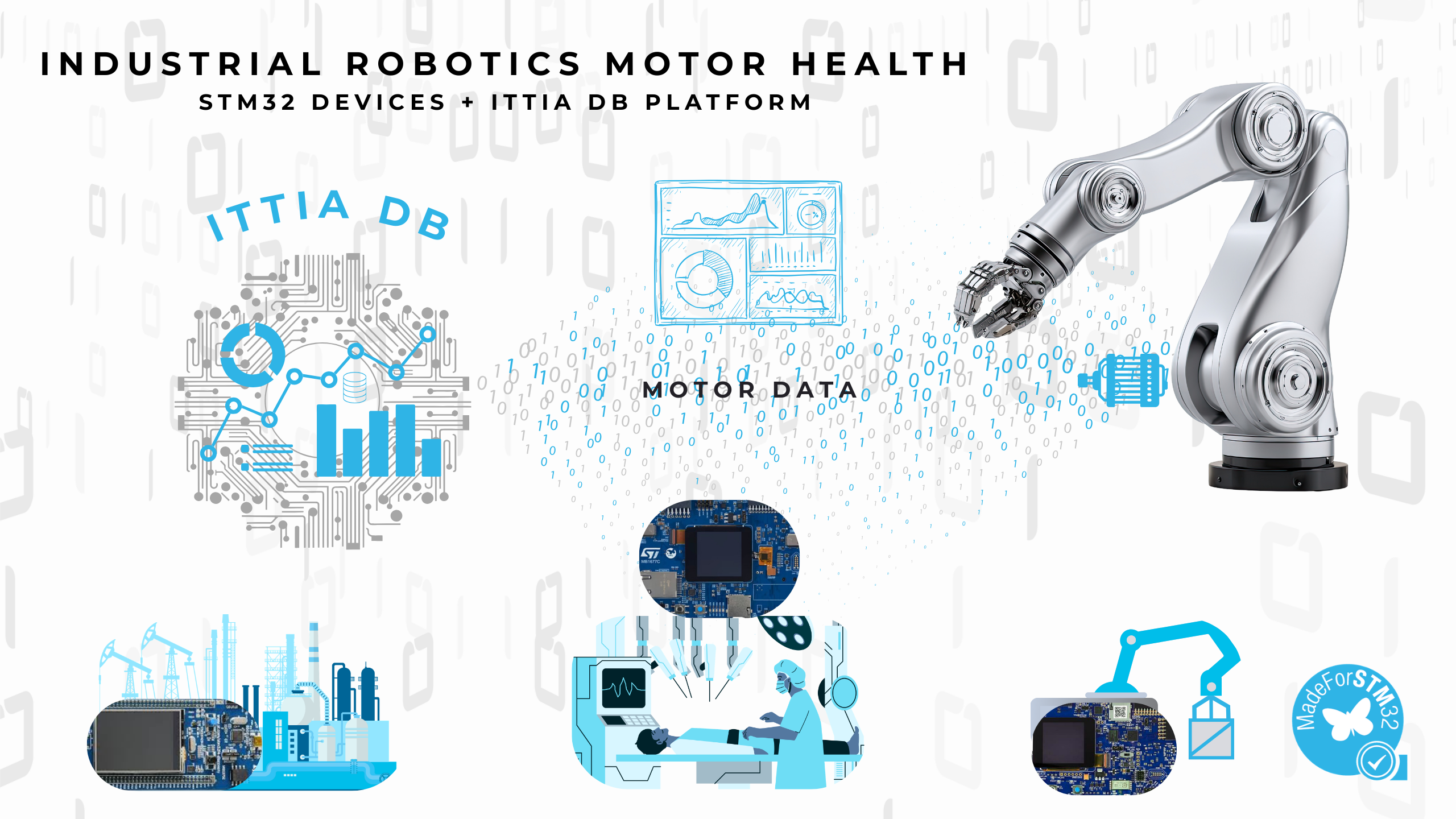
Industrial Robotics — Motor Health with STM32 and ITTIA DB Platform
Data-Centric Architecture for Monitoring Embedded Systems
Modern robotics built on STM32 microcontrollers require more than advanced control algorithms. Robots must also manage large volumes of operational data locally and deterministically. In real-time robotic systems, motor signals, vibration patterns, current signatures, and temperature data must be captured, stored, analyzed, and acted upon directly on the device.
For STM32-based robotics devices, this demands deterministic, structured, and power-fail-safe data management at the microcontroller level. From sensor acquisition and time-series logging to feature extraction and on-device AI inference, robotics systems must reliably process data locally while operating under strict real-time and memory constraints.
ITTIA DB Lite is a purpose-built data platform designed specifically for microcontrollers, making it an excellent fit for STM32 devices. Together, STM32 hardware and ITTIA DB Lite software provide a complete foundation for building data-centric Edge AI applications directly on the device.
This powerful combination enables developers to capture, manage, and analyze structured data reliably at the edge, supporting applications such as motor health monitoring and predictive maintenance in industrial automation, medical devices, robotics, and other motor-driven systems. By managing data deterministically and locally on STM32 microcontrollers, systems can transform raw sensor signals into actionable intelligence where it matters most, at the edge.
When data is managed intelligently on STM32 devices using the ITTIA DB Platform, robots gain the ability to become autonomous, explainable, and resilient, capable of detecting degradation, predicting failures, and acting immediately without relying on constant cloud connectivity.
Motors: The Mechanical Heart of Robotics
In robotics and industrial automation, motors are the fundamental drivers of motion and precision. Robotic arms depend on servo motors for precise positioning. Mobile robots rely on drive motors for navigation and torque control. Conveyor and automation systems use motors to sustain throughput. Spindle motors in robotic machining systems define production accuracy.
When these motors degrade or fail, the consequences are immediate:
- Robotic arm instability
- Production downtime
- Loss of precision
- Safety incidents
- Equipment damage
Motor failures are rarely sudden. Instead, they produce measurable signals long before failure occurs.
STM32 devices and ITTIA DB Lite are strong candidates for these applications. In robotics and industrial automation, motors are the fundamental drivers of motion and precision. Robotic arms depend on servo motors for accurate positioning, mobile robots rely on drive motors for navigation and torque control, conveyor and automation systems use motors to sustain throughput, and spindle motors in robotic machining systems directly influence production accuracy. With STM32 microcontrollers managing real-time control and ITTIA DB Lite providing deterministic, power-fail-safe data management, these systems can transform raw sensor signals into structured, AI-ready data, turning motor behavior into actionable intelligence at the edge.
This is where data-centric Edge AI on STM32 devices becomes essential, and where the ITTIA DB Platform provides the deterministic data infrastructure required for reliable motor health intelligence.
Why Motor Health Data Matters for STM32 Robotics
Motors continuously generate rich operational signals such as current, voltage, vibration, temperature, torque, and rotational speed. These signals provide a detailed view into the mechanical and electrical health of the motor and its surrounding system. When captured and managed properly on the device, this data can reveal early indicators of wear, imbalance, misalignment, overheating, or bearing degradation long before a failure occurs.
By deterministically ingesting and storing these time-series signals directly on the edge device, systems can transform raw motor telemetry into structured, high-value datasets that support feature extraction, anomaly detection, predictive maintenance, and real-time control decisions. This data-first approach enables machines to continuously observe their own behavior, improving reliability, safety, and operational efficiency across robotics, industrial automation, and other motor-driven environments.
As motors age, physical wear begins to appear in these signals:
- Bearings degrade
- Winding heats up
- Mechanical imbalance increases
- Shaft misalignment develops
Motor degradation is therefore a progressive data problem, not a binary failure event.
Detecting these subtle patterns requires deterministic data capture, long-term signal preservation, and structured time-series analysis directly on STM32 devices.
Safety and Traceability Requirements in Robotics
In robotics systems built on STM32 microcontrollers, effective data management is essential to meet safety and traceability requirements. Robots operating in industrial, medical, or collaborative environments must be able to record, preserve, and explain critical operational data such as sensor signals, control decisions, fault events, and AI inference results.
Deterministic on-device data management enables STM32-based systems to capture time-series motor data, control loop states, and system telemetry in a structured and power-fail-safe manner. This ensures that every decision, whether it is a motion command, anomaly detection, or safety shutdown, can be traced back to the original sensor signals and feature transformations that produced it. By maintaining this end-to-end data lineage directly on the device, robotics developers can support functional safety validation, post-incident analysis, regulatory compliance, and explainable AI behavior, even in environments where connectivity to cloud infrastructure is unavailable or unreliable.
In robotic systems, failures are not just operational issues, they can become safety hazards.
Examples include:
- A servo motor fault causing uncontrolled robotic arm motion
- Conveyor motor failure stopping production lines
- Spindle instability affecting manufacturing tolerances
- Pump or actuator failure creating environmental or operational risk
Modern industrial systems increasingly require traceability and explainability, including the ability to answer:
- What signal changed?
- When did the anomaly begin?
- Which feature crossed a threshold?
- What inference triggered shutdown?
Without deterministic on-device data captured and structured logging, answering these questions becomes impossible.
Deterministic Data Capture on STM32
On STM32 microcontrollers, deterministic data capture is critical for systems that rely on precise timing and predictable behavior, such as robotics, industrial automation, and motor control applications. Sensors connected to STM32 devices continuously produce high-frequency streams of data, current, vibration, temperature, speed, and control signals, that must be captured and stored without introducing latency or disrupting real-time control loops.
Deterministic data management ensures that each data sample is ingested, timestamped, and persisted in a predictable and bounded time, even under constrained CPU, memory, and flash resources. By managing data deterministically on the device, STM32 systems can reliably transform raw sensor signals into structured time-series records that support real-time monitoring, feature extraction, anomaly detection, and Edge AI inference, while maintaining the strict timing guarantees required for safety-critical embedded systems.
Edge AI models for motor health are only as reliable as the data pipeline beneath them. If signal capture is inconsistent or corrupted, AI models become unreliable. STM32 devices operating in real-time robotics environments face several challenges:
- Flash latency spikes
- Missed sensor samples
- Power interruptions
- Non-deterministic storage behavior
The ITTIA DB Platform solves these challenges on STM32 devices. Using ITTIA DB Lite, STM32 microcontrollers gain:
- Deterministic sensor data ingestion
- Transactional time-series storage
- Power-fail-safe persistence
- Flash-aware storage optimized for NOR, NAND, and SD media
- Structured storage for feature windows and AI telemetry
This ensures that signals are captured exactly when they occur, preserving the integrity required for reliable AI inference.
Why Cloud-Only Robotics Monitoring Is Insufficient
Cloud-only robotics monitoring is insufficient because modern robotic systems operate in environments where latency, reliability, and safety cannot depend on continuous connectivity. Robots generate large volumes of operational data, from motors, sensors, and control loops, that must be captured, processed, and acted upon immediately to maintain precision and safe operation. Sending all raw data to the cloud introduces network delays, bandwidth limitations, and potential connectivity interruptions, which can prevent timely detection of anomalies or system failures. In many industrial and mobile robotics deployments, robots must continue operating even when network access is limited or unavailable.
For this reason, critical data management, monitoring, and AI inference must occur directly on the device, enabling robots to analyze their own signals, make real-time decisions, and maintain operational safety while selectively exporting summarized insights to the cloud for fleet-wide analytics and model improvement.
Cloud analytics plays an important role in robotics systems, but it cannot replace real-time on-device intelligence. In robotics environments:
- Network connectivity may be intermittent
- Latency may exceed control-loop requirements
- Streaming raw sensor data may be impractical
- Safety decisions must occur immediately
Most critically, robotic control systems cannot wait hundreds of milliseconds for a cloud decision. A robotic arm detecting motor instability must react immediately. This requires on-device intelligence running directly on STM32 hardware.
On-Device AI for Motor Health on STM32
STMicroelectronics provides a comprehensive Edge AI software ecosystem for STM32 devices, including STM32Cube.AI, NanoEdge AI Studio, the STM32 Edge AI Developer Cloud, and the STM32 AI Model Zoo, which together enable developers to train, optimize, and deploy machine learning models directly on STM32 microcontrollers.
These tools convert trained models into optimized embedded code, automate model generation for sensor data, and provide benchmarking and reference applications for real-world AI workloads such as predictive maintenance, audio recognition, and computer vision.
ITTIA DB Lite integrates seamlessly into this ecosystem by providing deterministic, structured, and power-fail-safe data management on STM32 devices, enabling reliable capture, storage, and querying of sensor signals and time-series data that feed AI pipelines. By managing data ingestion, feature windows, and AI telemetry locally on the microcontroller, ITTIA DB Lite ensures that Edge AI models running with STM32Cube.AI or NanoEdge AI operate on consistent, traceable, and production-grade data directly at the edge
By combining deterministic time-series data management with embedded AI frameworks such as STM32Cube.AI, STM32 devices can run advanced motor health analytics locally.
With ITTIA DB Platform, STM32 systems can support:
- Real-time anomaly detection
- Remaining Useful Life (RUL) estimation
- Confidence scoring
- Model drift monitoring
- Inference logging and explainability
This enables robotics systems to:
- Detect bearing degradation early
- Identify mechanical imbalance trends
- Predict motor wear progression
- Schedule maintenance proactively
- Reduce unexpected downtime
Motor monitoring moves from reactive repair to predictive control.
The Data Journey on STM32 with ITTIA DB Platform
- Deterministic Ingestion
Sensor signals from motors are captured and timestamped with deterministic precision. - Structured Persistence
ITTIA DB Lite stores time-series signals and extracted features reliably on STM32 storage. - On-Device AI Inference
Edge AI models compute anomaly scores and RUL metrics locally. - Local Robotic Control
Controllers adjust torque, trigger alerts, or safely halt motion. - Fleet Intelligence
Using ITTIA Data Connect, summarized data can be exported securely for fleet-level analysis and model retraining. - Visualization and Insight
Data visualization plays a critical role in understanding and validating Edge AI systems running on STM32 devices, especially when monitoring complex behaviors such as motor health, sensor performance, and real-time system telemetry.
ITTIA Analitica provides developers and engineers with powerful tools to query, analyze, and visualize data captured on STM32 devices through ITTIA DB Lite, transforming raw sensor signals into meaningful insights.
By visualizing time-series data, feature windows, anomaly scores, and operational metrics, teams can quickly identify patterns, diagnose issues, and verify AI model behavior. This capability improves system transparency, debugging, and explainability, allowing engineers to trace outcomes back to the underlying data. With ITTIA Analitica, data collected on STM32 microcontrollers becomes observable and actionable, enabling faster development cycles, better predictive maintenance strategies, and more reliable Edge AI deployments
With ITTIA Analitica, developers can visualize:
- Motor feature windows
- Anomaly trends
- Model accuracy curves
- Drift behavior
- Motor health trajectories
Where This Matters Most in Robotics
STM32-based robotics platforms benefit significantly from deterministic motor data management in areas such as:
- Robotic arms and servo systems
- Autonomous mobile robots (AMR/AGV)
- Industrial conveyors
- Robotic machining systems
- Industrial pumps and compressors
In all of these environments, precision, uptime, and safety depend on reliable motor intelligence.
From Raw Signals to Explainable Robotics Intelligence
Use Case: Motor Health Monitoring on STM32
Motor health monitoring starts with reliable data management before AI can deliver value. Without deterministic data capture, structured time-series storage, persistent feature windows, and traceable inference logs, AI models become opaque and unreliable. By running the ITTIA DB Platform on STM32 devices, robotics and industrial systems gain deterministic data handling, on-device intelligence, explainable AI decisions, and production-grade reliability, enabling accurate and autonomous motor health monitoring directly at the edge.
Conclusion
Industrial motors continuously produce signals that reveal their health and degradation over time. When captured and managed correctly on STM32 devices, these signals become the foundation for predictive intelligence. Cloud-only analytics cannot meet the real-time requirements of robotics. Deterministic, on-device data management is essential.
By combining STM32 microcontrollers with the ITTIA DB Platform, robotics systems can transform raw motor signals into structured, explainable intelligence directly at the edge. This enables safer robots, more reliable automation, and predictive maintenance where it matters most, on the device itself. Building Data-Centric Edge AI Solutions for Robotics Motor Health with STM32 and ITTIA DB Platform.
