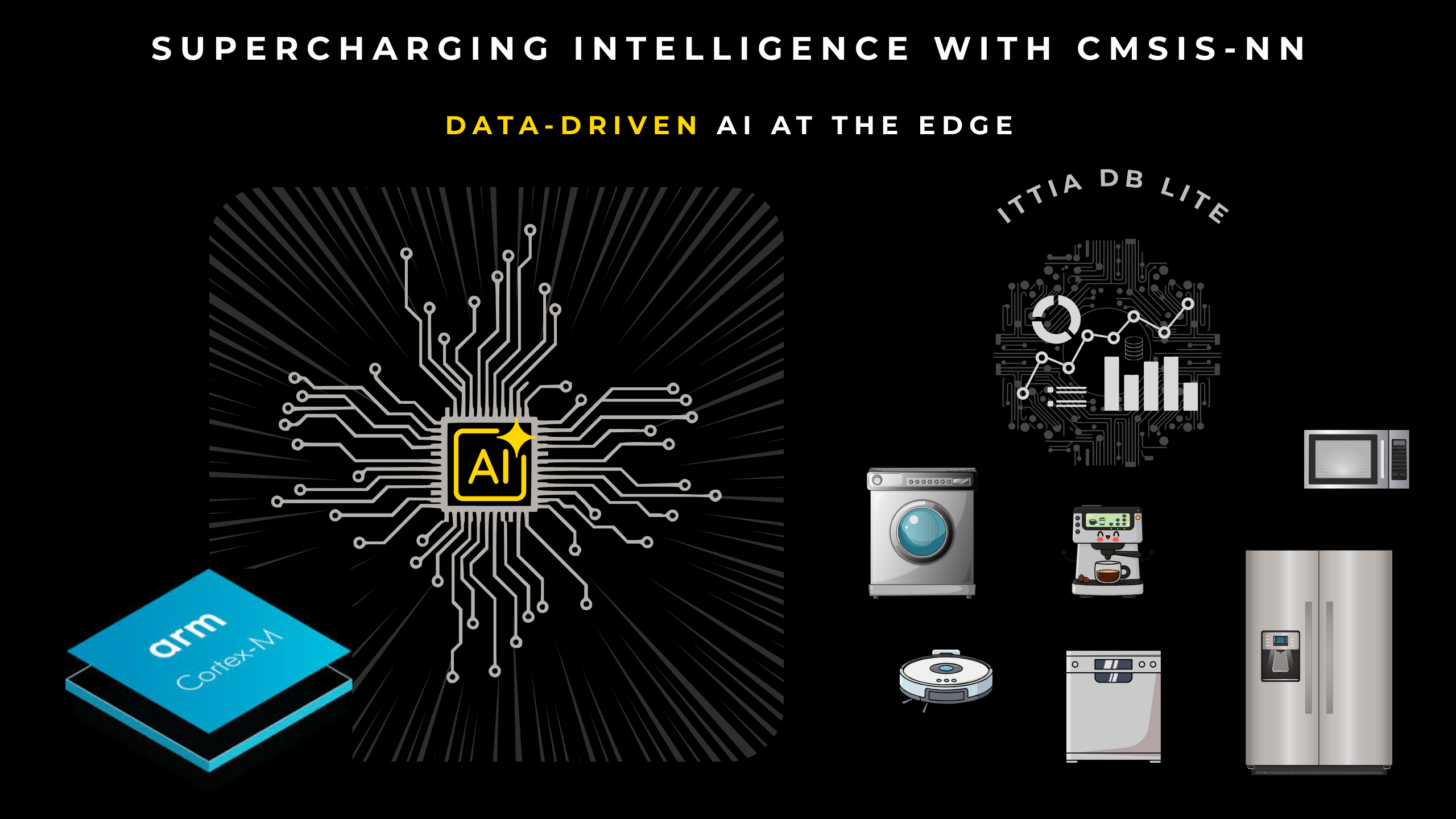
Supercharging Intelligence with CMSIS-NN
Data-Driven AI at the Edge
Edge AI is rapidly transforming embedded systems, from industrial automation and robotics to automotive ECUs and smart appliances. But deploying intelligence on microcontrollers is not just about running models. It’s about building a complete, deterministic pipeline where data, features, and inference work together reliably in real time.
TinyML (Tiny Machine Learning) is a field of embedded AI that focuses on running machine learning models directly on ultra-low-power, resource-constrained devices such as microcontrollers. Instead of fully relying on cloud computing, TinyML enables real-time inference at the edge, allowing devices to process sensor data locally with minimal latency, power consumption, and connectivity requirements. By using highly optimized, quantized models and efficient runtimes, TinyML makes it possible to bring intelligence to everyday devices, such as industrial sensors, wearables, automotive systems, and smart appliances, while ensuring fast response times, privacy, and reliable operation even in disconnected environments.
CMSIS is a standardized software framework from Arm that provides a common interface for developing applications on Cortex-M microcontrollers. It simplifies embedded development by offering consistent APIs, device support, and optimized libraries for core functions, RTOS, and DSP, enabling portable, efficient, and scalable software across different MCU platforms.
CMSIS-NN is a highly optimized library also developed by Arm that enables efficient neural network execution on Cortex-M microcontrollers by providing low-level, performance-tuned building blocks for core AI operations such as convolution, fully connected layers, activation functions, pooling, and softmax. Designed specifically for resource-constrained environments, it leverages fixed-point (quantized) arithmetic and optimized use of DSP and SIMD instructions to significantly reduce memory usage, power consumption, and latency while ensuring deterministic real-time performance.
Rather than implementing neural network math from scratch, developers can rely on CMSIS-NN to accelerate inference, making it practical to run TinyML models directly on embedded devices. As part of a typical Edge AI pipeline, where sensor data is collected, processed into features, and fed into models, CMSIS-NN works seamlessly with frameworks like TensorFlow Lite Micro and integrates with CMSIS, ultimately transforming complex AI computations into fast, efficient, and production-ready intelligence at the edge.
ITTIA DB Lite is a lightweight, deterministic edge data infostructure designed for microcontrollers, enabling real-time, power-fail-safe data management directly on constrained devices. It provides efficient time-series storage, structured data organization, and on-device feature generation, such as sliding windows, aggregation, and data cleaning, so sensor data can be reliably prepared for Edge AI workloads. With predictable latency, no background compaction or garbage collection pauses, and minimal memory footprint, ITTIA DB Lite ensures consistent performance even under stress. By preserving full data lineage from sensor to inference, it transforms microcontrollers into data-aware, self-observing systems capable of supporting explainable, production-grade Edge AI.
By combining ITTIA DB Lite, TinyML, and CMSIS-NN, developers can move beyond demos and build scalable, explainable, and production-ready Edge AI systems on Cortex-M devices.
Why Edge AI Starts with Data, not Models
TinyML has made it possible to run machine learning models on microcontrollers. However, real intelligence depends on how data is handled before and after inference.
An effective Edge AI system must:
- Continuously ingest high-frequency sensor data
- Organize it into structured time-series
- Generate features using sliding windows and transformations
- Feed clean, deterministic inputs into models
- Persist results for traceability and improvement
Without this pipeline, even the best model becomes unreliable. AI models alone don’t create intelligent systems, data does. For AI models to work reliably at the edge, data must be carefully managed throughout its lifecycle on the device. This includes deterministic ingestion of raw sensor signals, accurate timestamping, and efficient time-series storage to preserve context. The data then needs to be cleaned, normalized, and transformed into meaningful features, such as sliding windows, aggregates, and derived metrics, so models receive consistent, high-quality inputs. After inference, results must also be stored alongside the original data to maintain traceability and support explainability. Finally, selective data should be filtered and transmitted upstream for continuous learning, ensuring that edge systems not only make real-time decisions but also contribute to ongoing model improvement.
ITTIA DB Lite: The Foundation for Deterministic Edge Data
ITTIA DB Lite is designed specifically for microcontrollers, enabling real-time, power-fail-safe data management directly on the device.
Core Capabilities
- Deterministic Data Ingestion
- Predictable write latency
- No garbage collection or background compaction pauses
- Time-Series Optimization
- Efficient storage for sensor streams
- Append-optimized design for consistent performance
- Feature Engineering on Device
- Sliding windows, lag features, aggregation
- Data cleaning and normalization
- Power-Fail Safety
- Atomic commits and crash recovery
- Reliable persistence for safety-critical systems
- Explainability & Traceability
- Full lineage: sensor → signal → feature → inference → action
ITTIA DB Lite transforms microcontrollers from simple processors into data-aware, self-observing systems.
TinyML: Intelligence at the Microcontroller Level
TinyML enables machine learning models to run within the tight constraints of embedded systems:
- Kilobytes to megabytes of memory
- Low power consumption
- Real-time execution requirements
Typical TinyML use cases include:
- Predictive maintenance (motor health, vibration analysis)
- Anomaly detection
- Keyword spotting and audio classification
- Sensor fusion applications
However, TinyML depends heavily on consistent, high-quality input data—which is exactly what ITTIA DB Lite ensures.
CMSIS: The Software Foundation for Cortex-M
CMSIS provides a standardized interface and software framework for Cortex-M devices.
Why CMSIS Matters
- Hardware abstraction for portability across MCU vendors
- Standardized APIs for RTOS, DSP, and peripherals
- Integration with development tools like Keil and STM32Cube
CMSIS ensures that developers can build portable, optimized embedded applications without being locked into a single hardware ecosystem.
CMSIS-NN: Optimized Neural Networks for Cortex-M
CMSIS-NN delivers highly optimized neural network kernels tailored for Cortex-M processors.
Key Benefits
- Efficient implementations of convolution, fully connected, and activation layers
- Significant performance and energy efficiency improvements
- Reduced memory footprint for embedded AI models
CMSIS-NN enables TinyML models to run faster, smaller, and more efficiently, making real-time inference feasible on resource-constrained devices.
Bringing It All Together: The Edge AI Pipeline
When combined, these technologies create a complete and production-ready Edge AI architecture that spans the full data-to-decision pipeline. Sensor data is first ingested and stored deterministically as time-series, ensuring consistency and reliability at the source.
This data is then transformed locally through feature engineering, using sliding windows, aggregation, and cleaning, to produce high-quality inputs for AI models. TinyML models execute on-device using optimized kernels, enabling real-time inference with minimal latency and power consumption.
All signals, features, and inference results are persistently stored to maintain full traceability, supporting debugging, validation, and regulatory compliance. Finally, the system takes immediate local action while selectively sharing valuable data upstream for continuous learning. Together, this pipeline ensures that Edge AI systems are not just intelligent, but also deterministic, reliable, and explainable in real-world deployments.
By integrating ITTIA DB Lite, TinyML, CMSIS, and CMSIS-NN, developers can deliver real-world Edge AI systems that operate reliably under strict constraints. These solutions enable industrial equipment to predict failures before downtime occurs, automotive ECUs to monitor system health in real time, smart appliances to adapt intelligently to user behavior, and medical devices to produce traceable and dependable AI-driven decisions. Far from experimental prototypes, these are production-grade systems engineered for performance, determinism, and long-term reliability in real deployment environments.
Conclusion: Intelligence Requires a Complete Pipeline
Edge AI success is not defined by models alone, it is defined by the quality, structure, and reliability of the data pipelines that support them. At the edge, intelligence depends on how well systems capture raw signals, preserve context through time-series storage, and transform that data into meaningful features that models can trust. Deterministic behavior, consistent latency, and power-fail-safe persistence are critical to ensure that data remains accurate and usable under real-world conditions. Without this foundation, even the most advanced models become unreliable, producing inconsistent or non-explainable results.
By combining ITTIA DB Lite for a deterministic data foundation, TinyML for efficient on-device intelligence, CMSIS for a standardized and portable embedded framework, and CMSIS-NN for highly optimized AI execution, developers can build complete Edge AI pipelines directly on microcontrollers. These systems are capable of ingesting high-frequency sensor data, generating features in real time, executing inference with minimal latency, and persistently storing results for traceability, validation, and continuous improvement.
In this architecture, data is not just an input, it is the backbone of intelligence. It enables explainability through full lineage from sensor to action, supports regulatory compliance, and allows systems to evolve over time through feedback and retraining. Ultimately, the future of Edge AI belongs to systems that don’t just run models, but manage data intelligently, deterministically, and continuously at the source, transforming embedded devices into adaptive, self-improving, and production-ready intelligent systems.
