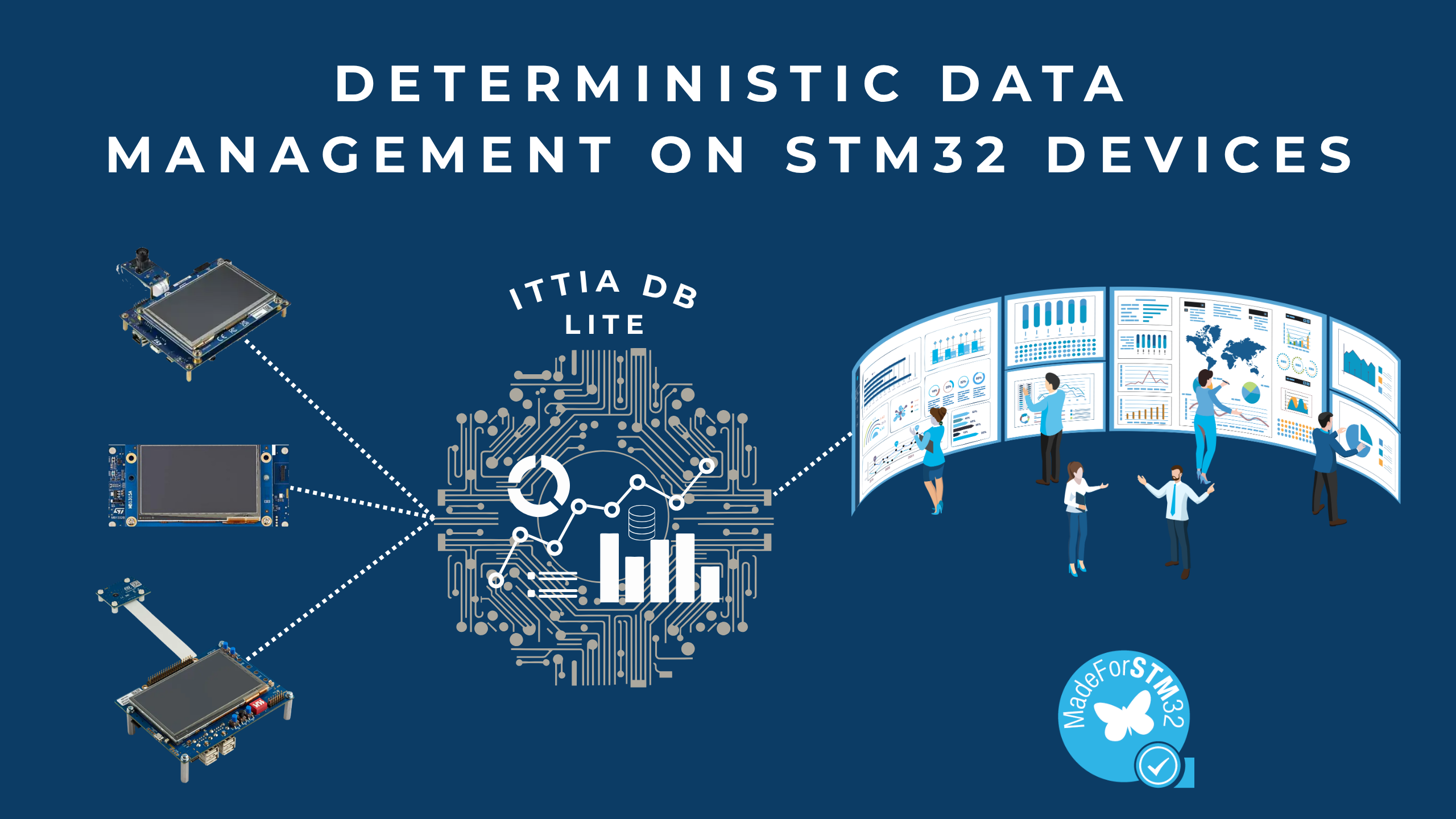
Deterministic Data Management on STM32 Devices
Define Real Edge AI Performance
STM32 microcontrollers, from low-power Cortex-M0+ to high-performance Cortex-M7 and AI-enabled STM32N6, are at the heart of modern embedded systems. But as these devices evolve from simple control units into data-driven Edge AI platforms, one requirement becomes critical: Deterministic data management.
Deterministic data management refers to the ability of a system to capture, process, store, and retrieve data with predictable and bounded timing, regardless of workload or system conditions. Instead of relying on average performance, deterministic systems guarantee worst-case execution time (WCET) for every operation, ensuring that inserts, reads, updates, and commits occur within known limits. This eliminates latency spikes caused by behaviors like garbage collection, background compaction, or deferred writes, which can disrupt real-time systems.
In embedded and Edge AI environments, deterministic data management is essential because it preserves timing integrity, data consistency, and system reliability, allowing control loops, feature extraction, and AI inference to operate with confidence. Ultimately, it transforms data from a best-effort resource into a trusted, time-bound foundation for intelligent decision-making at the edge.
With the ITTIA DB Platform (ITTIA DB Lite for STM32 MCUs), developers can build systems where data operations are predictable, bounded, and safe, even under worst-case conditions.
ITTIA DB Lite was built with determinism as its first foundation to meet the strict timing and reliability demands of Edge AI systems. From the ground up, it is designed to ensure that every data operation, insert, read, update, and commit, executes within predictable, bounded time, regardless of system load, storage conditions, or power events. By eliminating sources of unpredictability such as garbage collection pauses, background compaction, and unbounded memory usage, ITTIA DB Lite provides a stable and repeatable data pipeline for microcontrollers.
This deterministic approach is critical for Edge AI, where consistent data ingestion, feature generation, and inference timing directly impact accuracy and system behavior. As a result, ITTIA DB Lite enables developers to build reliable, real-time, and production-grade intelligent systems, where data is not just stored, but managed with precise control over time and execution.
The Problem: STM32 Systems Cannot Rely on Averages
In STM32-based applications such as motor control and predictive maintenance, industrial automation, medical monitoring, and smart energy systems, system behavior depends on precise timing and consistent execution. A single latency spike can break a control loop, cause missed sensor samples, or violate critical safety constraints leading to unreliable or even unsafe operation. In these environments, average latency is meaningless because it hides the rare but impactful delays that define real system performance. What truly matters is deterministic behavior and guaranteed worst-case execution, ensuring that every operation completes within known, bounded time limits.
What matters:
- Worst-Case Execution Time (WCET)
- Latency distribution (especially tail latency like P99.999)
WCET on STM32: The Foundation of Real-Time Reliability
Key Data Operation Metrics
On STM32 devices, critical database operations form the backbone of real-time data pipelines that support Edge AI and control systems. These include inserts for continuous sensor ingestion, updates for tracking system state changes, reads for feature extraction and inference input, commits to ensure transaction persistence, and checkpoint or log-structured storage (LLS) cleaning to maintain storage integrity. Each of these operations must execute with predictable timing and reliability, as they directly impact data freshness, system responsiveness, and the ability to make accurate, real-time decisions at the edge.
Requirements for STM32 Systems
- Statically bounded execution time
- Repeatable behavior across runs
- No dependency on runtime conditions (flash state, fragmentation, etc.)
How ITTIA DB Lite Delivers WCET on STM32
Designed for Cortex-M Constraints
ITTIA DB Lite is specifically optimized for the constrained environments of microcontrollers, making efficient use of limited RAM and flash while maintaining predictable performance. It is designed to operate seamlessly within tight ISR and RTOS scheduling constraints, including environments such as FreeRTOS, ThreadX, and even Zephyr. This ensures that data operations do not interfere with time-critical tasks, allowing developers to maintain real-time responsiveness while still enabling robust, on-device data management for Edge AI and embedded applications.
A Real-Time Operating System (RTOS) is essential for microcontrollers because it enables predictable, time-critical execution of multiple tasks within constrained resources. By providing scheduling, task prioritization, and precise timing control, an RTOS ensures that high-priority operations, such as sensor sampling, control loops, and communication, are executed reliably without interference. This is especially important in embedded and Edge AI systems, where consistent timing and responsiveness directly impact system stability, accuracy, and safety.
ITTIA DB Lite for STM32 devices delivers strong value across RTOS environments such as FreeRTOS, ThreadX, and Zephyr by providing a deterministic, low-overhead data management layer that integrates cleanly with real-time scheduling. It operates with bounded execution time and predictable resource usage, ensuring that database operations do not disrupt high-priority tasks or time-critical control loops. By aligning with RTOS concepts like task prioritization, ISR safety, and minimal blocking, ITTIA DB Lite enables reliable sensor ingestion, data processing, and persistence within multitasking systems, allowing developers to build robust, real-time Edge AI applications without compromising system stability or performance. General value-added include:
Bounded Execution Paths
- Fixed execution paths for all core operations
- No unbounded loops or unpredictable behaviors
Preallocated Memory Model
- No dynamic heap growth
- Fixed buffers → predictable timing and footprint
Flash-Aware Deterministic I/O
STM32 flash characteristics:
- Erase-before-write
- Page/block erase latency (can be milliseconds)
ITTIA DB Lite solves this by:
- Using append-optimized storage patterns
- Performing background erase safely (e.g., async erase ~0.25s without blocking foreground writes)
- Ensuring bounded foreground operation latency
Power-Fail Safe Transactions
- Atomic commits using copy-on-write and journaling
- Fast, deterministic recovery after reset
Evidence: WCET Proven Under Real STM32 Conditions
ITTIA DB Lite validates execution guarantees under:
- Full flash utilization
- Fragmented storage conditions
- Continuous data ingestion (ADC, IMU, CAN, etc.)
- Power cycling and brown-out scenarios
Result: Consistent WCET across all operations, even under stress
Latency Distribution: The Hidden Risk in STM32 Systems
The Real Metric is maximum latency (P99.999), not average latency.
Common Anti-Patterns on Embedded Systems
- Garbage collection pauses
- Background compaction
- Deferred writes
- Flash blocking during erase
These create:
- Timing jitter
- Control loop instability
- Missed deadlines
ITTIA DB Lite: Flat Latency on STM32
ITTIA DB Lite is designed to eliminate sources of unpredictability that commonly disrupt real-time systems. By removing garbage collection from the critical path, it avoids unexpected pauses that can break timing guarantees. It also eliminates background compaction overhead, ensuring that all operations remain controlled and predictable. With immediate write execution, there are no deferred write surprises that introduce latency spikes. Additionally, its append-optimized storage model reduces the impact of fragmentation while maintaining consistent and reliable write performance over time, even under sustained workloads.
Result: Predictable Timing Across STM32 Workloads
With ITTIA DB Lite:
- Tight latency distribution
- No long-tail spikes at P99.999
- Stable real-time behavior across workloads
Why This Matters for Edge AI on STM32
STM32 Edge AI pipelines depend on:
- Deterministic sensor ingestion (ADC, DMA, interrupts)
- Time-aligned feature generation (sliding windows, lag features)
- Consistent inference timing (STM32Cube.AI, CMSIS-NN)
If data timing is inconsistent:
- Feature windows become unreliable
- AI model accuracy drops
- System behavior becomes non-deterministic
ITTIA DB Platform + STM32: Enabling Deterministic Intelligence
By combining STM32 hardware, built on efficient Cortex-M architectures and supported by the STM32Cube ecosystem, with ITTIA DB Lite as a deterministic data layer, developers gain a complete foundation for building intelligent edge systems. STM32 provides the compute, peripherals, and AI enablement (such as STM32Cube.AI and CMSIS-based optimization), while ITTIA DB Lite ensures that all data operations, ingestion, storage, feature generation, and persistence, are executed with predictable, bounded timing. Together, they enable real-time, explainable, and production-grade Edge AI systems that can reliably capture high-frequency sensor data, structure it into meaningful time-series, generate consistent feature windows, and feed AI models with trustworthy inputs. This tight integration ensures that control loops remain stable, inference results are repeatable, and systems can operate safely under real-world conditions such as heavy workloads, fragmentation, or power interruptions, transforming STM32 devices into deterministic, data-driven intelligence platforms at the edge.
Summary
On STM32, determinism is not optional, it is the foundation upon which the entire system operates. Worst-Case Execution Time (WCET) defines reliability by ensuring every operation completes within known bounds, while latency distribution defines stability by eliminating unpredictable spikes that can disrupt real-time behavior. Ultimately, data management defines intelligence, because the quality, structure, and timing of data directly determine how effectively an Edge AI system can observe, learn, and act.
AI models alone do not create intelligent systems, data does. And on STM32 devices, that data must be captured, processed, and persisted with absolute timing guarantees to maintain control-loop integrity, ensure accurate feature generation, and deliver consistent inference results. Without deterministic data handling, even the most advanced models become unreliable in production.
With ITTIA DB Lite, STM32 evolves from a traditional microcontroller into a deterministic data engine for Edge AI. It provides the predictable, power-fail-safe, and real-time data foundation required to transform raw sensor signals into structured, explainable intelligence, enabling developers to build robust, scalable, and production-grade systems that operate with confidence at the edge.
