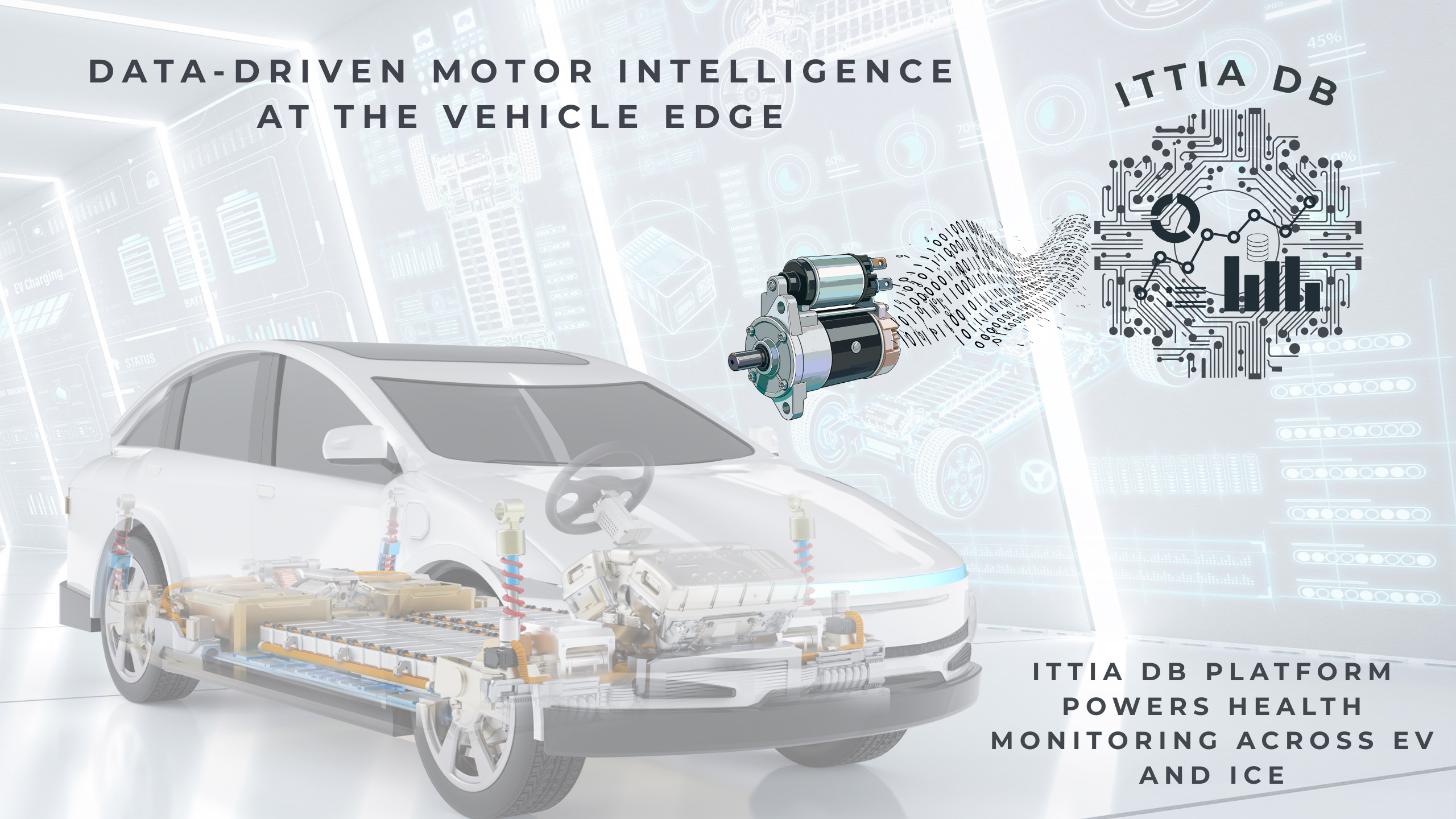
Data-Driven Motor Intelligence at the Vehicle Edge
ITTIA DB Platform Powers Health Monitoring Across EV and ICE
Modern vehicles, both electric and combustion, are no longer defined by a single engine or motor. They are complex, software-defined systems containing dozens of electric motors, many of them safety-critical, continuously operating under variable load, temperature, and duty cycles. As electrification and autonomy accelerate, the ability to observe, understand, and predict motor behavior directly on the vehicle has become essential.
This is where Edge AI and deterministic data management converge, and where the ITTIA DB Platform plays a foundational role.
The Most Important Motors in Electric Vehicles (EVs)
Across both electrified and combustion vehicles, motors are becoming data-rich, software-defined assets, not simple actuators, and that shift is driving entirely new requirements for on-device data management and Edge AI.
Auxiliary electric motors and battery cooling & thermal management motors in EVs must operate continuously under variable loads and thermal conditions, demanding high-frequency monitoring of current, vibration, temperature, and speed to ensure efficiency, safety, and long service life.
At the same time, critical motors in ICE vehicles, such as the starter motor, alternator, electric power steering (EPS), fuel pump, and cooling fans and pumps, are increasingly expected to deliver higher reliability, quieter operation, and predictive fault detection. Meeting these expectations requires deterministic ingestion, persistent time-series storage, and traceable analytics directly at the ECU, enabling Edge AI to detect anomalies, predict degradation, and explain behavior without relying on the cloud.
In both EV and ICE platforms, production-grade motor intelligence now depends on a data-centric foundation that can transform raw signals into AI-ready insights in real time, safely, and over the full vehicle lifecycle.
Let’s look at a few examples and their data dependencies.
Traction Motor (Drive Motor)
The traction motor is the heart of an EV, converting electrical energy into mechanical torque that propels the vehicle. Its efficiency, thermal behavior, and long-term health directly impact driving range, performance, and safety. Continuous telemetry, current, voltage, torque, speed, vibration, and temperature, data must be captured and retained to detect early degradation, thermal stress, or inverter-related anomalies.
Auxiliary Electric Motors
Modern EVs rely heavily on electric subsystems that were once mechanical, including electric power steering (EPS), electric brake boosters, electric coolant pumps for the battery, inverter, and motor, as well as the HVAC compressor. Failures in these motor-driven systems impact far more than comfort, they directly affect vehicle control, braking confidence, and thermal stability.
As a result, each subsystem continuously generates high-value operational data that must be captured, stored, and managed directly on the device in a deterministic and power-fail-safe manner. Robust on-device data management ensures this data remains trustworthy and available for real-time diagnostics, post-incident analysis, and predictive maintenance, even when connectivity is limited or unavailable.
Battery Cooling & Thermal Management Motors
Battery and power electronics health depend on cooling fans and pumps operating reliably across extreme conditions. Poor thermal control shortens battery life, limits fast charging, and triggers derating or shutdown. To ensure long-term intelligence and reliability, effective device data management is crucial.
Persistent on-device data management provides continuous visibility into thermal trends, duty cycles, and efficiency changes, directly on the vehicle. By capturing and managing this data locally in a deterministic and power-fail-safe way, you enable accurate diagnostics, predictive maintenance, and informed decision-making, ensuring stable performance even as conditions evolve over the vehicle’s lifespan.
The Most Important Motors in Combustion (ICE) Vehicles
Starter Motor
The starter motor represents a single point of failure, if it degrades, the vehicle simply will not start. Capturing cranking current, duration, and temperature trends enables early detection of mechanical wear or electrical issues. To make this insight reliable over the vehicle’s lifetime, this data must be managed directly on the device in a deterministic and power-fail-safe manner, ensuring trends are preserved across starts, shutdowns, and long periods of inactivity.
Robust on-device data management turns brief cranking events into durable intelligence that supports accurate diagnostics and predictive maintenance.
Alternator (Generator)
The alternator powers the vehicle’s electrical systems and charges the battery, making it foundational to overall vehicle operation. Degradation in alternator performance impacts every electronic subsystem, which makes continuous health monitoring critical to vehicle reliability. To achieve this, operational data such as output current, voltage stability, load behavior, and temperature must be captured and managed directly on the device in a deterministic and power-fail-safe manner.
On-device data management preserves long-term trends and correlations, enabling accurate diagnostics, early fault detection, and predictive maintenance across the vehicle’s lifetime.
Electric Power Steering (EPS) Motor
Now standard in ICE vehicles, electric power steering (EPS) motors are safety-critical and increasingly software-controlled. Monitoring load, torque demand, and thermal behavior is essential for safe and predictable operation. To ensure this monitoring is reliable over time, EPS operational data must be captured and managed directly on the device in a deterministic and power-fail-safe manner.
Healthy on-device data management preserves steering behavior history, supports real-time fault detection and post-event analysis, and provides the foundation for safety validation and long-term system reliability.
Fuel Pump Motor
Fuel delivery depends on precise pressure and flow, making reliable motor operation essential to engine performance and efficiency. Early signs of motor degradation often appear in electrical and vibration data long before drivability issues emerge. Capturing and managing this data directly on the device in a deterministic and power-fail-safe manner is critical to preserving these early indicators over time.
On-device data management enables accurate trend analysis, early fault detection, and predictive maintenance, helping prevent performance loss and unplanned downtime.
Cooling Fans & Pumps
Engine cooling motors protect against overheating and catastrophic engine damage, making their reliable operation critical to engine health. Predictive insights depend on retaining historical performance and thermal response data across a wide range of operating conditions. Capturing and managing this data directly on the device in a deterministic and power-fail-safe manner ensures these long-term trends are preserved and trustworthy, enabling accurate diagnostics, early fault detection, and predictive maintenance throughout the engine’s lifecycle.
Why Motor Data Matters More Than Ever
Across both EV and ICE platforms, modern vehicles contain dozens of electric motors, many of which are safety-critical and operate continuously under dynamic loads, wide temperature ranges, vibration, and electrical stress. As vehicles become more software-defined, motor failures are no longer purely mechanical, they increasingly manifest as electrical, thermal, and data-driven phenomena that evolve over time. Traditional approaches that sample data into RAM, discard historical context, and rely on intermittent cloud logs can no longer capture these subtle degradation patterns. True motor intelligence requires persistent, deterministic data management and analytics living at the edge, inside the ECU itself, where real-time behavior, long-term trends, and cause-and-effect relationships can be observed, preserved, and acted upon immediately.
How the ITTIA DB Platform Enables Motor Health at the Edge
The ITTIA DB Platform provides a complete, lifecycle-aware data foundation for motor health monitoring and Edge AI:
- ITTIA DB Lite enables deterministic, power-fail-safe data storage on microcontrollers, ensuring that critical motor telemetry survives resets and power cycles.
- ITTIA DB delivers high-performance, real-time data management on embedded processors, unifying time-series data, features, and inference results.
- ITTIA Analitica transforms raw motor telemetry into actionable insight through on-device analytics, feature windows, anomaly scoring, and explainability.
- ITTIA Data Connect securely shares selected motor health data beyond the vehicle—supporting fleet analytics, diagnostics, and lifecycle optimization without overwhelming bandwidth.
Together, they allow ECUs to retain raw signals, processed features, AI outputs, and context, turning transient motor behavior into long-term intelligence.
In addition, Edge AI models for motor health only succeed when their decisions can be explained. With structured, persistent data managed by the ITTIA DB Platform, engineers can trace:
- What data was observed
- Which features were generated
- Why a prediction or alert was issued
- How motor behavior changed over time
This transparency is critical for functional safety, regulatory compliance, and engineering confidence.
From Motor Control to Motor Intelligence
Motors are no longer just actuators, they are data-generating assets. The shift from reactive maintenance to predictive, explainable motor health requires deterministic data management and Edge AI working together on the vehicle.
By embedding the ITTIA DB Platform into motor control architectures, OEMs and Tier-1s can transform EV and ICE vehicles into self-monitoring systems, capable of learning, explaining, and improving throughout their operational lifetime.
Motor health starts with data. Intelligence starts at the edge.
