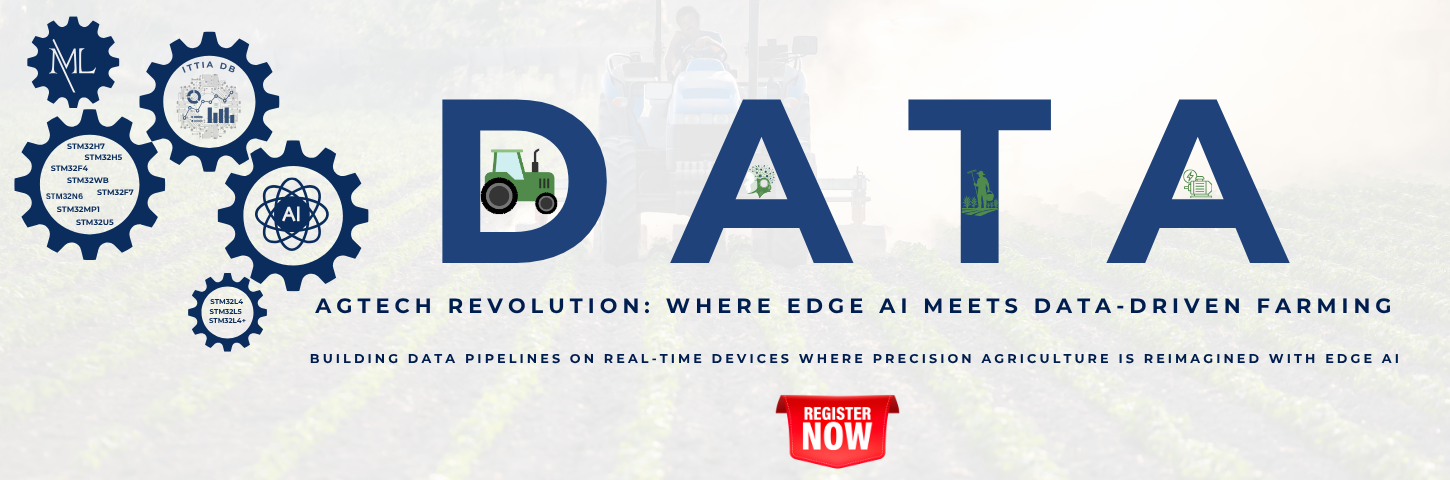
Building Data-Centric Edge AI for AgTech & Predictive Analytics
Data Foundations for AI: Preparation, Quality, and Analytics
Overview
This workshop is designed to introduce developers to the hardware and software required to build data-centric Edge AI applications for agricultural technology (AgTech) monitoring and predictive analytics. Participants learn how agricultural data, such as temperature and soil moisture, is acquired, processed, and managed deterministically at the device, and how this data is transformed into AI-ready features for on-device inference. The workshop covers the selection and integration of edge hardware (MCUs, MPUs, NPUs, sensors, and accelerators) alongside production-grade software for real-time control, time-series data management, signal processing, and Edge AI frameworks. Through hands-on exercises, developers gain a clear understanding of how data management, analytics, and AI work together to detect anomalies, predict failures, and enable reliable, explainable motor health intelligence directly at the edge.
Workshop Date: Thursday, July 30, 2026
Workshop Time: 11:00 AM–2:00 PM PT (2:00 PM–5:00PM ET)
Workshop Location: Online
Online Tutorial Workshop Syllabus
Objective: Detect abnormal conditions and optimize system performance in real time on an Edge device for AgTech applications. Build data-driven firmware to ingest raw environmental and equipment signals, generate cleaned features, apply Edge AI for anomaly detection and predictive analytics, and visualize operational and health trends over time.
The workshop comprises three 60-minute modules.
Module 1: Data-Driven Firmware Design and Programming
- Sensors for AgTech and equipment monitoring
- Sample environmental and operational signals such as soil moisture, temperature, humidity, light intensity, equipment current, vibration, and pressure
- Hardware setup
- Embedded device, storage media, and communication channels for field deployment
- Data modeling for edge devices: AgTech monitoring & predictive analytics
- Ingest and store sensor samples, features, inference results, events, and system metrics
- Define sampling rates, stream window sizes, and key data structures
- Data cleaning and conditioning with deterministic stream buffering
- Per-sensor filtering, normalization, outlier detection, and handling of missing data
- Transactional commits and time-series storage for reliable data management
- Feature engineering for Edge AI
- Extract features such as mean, variance, peak values, trends, and domain-specific indicators for environmental and equipment behavior
Module 2: Building an Edge AI Pipeline
- Select AI model algorithm
- Anomaly detection vs. classification for crop, environmental, and equipment conditions
- Datasets with variations and disturbances
- Environmental fluctuations (temperature, humidity, weather changes) and equipment irregularities (load changes, wear, abnormal operation)
- Train a model with an Edge AI development tool
- Train using normal operating conditions, validate with varying and abnormal scenarios
- Assess model size, latency, and deterministic performance
- Export optimized model to embedded runtime
- Real-time inference and operational logic pipeline
- Integrate ML inference into feature streams to generate anomaly scores or condition classifications per window
- Define thresholds, persistence logic, and system state models (e.g., normal, warning, critical)
- Inject simulated disturbances and observe model response and anomaly score transitions
Module 3: Edge Device Analytics, Visualization, and Connectivity
- Communicate with ITTIA Data Connect over Ethernet, WiFi, and/or serial UART
- Create a custom on-device dashboard with ITTIA Analitica
- Display metrics such as soil moisture trends, temperature variations, equipment load, anomaly counts, and system health indicators
- Visualize data via web dashboards, web services (HTTP/REST), Python, and C/C++
- Analyze patterns and system behavior
- Frequency, duration, and severity of anomalies
- Environmental trends and equipment performance changes
- Correlate multi-source data
- Link environmental conditions with equipment behavior
- Identify relationships between weather, soil, and operational performance
- Score system health and conditions
- Evaluate anomaly counts, severity trends, and performance indicators
- Generate operational and environmental state assessments
- Use anomaly data for diagnostics and optimization
- Support predictive analytics and resource optimization
- Improve decision-making for irrigation, equipment usage, and crop management
- Validate system performance
- Ensure bounded latency per processing window
- Maintain efficient storage usage and long-term reliability
Workshop Sample Application
During this hands-on workshop, you will be trained to design, build, and deploy a real-world, data-driven AI application, gaining practical skills you can immediately apply to embedded and edge systems.
Anomaly Detection in AgTech Systems
During the workshop, participants take on the role of an embedded engineer responsible for ensuring reliable operation of agricultural systems in dynamic, real-world environments. Using MCU-based devices, they capture live environmental and equipment data, such as soil moisture, temperature, humidity, light intensity, and equipment signals, directly at the edge, without reliance on cloud connectivity. The team trains an on-device AI model that learns what “normal” looks like across both environmental conditions and equipment behavior, continuously adapting as conditions change.
As the system operates, subtle anomalies begin to emerge, unexpected shifts in soil moisture, temperature fluctuations, irregular equipment loads, or environmental disturbances, early indicators that traditional threshold-based approaches may miss. The AI detects these anomalies in real time, while ITTIA DB Lite AI persistently stores and organizes the data and inference results directly on the device.
By combining AI with deterministic data management, raw signals are transformed into actionable insights. Anomaly frequency, duration, and severity are analyzed to generate real-time system health and environmental condition scores, alongside on-device statistics such as average soil conditions, peak environmental changes, equipment performance metrics, and anomaly counts.
By the end of the session, participants build a complete Edge AI solution that demonstrates how data-centric design and on-device AI enable predictive analytics and intelligent decision-making in AgTech systems, delivering reliable, explainable, and real-time insights directly at the edge.
Course Details
Workshop Cost: USD $250 per attendee
The workshop fee includes:
- Comprehensive lecture materials
Workstation: This is a hands-on workshop. You must have an STM32N6570-DK device, a USB-C cable, and a Windows PC with a USB-C port:
Edge Data AI Certification for Embedded Devices
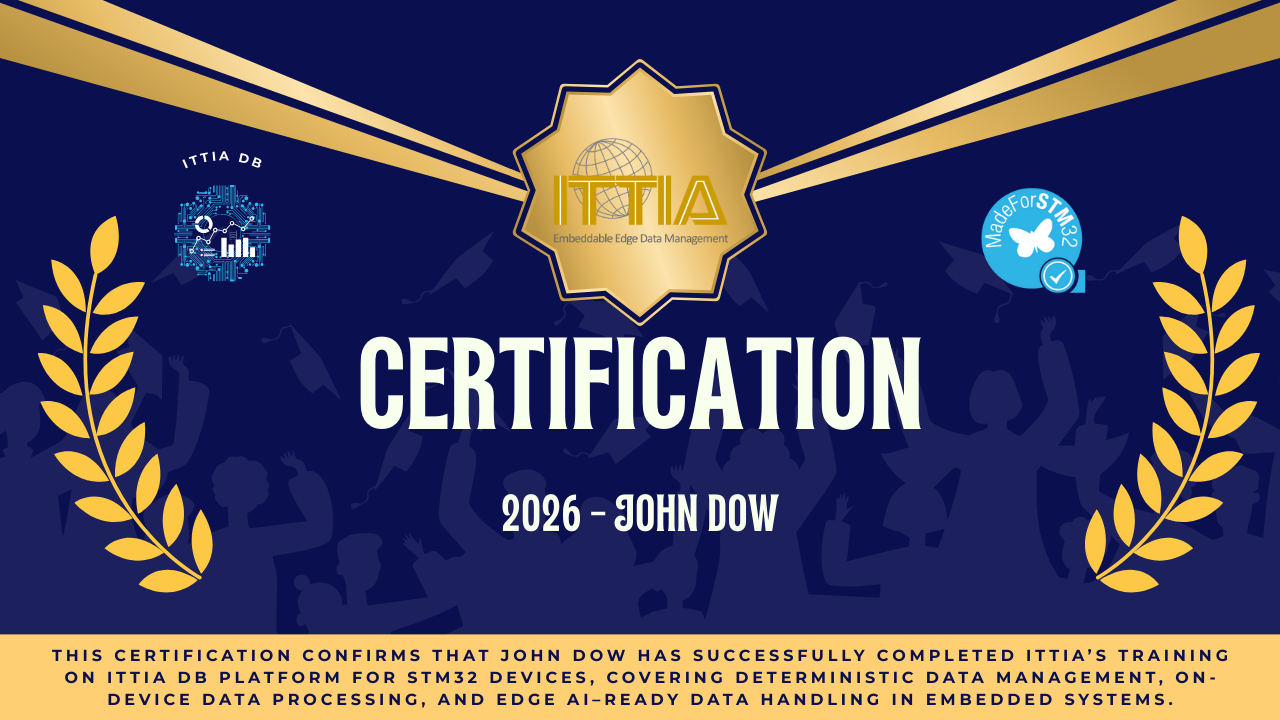
Workshop attendees will receive ITTIA DB Platform certification. This certification validates hands-on expertise in using the ITTIA DB Platform for deterministic data management, on-device data processing, and Edge AI–ready data handling. It demonstrates and validates the ability to design reliable, power-fail-safe, and AI-enabled embedded systems using proven data architectures, reducing development risk, accelerating time to production, and enabling high-quality, scalable solutions.
Past Workshop Participants
ITTIA has delivered highly sought-after, hands-on workshops that attract engineers and innovation leaders from across multiple sectors. Our sessions are trusted by companies building real-world, data- and AI-driven embedded systems, and have been attended by teams from leading organizations committed to advancing intelligent edge technologies, including:
Abbott – Acuity Brands – Advances Energy – Applied materials – Avery Biomedical Devices, Inc. – Badger Meter – Cardios – Cat Wranglers
Cognosos Inc. – Continental AG – CPI – Declarative Futures – EDS – Emtech – Everspin – EXFO – Honeywell – Kellogg Northwestern
L3Harris – Magna International – Mayo clinic – Megavolt Labs – Milwaukee Tool – Mold Masters – Nidec Global Appliances – OTTO Engineering
Philips – Resideo – Schneider Electric – Siemens – Southland Sensing Ltd. – TITOMA – TTI Floor Care – Wind River – Zetron/Codan
Audience
These immersive, hands-on workshops are built for embedded architects and engineers who are shaping the next generation of data-driven, AI-enabled edge systems and want more than theory, they want results. Through practical, expert-led sessions, participants learn how to select the right device platform, design deterministic real-time firmware, and implement robust on-device data management that elevates data to a first-class system asset. The program goes further by showing how to prepare and integrate optimized AI pipelines directly into embedded workflows, while addressing cybersecurity, functional safety, diagnostics, and long-term lifecycle management from day one. By the end of the workshop, engineers leave with the confidence, skills, and real-world experience needed to build intelligent, trustworthy, and future-proof embedded systems ready for production.
These workshops are highly technical, intended for professional engineers and are not suitable for the general public without relevant qualifications.
