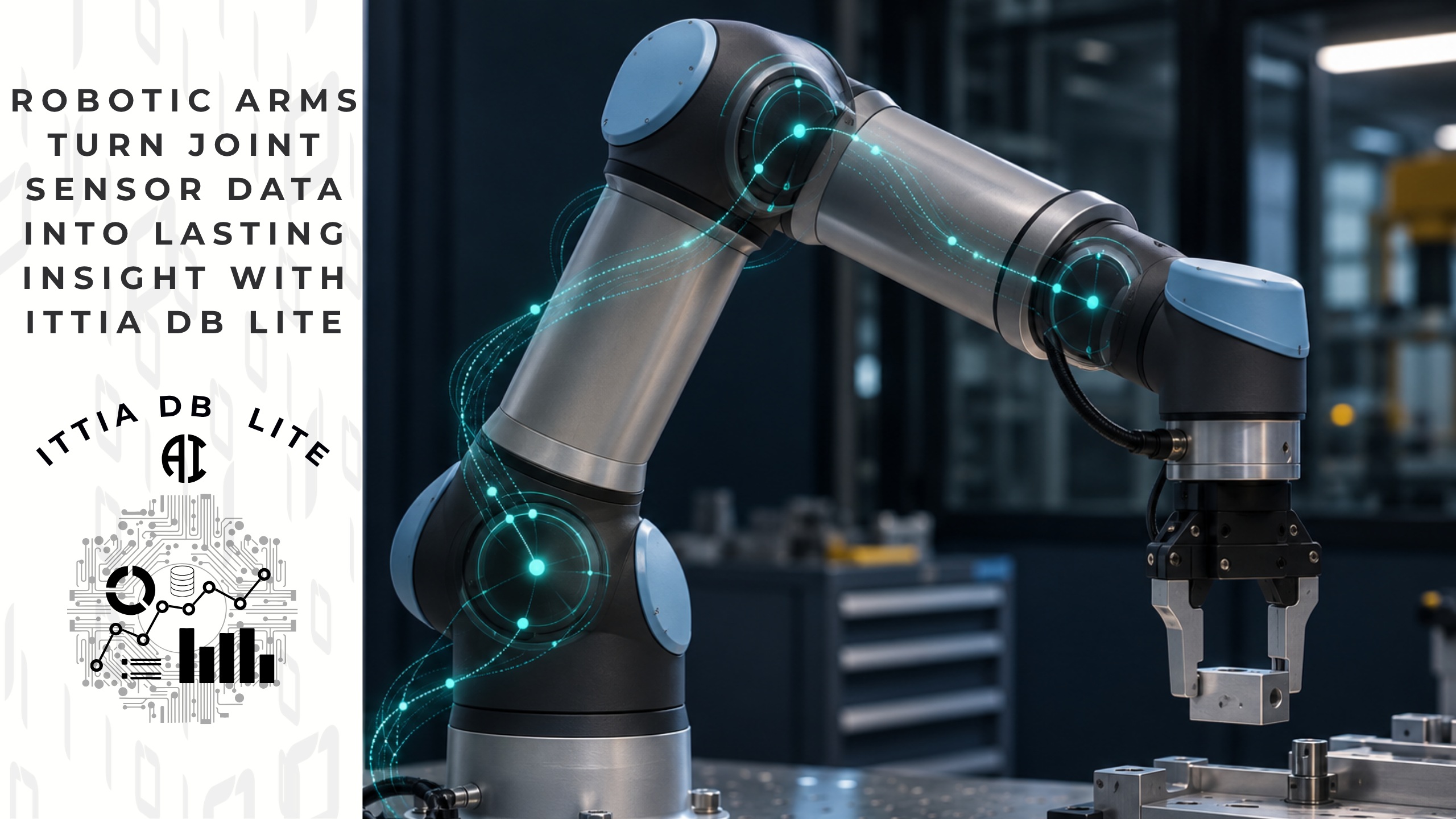
Robotic Arms Turn Joint Sensor Data into Lasting Insight with
ITTIA DB Lite
Preserve sensor history and operating context for joint monitoring and maintenance
A robotic arm’s movements depend on coordinated motors, gearboxes, encoders, and sensors. These components continuously generate information about position, current, vibration, temperature, and operating state.
That information can help engineers understand how the arm behaves and investigate changes over time. Its value depends on preserving enough context to explain what happened. ITTIA DB Lite provides an embedded data foundation for organizing sensor history and diagnostic records inside microcontroller-based robotic applications.
Joint sensors generate substantial data
The motor and gearbox at each joint are useful starting points for condition monitoring. Engineers can examine vibration alongside motor current, speed, temperature, and load to investigate unusual behavior. Consider an illustrative configuration with three vibration axes, each sampled at 20,000 samples per second and stored as a 16-bit value:
3 axes × 20,000 samples/second × 2 bytes = 120 KB/second
That represents approximately 432 MB per hour per joint, before timestamps, metadata, and storage overhead. Six joints would generate approximately 2.6 GB per hour from vibration alone. A practical design needs to decide which data deserves long-term storage and which data should be processed locally and retained briefly.
Give measurements their operating context
A vibration increase during acceleration may have a different meaning from the same increase during steady movement. Higher motor current may reflect a heavier payload, a different trajectory, or changing mechanical resistance. A useful diagnostic history therefore connects measurements with:
- Joint and motor identifiers
- Speed, position, and operating phase
- Payload or task configuration
- Sensor quality and calibration references
- Firmware, processing, and model versions
- Maintenance and component replacement events
With these associations, engineers can compare similar operating conditions rather than interpreting every change as evidence of a fault. ITTIA DB Lite offers transactional, streaming, and time-series data management for embedded applications, providing a foundation for organizing these records.
Process locally and preserve selected evidence
A proposed robotic arm monitoring application can use a microcontroller near each joint to acquire signals and prepare diagnostic features. The application might calculate vibration RMS, variance, or frequency-domain features, then evaluate them using thresholds or an AI model. ITTIA DB Lite can preserve selected feature history, operating context, and diagnostic events.
A possible workflow captures joint sensor data, processes it on the MCU, assesses joint health, preserves the results in ITTIA DB Lite, and makes the history available for engineering review.
Retention should reflect the available storage. Compact summaries can remain longer, while detailed raw captures can be preserved around selected events. A bounded capture buffer can also provide evidence from the period before an alert.
This approach makes useful history available without requiring indefinite storage of every sample.
A short example
A robotic arm repeatedly performs a pick-and-place operation. During one movement, its monitoring application detects unusual vibration at the elbow joint. The application preserves the associated sensor window, motor current, speed, task identifier, and diagnostic result using ITTIA DB Lite.
#include <ittia/db/db_stream.h>

enum { MOTOR_ID, SAMPLE_TIME, CURRENT_A, VIBRATION_MPS2, TEMPERATURE_C,
       CURRENT_SQUARED, VIBRATION_SQUARED };

dbstatus_t robotics_joint_history_create(db_stream_environment_t env, db_t db,
                                        void *memory, size_t memory_size,
                                        db_stream_graph_t *graph)
{
    static const db_aggregate_field_t summary[] = {
        { MOTOR_ID,      DB_AGGREGATE_GROUP_BY,        "joint_id" },
        { -1,            DB_AGGREGATE_END_TIMESTAMP,   "window_end" },
        { -1,            DB_AGGREGATE_COUNT,           "sample_count" },
        { CURRENT_A,     DB_AGGREGATE_AVERAGE,         "mean_current_A" },
        { CURRENT_SQUARED, DB_AGGREGATE_AVERAGE,        "mean_current_squared" },
        { VIBRATION_SQUARED, DB_AGGREGATE_AVERAGE,      "mean_vibration_squared" },
        { TEMPERATURE_C, DB_AGGREGATE_AVERAGE,         "mean_temperature_C" }
    };
    db_stream_node_t input, window, aggregate, output;
    db_table_output_policy_t policy = {0};
    policy.materialization_policy = DB_MATERIALIZE_APPEND;
    dbstatus_t status;
    *graph = NULL;
#define CHECK(call) do { status = (call); \
    if (DB_FAILED(status)) goto cleanup; } while (0)

    CHECK(db_stream_create_graph(graph, memory, memory_size));
    CHECK(db_stream_create_queued_input(&input, *graph, env,
        "robot_motor_samples", DB_FOR_SYSTEM_TIME_ALL, 256));

    /* Preserve the measurements for later investigation. */
    CHECK(db_stream_create_table_output(&output, input, db,
        "joint_sensor_history", DB_CREATE_NEW, &policy, 1));

    /* Summarize one-second windows, retaining counts to reveal missing data. */
    CHECK(db_stream_create_time_interval_window(&window, input,
        1000000, 1000000, 1024)); /* Durations are in microseconds. */
    CHECK(db_stream_create_aggregates(&aggregate, window,
        summary, DB_ARRAY_DIM(summary)));
    CHECK(db_stream_create_table_output(&output, aggregate, db,
        "joint_summary_history", DB_CREATE_NEW, &policy, 1));
    return DB_NOERROR;

cleanup:
    if (*graph) db_stream_free_graph(*graph, NULL);
    *graph = NULL;
    return status;
#undef CHECK
}
An engineer can later compare that event with earlier executions of the same movement. If the payload changed, that context remains visible. If a gearbox was recently replaced, the service record can identify the beginning of a new comparison period. The retained evidence supports investigation; the diagnosis still depends on a validated analysis method.
Keep diagnostic work coordinated with motor control
Motor control and historical data management have different timing requirements. Acquisition buffers, processing tasks, and persistence operations need explicit resource and scheduling budgets. Developers should measure the combined workload on the actual controller. Testing should include peak sensor traffic, repeated alerts, full storage, and power interruptions.
Transaction boundaries should preserve the required relationships between event records and their supporting data. Retention rules should also prevent important diagnostic records from referring to sensor evidence that has already been deleted.
Build robotic products that engineers can understand
Persistent joint history can support troubleshooting, maintenance review, and comparisons across software or hardware changes. It gives engineering teams evidence that remains available after the arm has completed its movement.
For robotic arm manufacturers, the value of ITTIA DB Lite lies in making selected sensor data and operating records organized, persistent, and accessible within the embedded application.
Conclusion: Powering the Next Generation of Robotics and Physical AI
Modern robotic systems incorporate both microcontrollers (MCUs) and microprocessors (MPUs) across motion controllers, robotic joints, motor drives, sensor interfaces, vision systems, autonomous navigation, and supervisory control. Each computing environment has distinct processing capabilities, memory constraints, and real-time requirements. Yet they share a critical need: the ability to independently manage and process data, maintain operational history, and make timely decisions without depending on continuous cloud connectivity.
The ITTIA DB Platform addresses these challenges by providing an integrated embedded data management and AI-enablement foundation designed for resource-constrained microcontrollers and more powerful microprocessor-based systems.
With decades of expertise in embedded database technologies, real-time data management, and data processing, ITTIA delivers capabilities that enable robotics developers to:
- Deterministic, Real-Time Data Management: Capture and manage continuous sensor and time-series data with predictable execution behavior, bounded resource utilization, and low-latency access for time-sensitive robotic applications.
- Persistent and Reliable Data Storage: Preserve sensor histories, operating conditions, system events, and AI inference results through transactional consistency, ACID capabilities, and power-failure recovery.
- Intelligent Data Processing and Feature Engineering: Transform raw sensor measurements into meaningful features through rolling statistics, RMS, variance, FFT, normalization, and time-window analysis to support condition monitoring and AI inference.
- AI-Ready Data and Inference Traceability: Maintain associations between sensor measurements, engineered features, AI models, inference outcomes, and robotic actions, enabling developers to investigate and validate decisions.
- Autonomous Edge Intelligence: Enable robotic devices to collect, store, process, and access operational data locally, supporting independent decision-making even when cloud connectivity is unavailable.
- Unified Data Management Across MCUs and MPUs: Support distributed robotic architectures with ITTIA DB Lite for microcontrollers and ITTIA DB for microprocessors, allowing data to be managed close to its source and selectively shared across devices, gateways, and cloud environments.
- Predictive Maintenance and Operational Intelligence: Use historical sensor measurements, anomaly detection, and operating trends to identify degradation, monitor robotic components, and support proactive maintenance.
- Efficient Embedded Resource Utilization: Deliver data management capabilities designed for constrained memory, processing power, storage endurance, and energy budgets.
For robotics manufacturers and embedded developers, these capabilities help reduce the complexity of building custom data infrastructure, accelerate development, improve system reliability, and establish a persistent foundation for increasingly sophisticated Physical AI applications.
ITTIA brings together embedded database technology, deterministic time-series processing, persistent operational intelligence, and AI-ready data management in a platform designed for intelligent machines.
As robotics evolves toward greater autonomy, the ability to maintain trusted data locally, understand historical behavior, and support intelligent decisions becomes fundamental to system design.
Build Smarter, More Autonomous Robots with ITTIA
Whether you are developing robotic arms, autonomous mobile robots, industrial automation systems, intelligent motor controllers, or next-generation Physical AI devices, ITTIA can help you design and implement the embedded data infrastructure your application requires. Our engineering team works with developers and manufacturers to evaluate hardware architectures, real-time requirements, data-processing workloads, and AI integration opportunities across MCU- and MPU-based platforms.
Contact ITTIA today to learn how the ITTIA DB Platform can accelerate your robotics development, strengthen deterministic data management, and enable reliable, cloud-independent Physical AI.
