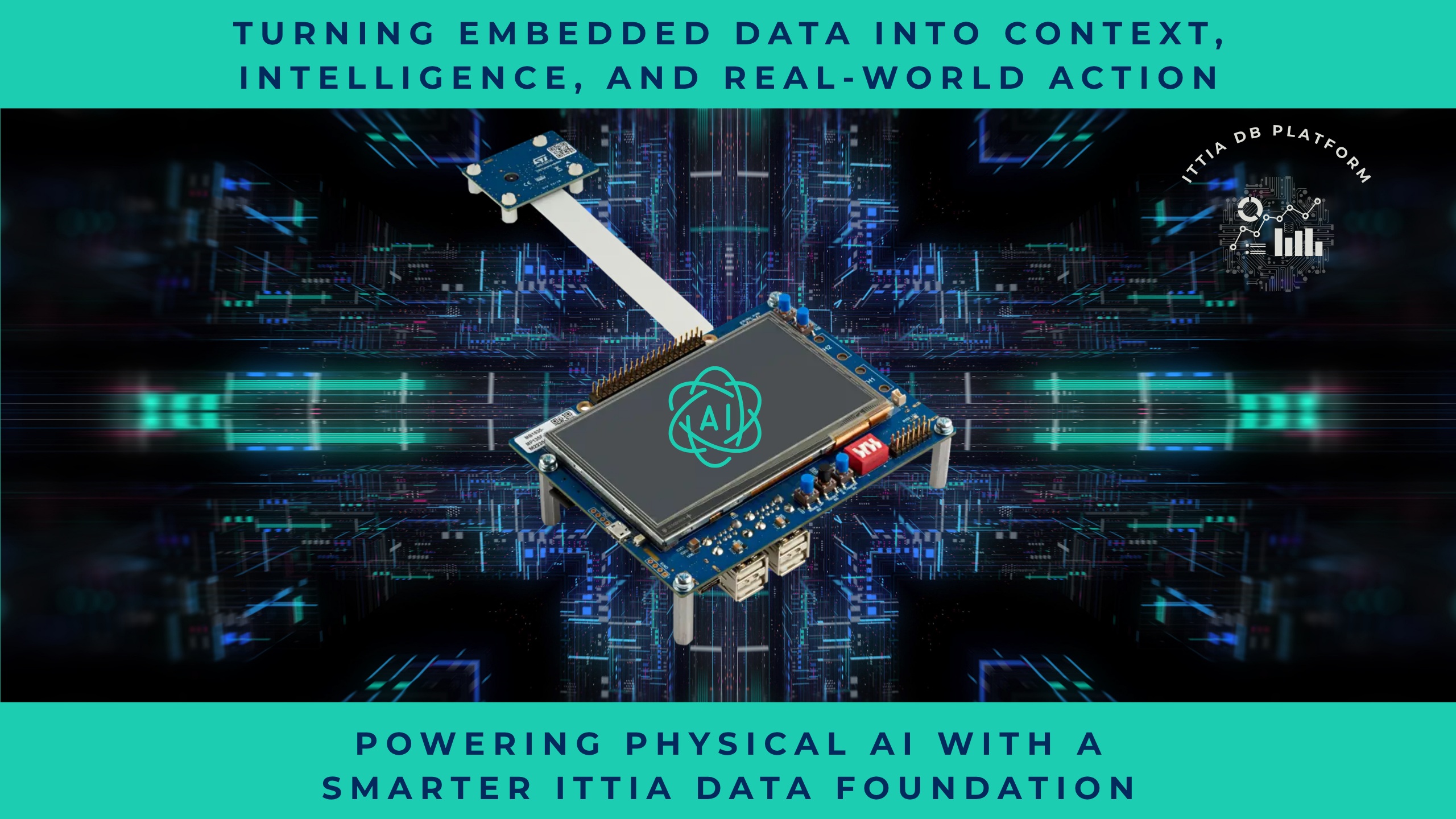
Powering Physical AI with a Smarter ITTIA Data Foundation
Turning embedded data into context, intelligence, and real-world action
Physical AI is artificial intelligence that can sense, understand, decide, and act in the physical world through machines and embedded systems. Instead of working only with digital information, Physical AI combines sensors, local data, historical context, AI inference, and actuators or controllers to interact with real-world environments.
Examples include robots, vehicles, industrial equipment, medical devices, drones, and smart machines that observe conditions such as motion, sound, temperature, vibration, images, or force, interpret that information with AI, make a decision, and then perform a physical action. In simple terms, Edge AI provides intelligence on or near the device, while Physical AI uses that intelligence to influence or control the physical world. Physical AI is changing the role of embedded systems.
Meanwhile, microcontrollers and embedded processors are no longer limited to reading sensors and controlling outputs. They are increasingly expected to understand their environment, maintain historical context, process information locally, run AI models, make decisions, and act in the physical world. That evolution creates a new architectural requirement: intelligent machines need a strong data foundation.
The ITTIA DB Platform is most valuable in embedded systems where data must be captured, organized, processed, preserved, and turned into intelligence directly on the device. That capability aligns naturally with the requirements of Physical AI.
Physical AI Begins with the Physical World
A Physical AI system interacts continuously with real-world conditions. A robot may monitor motion, force, motor current, position, vibration, and vision-derived features. A vehicle may analyze battery conditions, thermal behavior, motor health, and operating states. An industrial machine may continuously collect vibration, acoustic information, temperature, pressure, current, and RPM.
The intelligence of the system depends on more than the AI model itself. It depends on the ability to transform physical-world observations into organized, meaningful, and contextual information. A typical Physical AI pipeline can be expressed as: Physical Environment to Sensors to Structured Data to Historical Context to Data Processing and Feature Engineering to AI Inference to Decision to Physical Action to Recorded Result.
ITTIA DB Platform provides the data-management foundation supporting this loop.
Capturing Data Is Only the Beginning
Physical AI devices may generate large amounts of information from multiple sensors and subsystems, but simply collecting that data is not enough. The system must also be able to determine what happened, when it happened, under what operating conditions it occurred, what preceded it, how it compares with previous behavior, what information was provided to the AI model, and what decision the system ultimately made.
Answering these questions requires structured data management and historical context. ITTIA DB Platform helps organize sensor measurements, events, timestamps, device states, operating conditions, and historical records so that an intelligent device can understand not only what is happening now, but also the broader context surrounding each event and decision.
Physical AI Needs Memory
Many AI implementations focus heavily on inference. A model receives an input, produces a result, and the application responds. But physical systems often evolve over time.
A bearing may gradually develop a fault. A battery may slowly lose capacity. A robot actuator may exhibit increasing resistance or vibration. A thermal condition may become abnormal only after a sequence of operating events. A single sensor reading may not reveal these changes. Historical context can.
ITTIA DB Platform allows embedded devices to preserve local history so current conditions can be evaluated against previous normal behavior, earlier operating states, fault history, trends, and previous AI results. This gives the device something extremely important for Physical AI: memory of the physical world.
Data Processing Turns Measurements into Meaning
Raw sensor measurements are often not the information an AI model ultimately needs. Before inference, data may need to be filtered, aggregated, normalized, time-aligned, windowed, statistically processed, or transformed through feature engineering. In a predictive-maintenance application, for example, vibration or acoustic measurements may be converted into meaningful features such as RMS, variance, rates of change, rolling statistics, FFT components, MFCC features, and frequency-band energy.
For example, ITTIA DB Lite, a member of ITTIA DB Platform family, can support this transition from raw embedded data to structured, AI-ready information by combining local data management, historical context, and feature processing within the device. The resulting architecture becomes Sensors to ITTIA DB Lite to Historical Context to ITTIA DB Lite AI to Feature Engineering to AI Model to Decision, making the database an active part of the intelligence pipeline rather than simply a place where data is stored.
Multimodal Data Strengthens Physical AI
Physical systems rarely depend on one sensor alone. A machine-health application may combine sound, vibration, temperature, current, RPM, and load. A robot may combine force, motion, vision, proximity, and motor information. A medical device may combine multiple physiological measurements with operating and event information. This is where multimodal data management becomes important.
ITTIA DB Platform can help organize different forms of device data within a common structured environment, preserving timing, context, and relationships between them.
An acoustic anomaly by itself may be ambiguous. But:
Acoustic anomaly + increased vibration + rising temperature + abnormal current
can provide a much stronger indication of developing equipment trouble. The database therefore becomes a foundation for sensor fusion at the data level, helping Physical AI systems interpret multiple views of the same physical condition.
AI Inference Should Be Observable
As AI becomes responsible for more decisions that affect the physical world, observability becomes increasingly important. It is no longer enough for a system to simply report “fault detected”; engineers may also need to understand what sensor information was available, what historical conditions existed, which features were generated, what the AI model evaluated, what inference was produced, and what action followed.
ITTIA DB Platform can help preserve the relationship between sensor data, processed features, AI inference, device decisions, and physical actions, creating a traceable chain from Observation to Historical Context to Feature to Inference to Decision to Action to Recorded Result. This provides a more transparent, explainable, and auditable Physical AI architecture.
Intelligence Directly on the Device
One of the defining characteristics of Edge AI and Physical AI is that intelligence increasingly operates directly on or near the machine, providing advantages such as lower latency, reduced dependence on the cloud, lower bandwidth requirements, greater privacy, continued operation without connectivity, and faster physical response. However, local AI also places greater responsibility on the embedded system itself, which must efficiently manage its own data, historical context, processing, storage, and inference pipeline.
ITTIA DB Platform helps provide this local data infrastructure across both MCU- and MPU-based architectures, enabling intelligent devices to operate more independently, efficiently, and responsively at the edge.
From MCU to MPU
Physical AI can exist across many classes of embedded hardware. On microcontrollers, ITTIA DB Lite provides structured embedded data management, while ITTIA DB Lite AI extends that foundation into data processing, feature engineering, and AI-ready pipelines.
On more powerful embedded processors, ITTIA DB can support relational and time-series workloads, richer analytics, and more complex device-level data management. This allows Physical AI architectures to scale from small intelligent sensors and controllers to gateways, robots, vehicles, and larger embedded computing platforms.
Physical AI Across Industries
The same architecture can apply across many markets. In industrial automation, Physical AI can monitor motors, pumps, compressors, and machinery for developing faults. In automotive systems, it can support battery intelligence, traction motor health, diagnostics, and intelligent ECUs.
In robotics, it can combine motion, force, vision, acoustic, and operational information to support intelligent actions. In medical devices, it can preserve sensor history, support intelligent monitoring, and provide traceability around device decisions. In energy and infrastructure, it can monitor equipment condition, environmental measurements, and operational trends locally.
Different industries may use different sensors and AI models, but the underlying need remains similar: data must become context before context can become intelligence.
The Data Foundation Behind Physical AI
Physical AI requires more than processors, sensors, and neural networks; it requires an architecture that connects the physical world to intelligent action. A complete Physical AI pipeline can be described as Physical Environment to Sensors to ITTIA DB Platform to Structured Data and Historical Memory to Data Processing and Feature Engineering to AI Inference to Decision to Physical Action.
In this architecture, sensors provide awareness, processors provide compute, AI models provide inference, and ITTIA DB Platform provides the data foundation that connects them. The future of embedded intelligence will therefore be defined not only by how quickly a device can run an AI model, but also by how effectively it can capture, organize, process, preserve, and understand its own data. Physical AI depends on memory, context, multimodal information, feature engineering, inference traceability, and reliable local data management. ITTIA DB Platform helps provide this foundation, enabling embedded systems to transform physical-world data into structured information, AI-ready intelligence, and traceable physical action directly on the device. As embedded systems evolve into intelligent machines, data management becomes more than a supporting function; it becomes part of the intelligence itself.
Discover the Possibilities with ITTIA
Are you developing an embedded or intelligent device that requires reliable data management, real-time data processing, historical context, or AI enablement? We invite you to connect with ITTIA experts to explore how the ITTIA DB Platform can help transform your microcontroller- or processor-based application into a more intelligent, data-centric system.
Our team can review your device architecture, data sources, processing requirements, storage constraints, and AI integration plans, and demonstrate how ITTIA technology can support the development of reliable, efficient, and intelligent embedded applications across a wide range of industries.
