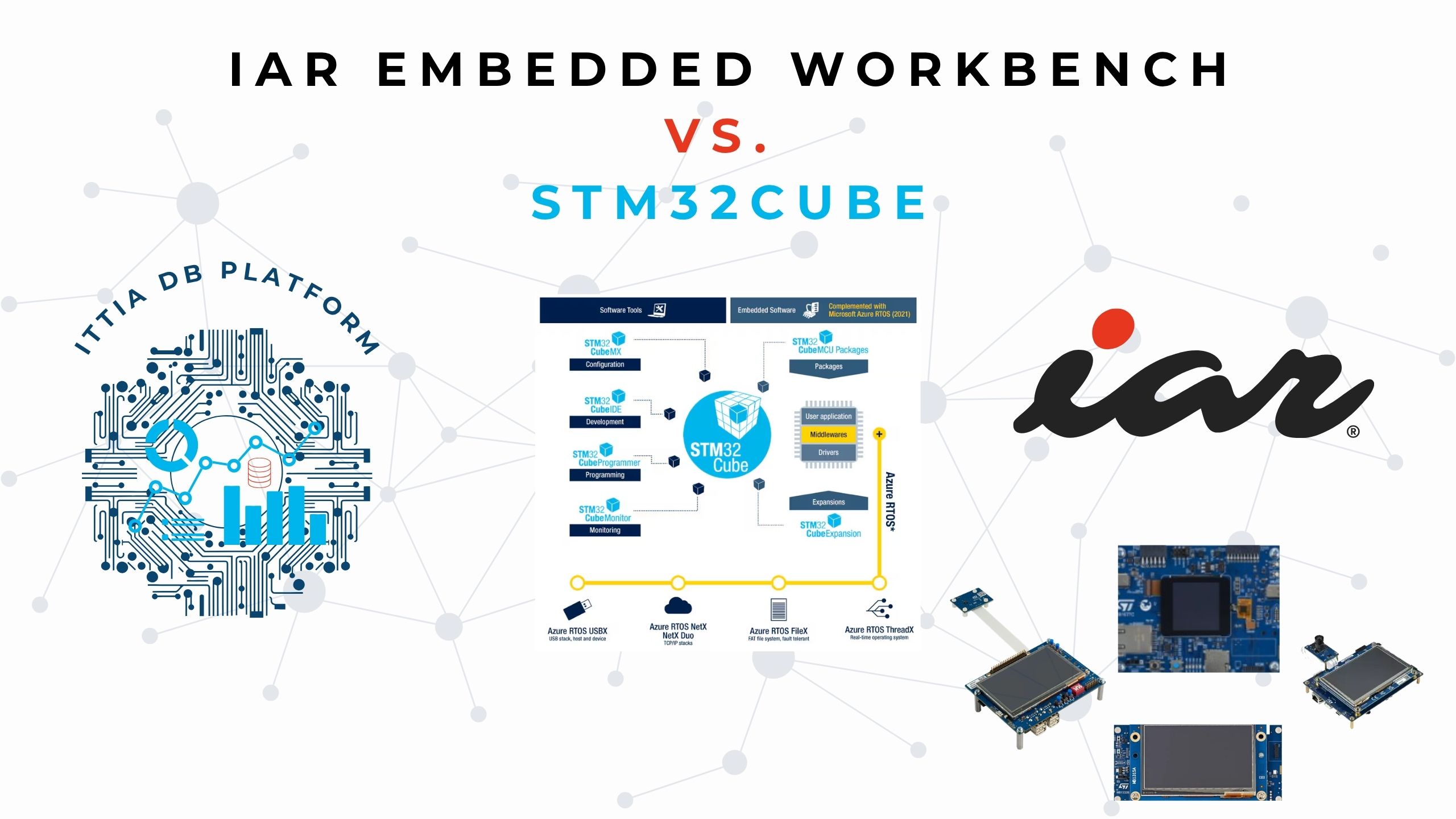
IAR Embedded Workbench vs. STM32Cube
Two Paths to Building Advanced STM32 Edge Applications
Embedded development teams building on STM32 have an important choice to make: which development environment best supports their engineering workflow, performance requirements, debugging strategy, software lifecycle, and production goals?
Two prominent options are IAR Embedded Workbench for Arm and the STM32Cube development ecosystem. Both can support serious STM32 development, but they approach the engineering problem from different directions.
IAR Embedded Workbench is positioned as a comprehensive commercial embedded development toolchain combining compiler technology, debugging, code analysis, and development tools across multiple microcontroller and processor architectures. IAR also provides direct support for STMicroelectronics’ STM32 devices.
STM32Cube, in contrast, is STMicroelectronics’ native development ecosystem. STM32CubeIDE supports STM32 development and debugging, while STM32CubeMX provides graphical configuration and code generation for STM32 peripherals, middleware, clocks, and initialization. STM32CubeMX can also generate projects for IAR Embedded Workbench, highlighting that the two environments can compete at one level while remaining interoperable at another.
The more important question, however, is not simply which IDE should developers use? For the next generation of embedded and Edge AI applications, the bigger question is: How will the application manage the data generated inside the MCU?
Development Tools Are Only One Part of the Edge Architecture
Modern embedded applications are moving far beyond traditional firmware. An STM32 device may continuously ingest sensor measurements, CAN data, industrial signals, battery information, vibration data, environmental measurements, or machine operating conditions.
The application may need to maintain historical windows, calculate rolling statistics, detect events, prepare AI features, run inference, preserve diagnostic history, and explain why an AI model reached a particular decision. The compiler and IDE are essential for building the firmware, but they do not replace the need for embedded data architecture.
This is where the ITTIA DB Lite product family adds another layer to both IAR Embedded Workbench and STM32Cube.
ITTIA DB Lite: Adding a Data Layer to the Development Environment
ITTIA DB Lite provides structured embedded data management for resource-constrained microcontrollers. Instead of creating separate arrays, circular buffers, flash files, custom logging structures, and application-specific storage mechanisms for every project, developers can establish a common data-management architecture directly inside the device.
Sensor and application data can be organized as transactional and time-series information that can be retained, queried, processed, and reused across the application. This transforms the MCU from a system that simply reacts to the latest measurement into one that can understand what is happening now in the context of what happened before.
Whether the application is being developed in IAR Embedded Workbench or within the STM32Cube environment, the fundamental requirement remains the same: The application needs reliable access to its own data.
ITTIA DB Lite AI: Connecting Data with Edge AI
Edge AI makes the data-management requirement even more important.
AI models rarely gain maximum value from one isolated sensor measurement. They often require a historical window and calculated features describing changes, trends, variance, frequency behavior, rates of change, or relationships between measurements. ITTIA DB Lite AI connects historical device data with this AI workflow.
A typical processing architecture can become:
Sensors → ITTIA DB Lite → Historical Data → ITTIA DB Lite AI → Feature Engineering → AI Model → Device Decision
The development tool is responsible for building and debugging the embedded application. The ITTIA DB Lite product family provides the data infrastructure inside that application. This distinction is important.
The IAR Embedded Workbench Value
For development organizations using IAR Embedded Workbench, ITTIA DB Lite can become another production software component within the IAR project.
IAR emphasizes optimized code generation, debugging, runtime analysis, reliability, and support for a broad range of microcontrollers and processor architectures. This can be particularly valuable for companies that standardize their embedded development methodology across several semiconductor suppliers rather than remaining within one MCU ecosystem.
ITTIA DB Lite complements that strategy because the product family is also intended for embedded MCU environments rather than being tied conceptually to a single application. A development team can therefore combine its compiler and debugging strategy with a reusable embedded data strategy. The result is:
IAR Development Environment + ITTIA DB Lite = Embedded Development + Embedded Data Infrastructure
For Edge AI:
IAR + ITTIA DB Lite/AI = Firmware Development + Historical Data + Feature Engineering + AI Enablement
The STM32Cube Value
STM32Cube takes a different approach. It provides an STM32-focused workflow around device configuration, initialization, middleware, development, and debugging. STM32CubeMX supports configuration and generation of STM32 initialization code, while STM32CubeIDE supports STM32 application development and debugging.
ST also provides an increasingly broad Edge AI ecosystem. As of 2026, STM32Cube AI Studio is ST’s stand-alone environment for evaluating, optimizing, validating, and deploying neural-network models on STM32 MCUs, replacing the older X-CUBE-AI workflow for new development. That creates a strong model-deployment environment.
ITTIA DB Lite adds the missing data dimension around that AI model. STM32Cube AI tools can help developers bring a trained model onto an STM32 device. ITTIA DB Lite and ITTIA DB Lite AI can help manage the operational data that continuously feeds, contextualizes, and explains the model after deployment. The architecture becomes:
STM32 Sensors and Peripherals → ITTIA DB Lite → Historical Context → ITTIA DB Lite AI → AI Features → STM32 AI Model → Intelligent Application
It Is Not Only About IAR vs. STM32Cube
IAR Embedded Workbench and STM32Cube may compete for portions of the embedded development workflow, but the customer does not necessarily need to view the decision as an absolute technology divide. STM32CubeMX itself can generate projects targeting IAR Embedded Workbench in addition to STM32CubeIDE.
This creates an opportunity for a broader development strategy. A team may use STM32Cube technology for device configuration and ST-specific software while using IAR for compilation, debugging, optimization, or broader organizational development requirements. ITTIA DB Lite can provide a common embedded data layer across these choices. The development environment may change. The application’s requirement for reliable data management does not.
The New Competitive Dimension: Data-Centric Embedded Development
The future competition in embedded development will not be defined only by compiler optimization, debugger capability, code generation, or peripheral configuration. Developers increasingly need to answer another set of questions: How does the application retain its operational history? How does it query that history? How are features generated for AI? How are inference results connected to the sensor data that produced them? How does the MCU preserve important events? How can engineers reconstruct what occurred before an anomaly or failure? These are data architecture questions.
And as MCU applications become more intelligent, they become increasingly important. IAR and STM32Cube help developers build embedded software. ITTIA DB Lite helps that software understand and use its data.
That is the foundation for the next generation of data-centric Edge AI applications, which will be covered in more detail in our next blog. Stay tuned.
