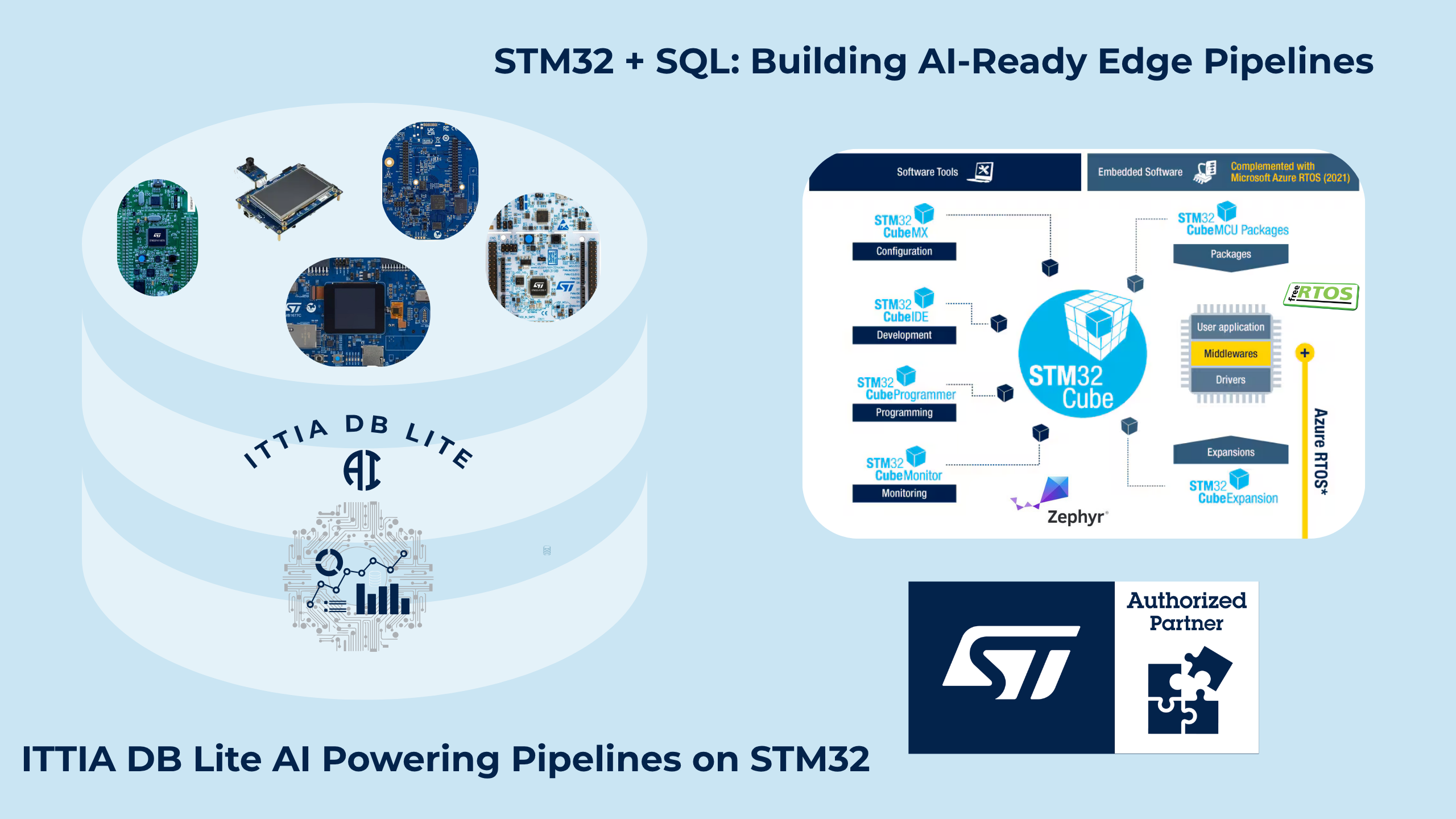
STM32 + SQL: Building AI-Ready Edge Pipelines
ITTIA DB Lite AI Powering Pipelines on STM32
Edge devices are no longer simple data collectors, they are evolving into intelligent systems that must sense, decide, and act in real time. As adoption accelerates, a critical question emerges: how can data be managed reliably, securely, and intelligently on the device itself? Platforms from STMicroelectronics, especially the widely deployed STM32 family, have set the benchmark for performance, safety, and reliability, powering billions of applications across automotive, industrial automation, medical devices, and consumer electronics. Yet while hardware capabilities have advanced significantly, the data infrastructure at the edge remains the missing layer needed to unlock truly intelligent, data-driven systems.
Relational databases provide a structured and standardized way to organize data into tables with well-defined relationships, enabling efficient storage, querying, and analysis. By using a schema and SQL (Structured Query Language), developers can easily filter, join, and aggregate data, making it far more manageable than unstructured or file-based approaches. This model ensures data integrity, consistency, and traceability, which are critical for building reliable systems, especially in embedded and Edge AI environments. When applied to devices such as microcontrollers, relational databases bring clarity and scalability to data pipelines, allowing engineers to transform raw sensor data into meaningful insights and actionable intelligence directly at the edge.
For MCUs, adopting a relational database model brings structure, reliability, and efficiency to data management that ad hoc buffers and flat files simply can’t provide. Data is organized into well-defined tables with relationships, enabling clean schemas, consistent data integrity, and traceable pipelines from sensor to insight. With embedded SQL, developers can perform powerful queries, filtering, and aggregations directly on-device, reducing firmware complexity and eliminating custom data-handling code. This approach supports deterministic behavior, efficient time-series handling, and easier feature engineering for Edge AI, all while maintaining predictable resource usage. The result is a more scalable, maintainable, and intelligent MCU system, where data is not just stored, but understood and acted upon in real time.
Why Data Management Matters on STM32 Devices
Modern embedded applications are no longer defined solely by control logic, they are driven by data pipelines. Sensors continuously generate streams of information such as temperature, vibration, and current, which must be captured, processed, and stored in real time. AI models depend on this data being structured, synchronized, and high quality, while system decisions must remain explainable and reliable. Without a proper data infrastructure, data can be lost during bursts or interrupts, timing becomes inconsistent, storage fragments, and AI models are fed poor-quality inputs, ultimately causing systems to lose determinism and stability. The result is unreliable intelligence.
The Shift: From Code-First to Data-First Embedded Systems
The next generation of STM32 applications is data-first, built on a pipeline that transforms raw signals into intelligent action:
Sensors → Deterministic Data → Features → AI → Action
This shift demands more than traditional embedded design, it requires structured storage instead of flat files, deterministic data ingestion under real-time constraints, on-device analytics and feature engineering, and secure, controlled data ownership. Without these capabilities, systems cannot deliver reliable or explainable intelligence. This is exactly where the ITTIA DB Platform plays a critical role, providing the data infrastructure needed to turn STM32 devices into truly intelligent, data-driven systems.
The relational model plays a critical role in enabling data-first pipelines on STM32 by transforming raw, continuous sensor streams into structured, consistent, and queryable data. Instead of relying on fragmented buffers or flat files, data is organized into well-defined tables that preserve relationships between signals, features, and AI outputs. This allows developers to use SQL to filter, aggregate, and correlate data directly on the device, enabling efficient feature engineering and real-time analytics. As a result, systems gain deterministic behavior, full data lineage, and explainable decision-making—ensuring that AI models operate on high-quality, reliable inputs and that the entire pipeline remains stable, scalable, and intelligent.
ITTIA DB Lite AI: The Data Engine Inside STM32
ITTIA DB Lite AI is purpose-built for microcontrollers, delivering a deterministic, power-fail-safe data layer directly on STM32 devices. It brings a relational data model with SQL to the MCU, enabling structured storage and powerful on-device queries for filtering, aggregation, and analysis. With deterministic ingestion that is ISR/DMA-safe, no data is lost, even during high-frequency bursts. Its time-series optimized storage efficiently handles continuous sensor streams, while on-device feature engineering supports rolling windows, trends, lag features, and normalization, making data immediately AI-ready. Combined with crash-safe, atomic operations, it guarantees data integrity even under power interruptions. The result is a transformation of STM32 from a simple data logger into a reliable, intelligent data engine for Edge AI.
ITTIA Analitica: Visualization Where Data Lives
Data campaign visualization on MCUs is essential for turning raw device data into immediate insight, enabling engineers to see system behavior in real time directly at the source. Instead of waiting for cloud processing, on-device visualization allows teams to validate sensor integrity, monitor trends, and observe AI outputs such as anomaly scores or predictions as they happen.
This improves debugging, accelerates development cycles, and ensures that data used for training and decision-making is accurate and meaningful. In constrained embedded environments, having visualization tightly integrated with the data pipeline also enhances explainability and trust, making it easier to understand why a system made a decision, an increasingly critical requirement for safety, reliability, and certification in modern edge applications.
Data without visibility is underutilized. ITTIA Analitica brings real-time dashboards and visualization directly to the edge, enabling teams to monitor sensor streams and overall system behavior while visualizing AI outputs such as anomaly scores and predictions as they happen. This empowers engineers to debug, validate, and refine models directly on the device, while also providing critical explainability for system decisions. Instead of guessing, teams gain full transparency, they see exactly what the device sees, in real time.
ITTIA Data Connect: Smart Data Movement
Data distribution is critical in embedded systems built with sensors, MCUs, and MPUs because intelligence depends on getting the right data to the right place at the right time. Sensors generate continuous streams that must be processed locally for real-time decisions, shared with higher-level processors for coordination, and selectively transmitted to gateways or the cloud for long-term analytics and model improvement. Without a controlled data distribution strategy, systems risk bandwidth overload, latency spikes, data loss, and security exposure. Efficient, selective distribution ensures that time-critical data remains on-device for immediate action, while only meaningful insights or compressed datasets are transmitted upstream. This not only improves system performance and scalability but also preserves data ownership, reduces costs, and enables reliable, end-to-end Edge AI pipelines.
Not all data should go to the cloud, and in many embedded systems, it shouldn’t. ITTIA Data Connect enables secure, selective data synchronization, allowing devices to stream data over UART, Ethernet, or Wi-Fi while transmitting only what truly matters, such as anomalies, summaries, and key performance indicators. This intelligent filtering ensures that time-critical processing stays local, while valuable insights are shared upstream for further analysis. The result is lower bandwidth consumption, stronger privacy and IP protection, and higher-quality datasets for cloud training, enabling scalable and efficient Edge AI systems.
Data Ownership and Competitive Advantage
One of the biggest risks in modern embedded and Edge AI systems is losing control of your data, often without realizing it. When devices lack proper on-device data infrastructure, raw sensor data is continuously pushed upstream to external systems or cloud services, where third parties can access, analyze, and potentially benefit from insights that were generated by your own products. Over time, this erodes competitive differentiation, as the unique intelligence derived from your devices is no longer exclusively yours.
With ITTIA DB Lite AI, this dynamic changes fundamentally. Data is captured, structured, and processed directly at the source, enabling real-time understanding and decision-making on the device itself. Only intentional, curated data, such as anomalies, summaries, or model-relevant insights, is shared externally, ensuring efficiency while protecting sensitive information. This approach allows manufacturers to maintain full ownership, control, and sovereignty over their data, turning it into a strategic asset rather than a liability. Your data stays yours, and becomes a powerful competitive advantage.
Final Thoughts: Why Relational Models and SQL Matter on MCUs
Many embedded systems still rely on flat files, ad-hoc buffers, and custom data-handling code, approaches that quickly become complex, fragile, and difficult to scale. As systems grow in capability and data volume, this lack of structure limits performance, maintainability, and reliability. By contrast, relational models with SQL introduce standardization across teams and projects, enabling powerful querying through filtering, joins, and aggregation, while promoting cleaner architecture and faster development and debugging. Bringing SQL to STM32 unlocks enterprise-grade data capabilities directly at the edge, transforming how embedded systems are built and managed.
With the ITTIA DB Platform, STM32 devices evolve from simple controllers into data-centric systems, where AI pipelines become deterministic, explainable, and reliable. Engineers gain full control, visibility, and scalability, enabling them to build systems that not only act, but understand and justify their actions.
Ultimately, AI models alone don’t create intelligent systems, data does. The future of embedded design will not be defined by compute power alone, but by how effectively devices manage and use their data. With STM32 hardware and ITTIA DB Lite AI, developers can build deterministic pipelines, enable real-time intelligence, and maintain full data ownership and trust. Data First. Intelligent Edge Systems Follow.
