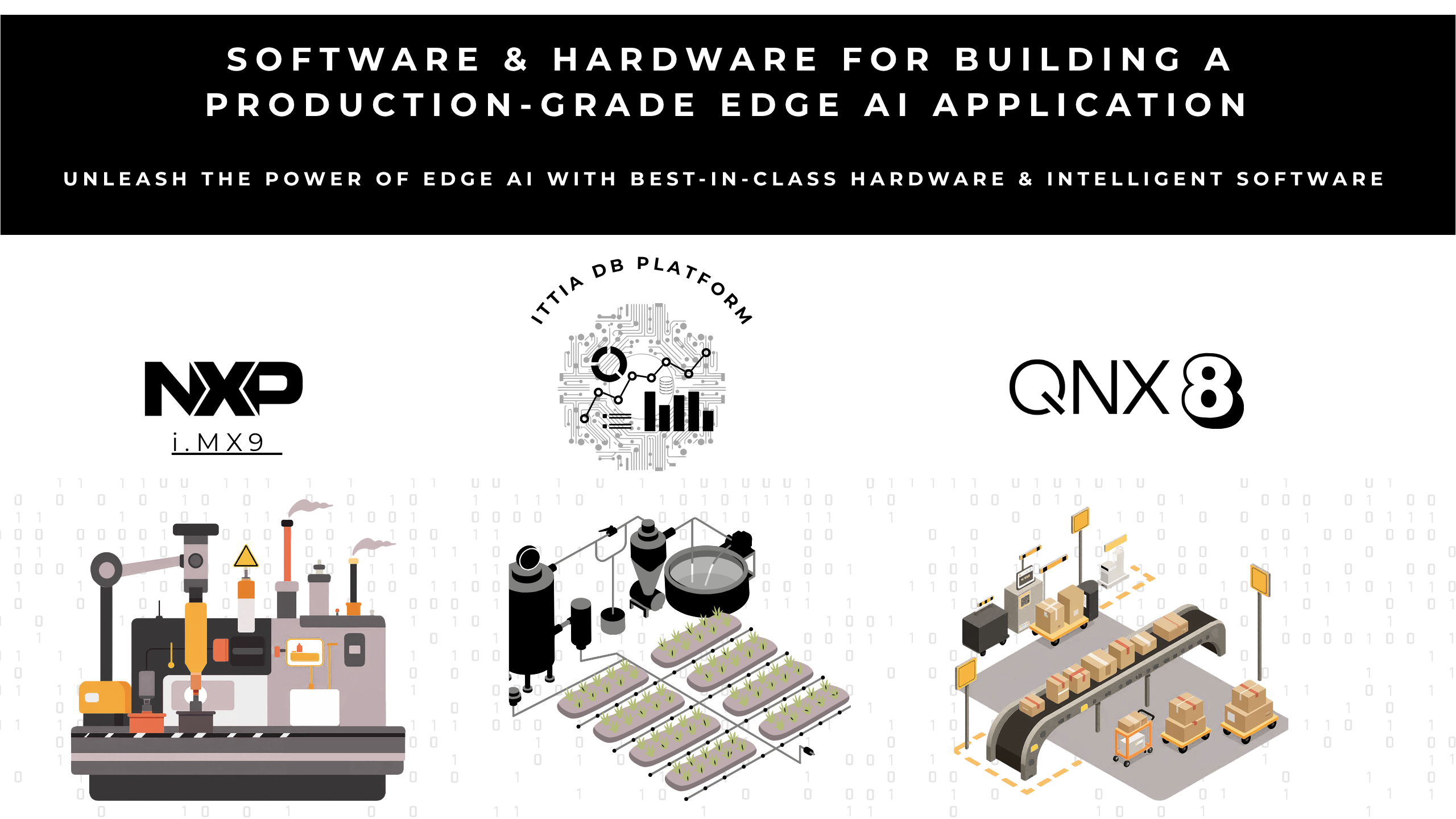
Building a Production-Grade Edge AI Application
i.MX9, QNX 8, and ITTIA DB Platform
Manufacturers developing embedded edge devices often struggle to integrate the right combination of hardware and software because each decision, processor selection (MCU vs. MPU), memory constraints, RTOS compatibility, AI framework support, and data management architecture, directly impacts performance, power consumption, and long-term scalability.
Hardware platforms from vendors offer diverse capabilities, but aligning them with software stacks (middleware, drivers, AI models, and data pipelines) introduces significant complexity and risk. Without a cohesive approach, teams face fragmented toolchains, unpredictable latency, inefficient resource usage, and integration delays.
This challenge is amplified in edge AI applications, where deterministic data handling, real-time processing, and reliability under power or connectivity constraints are mandatory. As a result, many projects stall not because of lack of innovation, but due to the difficulty of building a tightly integrated, production-ready hardware-software ecosystem.
Meanwhile, Edge AI is no longer about demos, it’s about deploying reliable, deterministic, and explainable intelligence directly on devices. Whether in automotive, industrial automation, or smart infrastructure, success depends on how well you manage data at the edge.
Therefore, it is becoming increasingly demanding for manufacturers to select and successfully build systems that combine i.MX9 for high-performance compute and AI acceleration, QNX 8 for real-time, safety-grade operating environments, and the ITTIA DB Platform for deterministic data management.
Each layer introduces its own complexity, balancing AI workloads with constrained power budgets, ensuring real-time behavior and functional safety compliance, and managing high-frequency data streams reliably at the edge. Integrating these technologies into a cohesive, production-ready architecture requires deep expertise across hardware, OS, and data infrastructure, along with careful tuning to avoid latency, data loss, or system instability. As edge AI applications scale in sophistication, manufacturers are challenged not just to select best-in-class components, but to ensure they operate seamlessly together as a unified, deterministic system.
This blog walks through how to build a production-ready Edge AI application using:
- i.MX9 for compute and AI acceleration
- QNX 8 for real-time, safety-grade OS
- ITTIA DB Platform for deterministic data management
Why This Stack Matters
Edge devices operate in environments where decisions must be made instantly and reliably, driving the need for real-time response capabilities that meet strict latency bounds. At the same time, many applications, such as automotive, industrial, and medical systems, require functional safety and high reliability, where failures are not acceptable.
These demands must be met within the constraints of limited compute power and memory, forcing highly efficient system design. Additionally, edge systems must ensure power-fail resilience, preserving critical data and maintaining system integrity even during unexpected interruptions. Finally, as AI becomes integral to edge applications, there is a growing requirement for explainability and traceability, enabling systems to justify decisions and trace outcomes back to raw data for validation, compliance, and continuous improvement.
This is where the combination of i.MX9 + QNX 8 + ITTIA DB Platform becomes powerful:
- i.MX9 delivers energy-efficient AI acceleration
- QNX 8 ensures deterministic, safety-certified execution
- ITTIA DB Platform provides structured, persistent, and queryable data pipelines
Together, they transform edge devices into data-centric intelligent systems.
The Embedded Systems and Edge AI Data Journey
As explained earlier, edge devices operate in environments where decisions must be made instantly and reliably, driving the need for real-time response capabilities that meet strict latency bounds. At the same time, many applications require functional safety and high reliability, where failures are not acceptable. These demands must be met within the constraints of limited compute power and memory, forcing highly efficient system design.
Additionally, edge systems must ensure power-fail resilience, preserving critical data and maintaining system integrity even during unexpected interruptions. Finally, as AI becomes integral to edge applications, there is a growing requirement for explainability and traceability, enabling systems to justify decisions and trace outcomes back to raw data for validation, compliance, and continuous improvement.
At the core of every Edge AI application is a structured data pipeline:
Sensor → Signal → Feature → Inference → Action
1. Sensor & Signal Acquisition
Data is the most fundamental asset in embedded edge devices, as it directly drives monitoring, control, and intelligent decision-making. Every sensor reading, event, and system state contributes to how effectively a device can understand and respond to its environment. However, managing and processing this data at the edge is inherently complex. It requires deterministic capture of high-frequency signals, efficient structuring of time-series data, real-time processing within tight resource constraints, and resilience to power interruptions, all while ensuring data integrity and availability.
As edge AI adoption grows, this complexity increases further, demanding clean, consistent, and traceable data pipelines to support accurate models and reliable outcomes. Without robust data management and processing, even the most advanced hardware and algorithms cannot deliver dependable, production-grade results. Devices collect raw data:
- Vibration
- Temperature
- Current
- Speed
With ITTIA DB Platform devices greatly benefit from:
- Deterministic ingestion of high-frequency signals
- Time-series storage with guaranteed ordering
- Power-fail-safe persistence
2. Data Structuring & Storage
Structuring and organizing data in embedded edge devices is essential for turning raw signals into reliable, actionable intelligence. By converting unstructured sensor streams into well-defined time-series datasets, devices can efficiently query, process, and analyze data in real time, even within tight compute and memory constraints.
This organization improves data quality, enables consistent feature extraction for AI models, and ensures that important events are not lost or misinterpreted. It also supports deterministic behavior, faster decision-making, and easier debugging. Most importantly, structured data provides traceability, from raw signals to final outcomes, making systems more explainable, reliable, and ready for production in safety-critical and data-driven edge applications. Raw signals are not useful unless they are structured and preserved.
ITTIA DB Platform enables:
- Time-series schemas optimized for embedded systems
- Efficient indexing and query
- Flash-aware storage for longevity
Result: Clean, reliable, queryable data on-device.
3. Feature Engineering at the Edge
Edge data transformation is evolving to meet the growing demands of real-time analytics and AI at the device level, introducing new requirements such as sliding windows, statistical feature extraction, and lag-based temporal context. Instead of processing raw sensor streams in isolation, modern edge systems must continuously segment data into sliding windows to capture meaningful patterns over time.
Within these windows, transformations statistical calculations (mean, variance, peaks) convert signals into features that AI models can efficiently interpret. Lag features further enrich this process by incorporating historical context, enabling systems to detect trends, anomalies, and gradual changes that would otherwise be missed. Together, these transformation techniques shift edge devices from simple data collectors to intelligent processors capable of understanding dynamic system behavior in real time.
Before AI inference, data must be transformed:
- Sliding windows
- Statistical features
- Lag features (temporal context)
With ITTIA DB Platform:
- Feature windows are materialized directly in the database
- No need for external pipelines
- Deterministic execution for real-time systems
4. AI Inference on i.MX9
Edge AI inference brings intelligence directly onto embedded devices, enabling them to analyze data and make decisions in real time without relying on cloud connectivity. By running trained models locally on MCUs or MPUs, edge systems can process structured sensor data, detect anomalies, classify patterns, and trigger immediate actions with minimal latency. This is especially critical in applications where responsiveness, reliability, and privacy are essential, such as automotive, industrial automation, and medical devices. Edge inference also reduces bandwidth usage by eliminating the need to transmit raw data, while ensuring continuous operation even in disconnected environments. When combined with well-managed, high-quality data pipelines, edge AI inference transforms devices into autonomous systems capable of delivering fast, consistent, and explainable outcomes.
Using frameworks supported by i.MX9 (e.g., TensorFlow Lite, eIQ):
- Run anomaly detection or predictive models
- Execute inference locally with low latency
- Avoid dependency on cloud connectivity
The output:
- Anomaly score
- Remaining Useful Life (RUL)
- Classification results
5. Decision & Action Layer
The Decision & Action Layer at the edge is where data-driven intelligence is translated into real-world outcomes, closing the loop between sensing, analysis, and control. After data is captured, structured, and processed, often enriched through feature extraction and AI inference, this layer evaluates results against defined rules, thresholds, or learned models to determine the appropriate response. Actions may include adjusting control parameters, triggering alerts, shutting down equipment for safety, or optimizing system performance in real time. Because these decisions occur locally on the device, they must be deterministic, low-latency, and reliable even under constrained resources or intermittent connectivity. This layer is critical for enabling autonomous operation, ensuring that edge systems not only understand their environment but can respond immediately and effectively when it matters most.
Based on inference:
- Trigger alerts
- Adjust control loops
- Log events for compliance
With ITTIA DB Platform:
- Store inference results alongside raw and feature data
- Maintain full traceability
- Enable explainable AI decisions
Why RTOS is Critical
A Real-Time Operating System (RTOS) is essential for edge devices because it provides the deterministic behavior required to handle time-critical tasks reliably and predictably. In environments where sensor data must be processed, decisions made, and actions executed within strict timing constraints, an RTOS ensures that high-priority tasks are scheduled and executed without delay or interference. This is particularly important for applications involving control systems, safety functions, and real-time data processing. An RTOS also enables efficient use of limited CPU and memory resources, supports concurrency, and improves system stability under varying workloads. By guaranteeing bounded execution times and predictable task management, an RTOS forms the backbone of robust, responsive, and production-ready edge systems.
Edge AI without a reliable OS is fragile.
QNX-8 provides:
- Real-time microkernel architecture
- Process isolation and fault containment
- Safety certification readiness (ISO 26262, IEC 61508)
This ensures:
- AI pipelines don’t interfere with control systems
- Failures are contained and recoverable
- Deterministic execution across workloads
ITTIA DB Platform: The Missing Piece
Most Edge AI solutions fail not because of models, but because of data mismanagement. ITTIA DB Platform solves this by providing:
Deterministic Data Handling
- Bounded latency for reads/writes
- Predictable performance under load
Power-Fail Safety
- Transactional persistence
- No data corruption on sudden shutdown
Resource Efficiency
- Optimized for MCUs and MPUs
- Minimal memory footprint
End-to-End Traceability
- Full lineage: sensor → feature → inference → action
- Essential for safety and compliance
Secure Data Management
- Encrypted storage
- Controlled data export
- Secure communication channels
Example Use Case: Motor Health Monitoring
Motor health data management has become a new must-have capability in modern systems, as motors are at the core of critical operations across automotive, industrial, energy, and robotics applications. Traditional monitoring approaches that rely on periodic checks or reactive maintenance are no longer sufficient. Instead, continuous, structured data capture of vibration, current, temperature, and speed signals is required to detect early signs of wear, imbalance, or failure. By managing this data reliably at the edge, systems can enable real-time analytics, predictive maintenance, and AI-driven insights that prevent downtime and improve safety. Without robust data management, motor health solutions remain incomplete, unable to deliver the accuracy, traceability, and responsiveness needed for production-grade deployments.
Let’s put it all together:
- Sensors capture vibration and current
- ITTIA DB Platform stores and structures the signals
- Feature windows are generated on-device
- AI model on i.MX9 detects anomalies
- QNX ensures deterministic execution
- System triggers maintenance alerts
- Data is logged for audit and optimization
Outcome:
- Reduced downtime
- Predictive maintenance
- Explainable, production-grade AI
From Prototype to Production
Many Edge AI projects fail at the transition from prototype to deployment.
This stack ensures:
- Scalability across devices and fleets
- Consistency in data handling
- Safety-grade reliability
- Long-term maintainability
Final Thoughts
Edge AI is not just about running models, it is about managing data intelligently, reliably, and deterministically. Without high-quality, structured data, even the most advanced AI models cannot deliver consistent or trustworthy outcomes. By combining i.MX9 for powerful AI compute, QNX-8 for real-time, safety-critical operation, and the ITTIA DB Platform for deterministic data management, manufacturers can build systems that are truly autonomous, explainable, and production-ready. The key takeaway is clear: while AI models bring intelligence, it is structured and reliable data that makes that intelligence dependable and trustworthy in real-world deployments.
