
Modern HVAC Systems Need Smart Data
Edge AI Data Management for Blower Fans, Compressors, & Ventilation Devices
Heating, ventilation, and air conditioning (HVAC) systems are among the most critical mechanical infrastructures in homes, commercial buildings, hospitals, and industrial facilities. At the core of these systems are electric motors driving blower fans, compressors, and ventilation units, which operate continuously to regulate airflow, temperature, and humidity.
As buildings become smarter and more energy-efficient, HVAC systems are evolving from simple control systems into intelligent edge devices capable of monitoring their own performance and mechanical health. This transformation is powered by Edge AI, but successful Edge AI depends on one essential element: reliable data management directly on the device.
The Mechanical Heart of HVAC Systems
Motors are responsible for the physical work inside HVAC systems. They drive:
- Blower fans that circulate conditioned air through ducts
- Compressors that regulate refrigerant pressure and cooling cycles
- Ventilation fans that manage airflow and indoor air quality
These motors run for thousands of hours each year. Over time, mechanical wear, airflow obstruction, electrical imbalance, or bearing degradation can lead to reduced efficiency or unexpected failures.
Detecting these issues early requires monitoring operational signals such as:
- Motor current signatures
- Vibration patterns
- Temperature variations
- Rotational speed
- Airflow performance
When analyzed properly, these signals provide powerful indicators of motor health and system efficiency.
The Challenge: Managing Sensor Data on Embedded HVAC Controllers
Modern HVAC equipment increasingly includes embedded controllers, microcontrollers (MCUs), and edge processors (MPUs) that collect operational data from multiple sensors.
However, raw sensor streams alone are not useful unless they are captured, structured, stored, and processed correctly.
Without proper data management, HVAC systems may suffer from:
- Lost or corrupted sensor data
- Inconsistent time-series records
- Poor feature generation for AI models
- Limited visibility into historical equipment behavior
- Difficulty diagnosing field failures
Edge AI models rely heavily on high-quality data pipelines. If the data is unreliable, the predictions will also be unreliable.
This is why ITTIA DB Platform embedded data management is the foundation of intelligent HVAC systems. By continuously collecting and analyzing operational data from motors, sensors, and system components, manufacturers can shift from reactive maintenance to predictive maintenance, identifying potential issues before they become failures. Instead of waiting for equipment to break and dispatching field engineers to diagnose problems onsite, intelligent edge systems can monitor vibration, current, temperature, and performance patterns to detect early signs of wear or abnormal behavior.
This allows systems to automatically generate alerts, recommend maintenance actions, or even adjust operating conditions to prevent damage. As a result, companies can significantly reduce unnecessary service visits, avoid costly emergency repairs, and minimize downtime. With reliable device data and analytics, many issues can be diagnosed remotely, enabling support teams to resolve problems faster while reducing travel costs and improving overall service efficiency.
Edge AI for Motor Health Monitoring
Edge AI enables HVAC systems to analyze motor behavior directly on the device without relying on cloud connectivity. A typical edge intelligence pipeline includes:
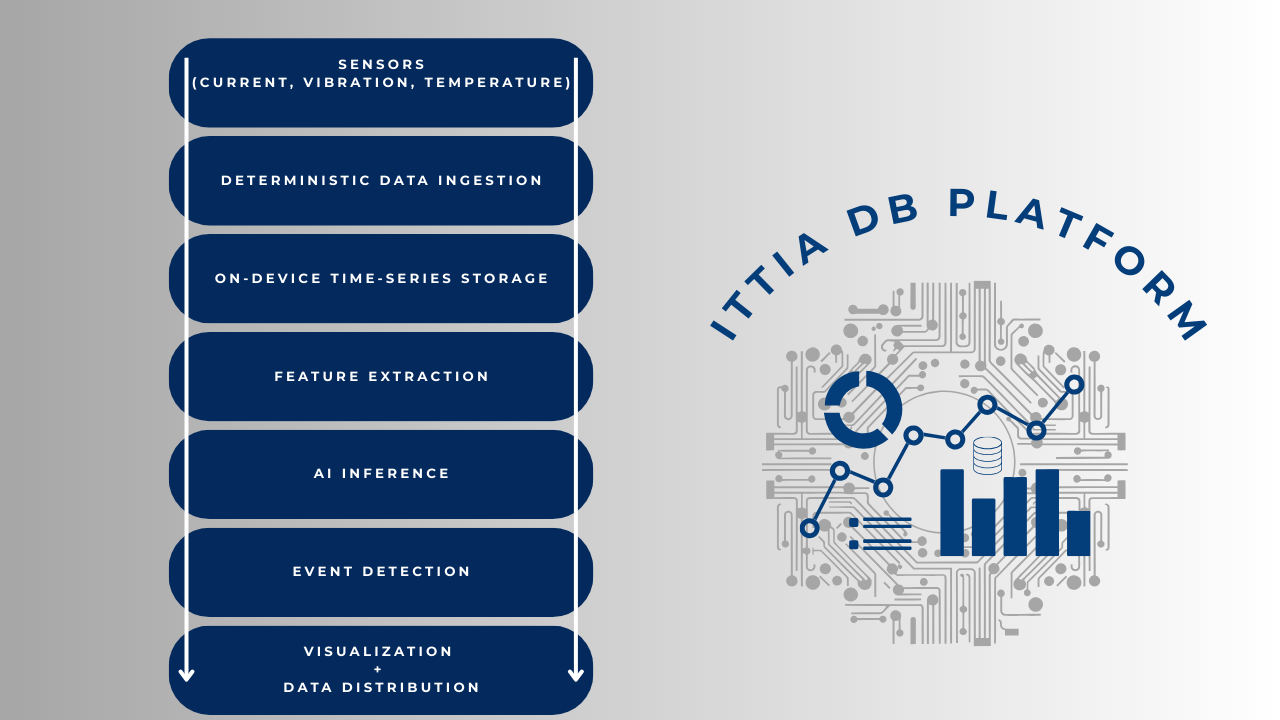
For example, an HVAC system could detect:
- Early bearing wear in blower motors
- Compressor inefficiencies due to refrigerant imbalance
- Ventilation fan vibration anomalies
- Motor overheating due to airflow restrictions
By detecting these issues early, systems can trigger maintenance alerts, adjust operating parameters, or prevent catastrophic failures.
But for this pipeline to work, sensor data must be captured and organized reliably at the edge.
The Role of ITTIA DB Platform
The ITTIA DB Platform, including ITTIA DB Lite, ITTIA DB, ITTIA Analitica, and ITTIA Data Connect, provides a complete embedded data infrastructure for intelligent HVAC systems.
ITTIA DB Lite – On-Device Data Management
Running directly on microcontrollers and embedded processors, ITTIA DB Lite enables deterministic capture and power-fail-safe storage of HVAC sensor signals. Motor telemetry such as vibration, current, and temperature is stored as structured time-series data, making it immediately usable for Edge AI processing.
ITTIA DB – Advanced Edge Data Processing
For more capable edge processors and building gateways, ITTIA DB manages larger operational datasets, enabling deeper analysis of HVAC performance across multiple devices or subsystems.
ITTIA Analitica – Visualization and Operational Insight
ITTIA Analitica allows engineers and operators to visualize HVAC performance through dashboards and analytics tools. It enables investigation of anomalies, comparison of motor health metrics, and tracing AI predictions back to raw sensor signals.
ITTIA Data Connect – Secure Data Distribution
ITTIA Data Connect securely synchronizes device insights with building management systems or cloud platforms. This allows fleet-wide monitoring, AI model retraining, and optimization of HVAC system performance across multiple installations.
Use Case: Self-Monitoring HVAC System with ITTIA DB Platform
In a modern commercial building, HVAC infrastructure is evolving into a self-monitoring and self-optimizing system capable of continuously evaluating its own mechanical health.
Each air handling unit contains motors driving blower fans, compressors, and ventilation systems. These components are equipped with sensors that measure vibration, motor current, temperature, airflow, and rotational speed. The embedded controller inside the HVAC unit runs ITTIA DB Lite, which deterministically captures these high-frequency sensor signals and stores them as structured time-series data directly on the device.
Using this data, the system generates feature windows for Edge AI models that detect abnormal vibration patterns, airflow restrictions, or compressor inefficiencies. When the AI model identifies early signs of motor degradation, the system can automatically adjust fan speed, reduce mechanical stress, or alert maintenance teams before a failure occurs.
ITTIA DB can operate on a building gateway to aggregate operational data from multiple HVAC units, enabling facility managers to analyze long-term performance trends. With
ITTIA Analitica, engineers can visualize motor health metrics, investigate anomalies, and trace predictions back to raw sensor signals. Meanwhile, ITTIA Data Connect securely distributes summarized diagnostics and performance metrics to building management systems or cloud platforms for fleet-wide optimization. The result is an HVAC infrastructure that continuously observes its own operation, predicts maintenance needs, reduces unexpected downtime, and optimizes energy efficiency, while minimizing costly field service visits.
Benefits for HVAC Manufacturers and Building Operators
By combining Edge AI with embedded data management, HVAC systems gain powerful new capabilities:
- Predictive maintenance for blower and compressor motors
- Reduced downtime and maintenance costs
- Improved energy efficiency
- Early detection of mechanical degradation
- Better diagnostics for field service teams
- Long-term visibility into equipment behavior
Most importantly, manufacturers and operators gain continuous insight into how HVAC systems perform in real-world environments.
The Future of Intelligent HVAC Systems
HVAC infrastructure is evolving toward self-monitoring and self-optimizing systems capable of understanding their own mechanical health. These intelligent systems will continuously observe motor behavior, analyze operational patterns, and adapt to maintain efficiency and reliability.
However, this intelligence is only possible when data is captured, structured, and managed reliably at the edge. By providing deterministic, embedded data management for Edge AI pipelines, the ITTIA DB Platform enables HVAC systems to transform raw motor signals into actionable intelligence, helping create smarter buildings, more efficient energy usage, and more resilient mechanical infrastructure.
