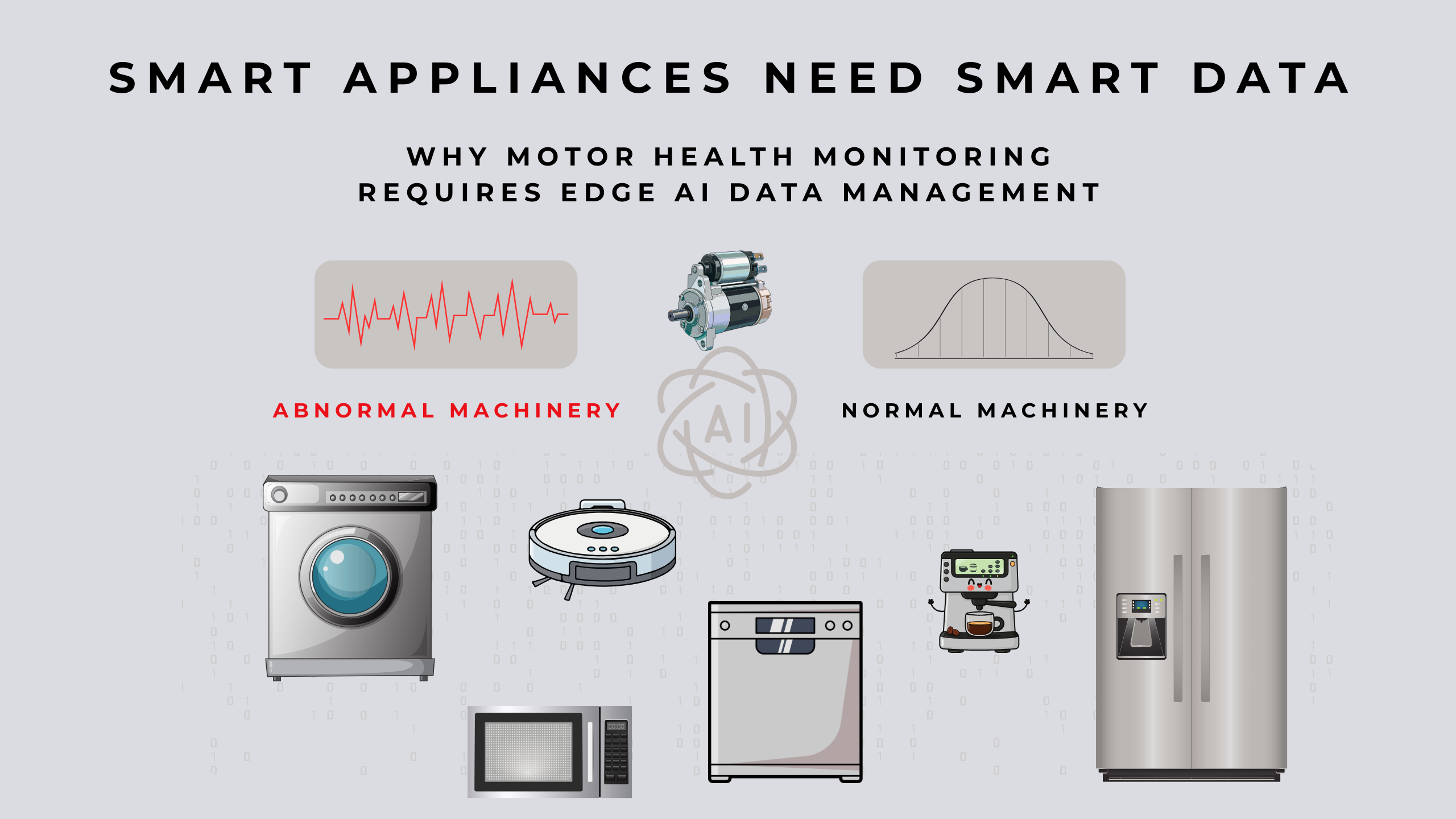
Smart Appliances Need Smart Data
Why Motor Health Monitoring Requires Edge AI Data Management
Modern smart appliances, from washing machines and refrigerators to HVAC systems and robotic cleaners, are powered by electric motors that operate continuously in demanding conditions. These motors are the mechanical heartbeat of the device, responsible for driving compressors, pumps, fans, and actuators that keep appliances functioning reliably.
As appliances become increasingly connected and intelligent, manufacturers are turning to Edge AI to monitor motor health directly inside the device. By analyzing signals such as vibration, current, temperature, and rotational speed, appliances can detect early signs of wear, imbalance, or mechanical degradation before a failure occurs.
However, successful Edge AI does not begin with the AI model. It begins with data management.
Without reliable, structured, and deterministic data handling on the device, AI models cannot deliver trustworthy results. This is where data-centric architecture and embedded data platforms become essential.
The Hidden Challenge: Managing Motor Data on Smart Devices
Motor health monitoring requires continuous observation of physical signals. These signals are typically high-frequency time-series data streams that must be captured and processed reliably on embedded hardware. Typical signals include:
- Motor current signatures
- Vibration patterns
- Rotor speed and torque measurements
- Temperature readings
- Voltage fluctuations
These signals must be captured in real time and transformed into structured datasets that AI models can understand. Without proper data management, devices face several challenges:
- Lost sensor data during power interruptions
- Unstructured logs that cannot be used by AI models
- Inconsistent feature windows
- High latency caused by inefficient data pipelines
- Limited ability to trace predictions back to raw signals
These problems often result in unreliable predictions and missed early warning signs. To make Edge AI truly effective, appliances need a deterministic data foundation.
Why Edge AI Data Management Matters
Edge AI systems depend on several stages of data processing before an AI model can generate meaningful insights. The device must be able to:
- Capture sensor signals deterministically
- Store structured time-series data safely
- Generate feature windows for AI models
- Execute real-time inference
- Trigger actions or alerts
Each of these stages requires reliable data handling.
A robust edge data platform ensures:
- Data integrity even during power interruptions
- Deterministic ingestion of sensor signals
- Efficient feature generation pipelines
- Low-latency query and analytics capabilities
- Traceability from sensor data to AI decisions
This is the foundation for trustworthy Edge AI systems.
The Role of ITTIA DB Platform in Smart Appliances
The ITTIA DB Platform provides embedded data management designed specifically for edge devices such as microcontrollers, microprocessors and embedded processors used in smart appliances. It enables appliance manufacturers to build data-centric Edge AI systems that manage sensor data directly on the device. Key capabilities include:
- Deterministic Sensor Data Ingestion: High-frequency signals from motors and sensors can be captured reliably with predictable latency, ensuring that important events are never lost.
- Power-Fail-Safe Storage: Motor telemetry and operational logs are stored transactionally, protecting critical data even if power is interrupted.
- Time-Series Data Management: Sensor streams are organized into structured time-series datasets that support efficient queries and feature extraction.
- Feature Window Materialization: Sliding windows of data can be generated directly on the device, providing AI models with the contextual data needed for anomaly detection and predictive maintenance.
- Efficient Resource Usage: Optimized storage and processing allow advanced data pipelines to run on constrained devices such as microcontrollers.
From Raw Motor Signals to Edge Intelligence
With the right data architecture, smart appliances can transform raw signals into actionable insights. Typical processing flow includes:
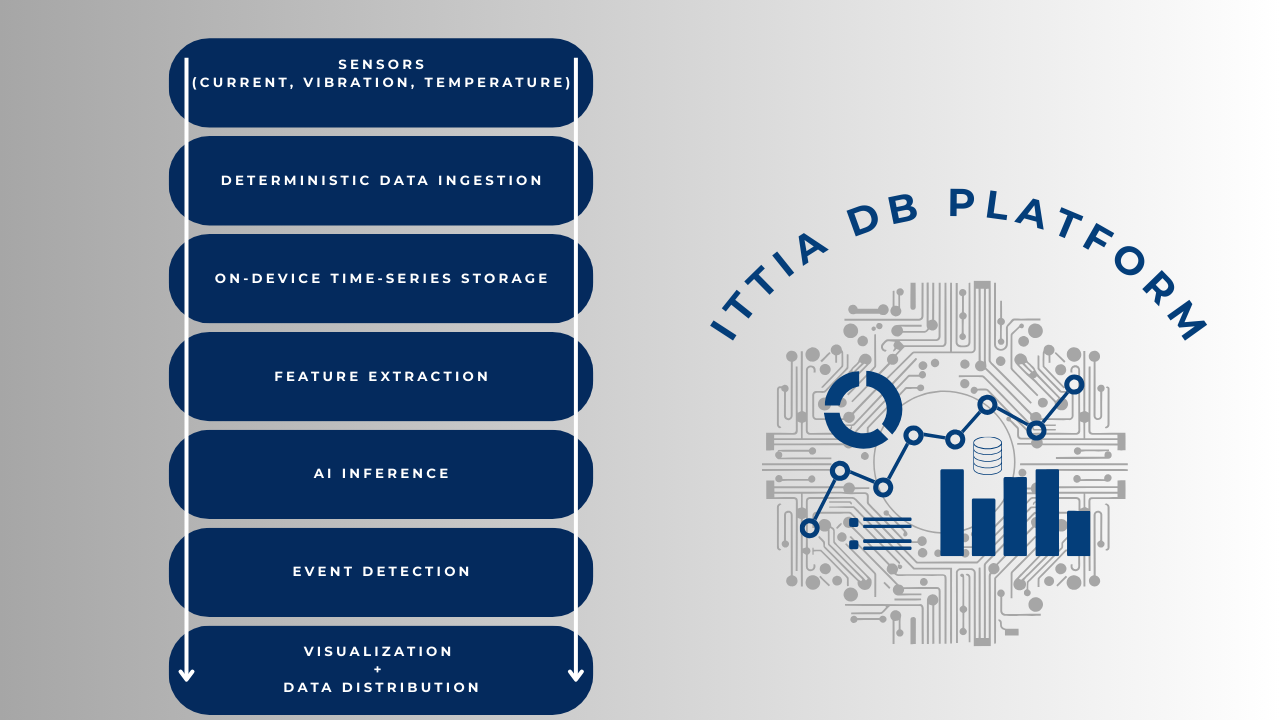
For example, a washing machine motor could detect abnormal vibration patterns during the spin cycle. Modern washing machines rely on high-performance electric motors to drive the drum through multiple operating cycles such as washing, rinsing, and high-speed spinning. These motors operate under varying loads, vibration patterns, and thermal conditions.
Over time, issues such as bearing wear, imbalance, overheating, or electrical degradation can develop. Detecting these conditions early requires continuous monitoring of signals such as motor current, vibration, temperature, and rotational speed, and converting those signals into meaningful health indicators.
The ITTIA DB Platform, including ITTIA DB Lite, ITTIA DB, ITTIA Analitica, and ITTIA Data Connect, enables a complete data-centric architecture for washing machine motor health management. ITTIA DB Lite runs directly on the embedded controller inside the appliance, capturing and storing motor telemetry such as vibration, current, and temperature as deterministic time-series data while ensuring power-fail-safe persistence. This structured data allows the device to build feature windows for Edge AI models that detect anomalies such as imbalance during the spin cycle or early signs of bearing wear.
ITTIA DB can operate on more capable processors or appliance gateways to manage larger datasets, logs, and historical motor performance across multiple appliances. ITTIA Analitica enables engineers and service teams to visualize motor behavior, analyze operational trends, and investigate anomalies through dashboards and queries that trace AI predictions back to raw signals. Finally, ITTIA Data Connect securely distributes summarized insights, diagnostic logs, and health metrics to fleet management systems or cloud platforms for continuous improvement of AI models and product reliability.
Together, the ITTIA DB Platform transforms washing machines from simple appliances into data-driven intelligent systems capable of monitoring motor health, predicting failures, optimizing performance, and improving product longevity through Edge AI and reliable on-device data management.
The device can then:
- Adjust motor speed
- Alert the user about potential maintenance
- Log diagnostic data for service technicians
- Prevent catastrophic motor failure
This intelligence happens locally on the appliance, without relying on cloud connectivity.
Benefits for Appliance Manufacturers
By integrating ITTIA DB Platform embedded data management with Edge AI, manufacturers can deliver more reliable and intelligent products.
Key benefits include:
- Predictive maintenance for motors and compressors
- Reduced warranty costs and service calls
- Improved product reliability
- Real-time device diagnostics
- Enhanced energy efficiency
- Longer appliance lifespan
Most importantly, manufacturers gain long-term visibility into how devices actually behave in real-world conditions by continuously collecting and analyzing operational data such as motor load, vibration patterns, temperature changes, and usage cycles. Instead of relying only on laboratory testing or limited field reports, this real operational data reveals how components perform over months and years across thousands of devices.
With this insight, engineers can identify emerging failure patterns, improve predictive maintenance models, refine Edge AI algorithms, and optimize hardware and firmware design in future product generations. This feedback loop between deployed devices and engineering teams enables continuous improvement of AI models, product reliability, energy efficiency, and overall appliance performance.
The Future of Smart Appliances
Smart appliances are rapidly evolving from simple connected devices into autonomous systems capable of understanding and managing their own mechanical health. Modern appliances such as washing machines, HVAC units, coffee machines, and robotic cleaners now integrate sensors, Edge AI models, and embedded software that monitor motors, pumps, compressors, and other mechanical components in real time. These systems are often built using a combination of microcontrollers (MCUs) for real-time control and signal acquisition and microprocessors (MPUs) for higher-level analytics, connectivity, and user interfaces. As a result, large volumes of sensor signals, operational logs, and AI-generated insights must be captured, structured, and orchestrated efficiently across these embedded systems. Effective data management ensures that raw signals are transformed into reliable time-series datasets, feature windows for AI models, and actionable health metrics. When data flows seamlessly between MCUs, MPUs, and analytics layers, smart appliances can detect anomalies, predict component wear, and optimize performance, enabling a new generation of self-aware, resilient, and intelligent devices.
Edge AI makes this possible, but only when supported by reliable data infrastructure.
The future of intelligent appliances will be driven by systems that can:
- Capture sensor data deterministically
- Manage time-series data locally
- Generate AI-ready features in real time
- Provide explainable insights into device behavior
By combining Edge AI with embedded data management, platforms like ITTIA DB Platform enable appliances to move beyond reactive operation toward predictive and self-optimizing systems.
The result is a new generation of smart appliances that are more reliable, efficient, and intelligent than ever before.
