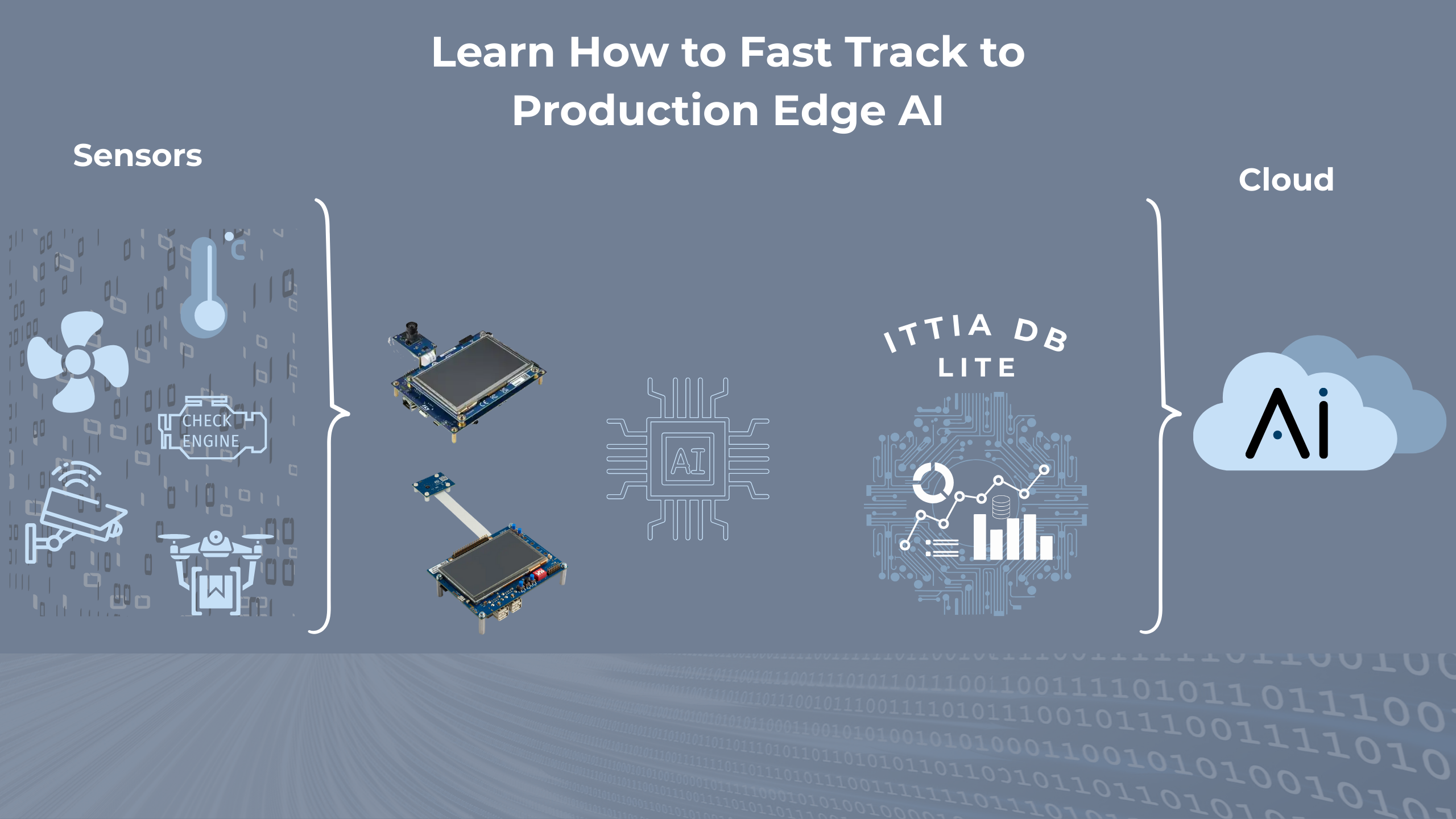
Learn How to Fast Track to Production Edge AI
Data-Centric Edge AI Application with ITTIA DB Platform
Building Edge AI is no longer just about training a model and flashing firmware. Real products, whether in automotive, industrial automation, medical devices, or energy systems, demand something much deeper: a data-centric architecture that is deterministic, resilient, explainable, and ready for deployment at scale.
If you’re learning how to build a production-ready Edge AI application, here’s the practical roadmap engineering teams follow in the real world, using the ITTIA DB Platform as the backbone.
Start with Data, Not Models
Edge AI is only as good as the data pipeline feeding it. Preparing and cleaning data on devices at the edge is a critical step in making AI reliable in real-world systems. Before any model can deliver meaningful results, raw sensor streams must be filtered, normalized, windowed, and structured to remove noise, handle outliers, and create consistent feature sets, all under tight resource and timing constraints. Performing this processing directly on the device preserves context, reduces latency, and enables explainable outcomes by keeping both raw and processed data available for correlation and validation. Platforms like the ITTIA DB Platform from ITTIA provide a deterministic foundation for this workflow, allowing engineers to persist time-series data, apply real-time cleaning pipelines, and feed AI models with high-quality inputs. The result is data-centric Edge AI: devices that don’t just run models, but continuously refine their data, improve inference accuracy, and support production-grade intelligence without depending on fragile firmware or constant cloud connectivity.
In production systems, your device must continuously handle:
- High-rate sensor ingestion (time-series, images, events)
- Local persistence (survives resets and power loss)
- Structured storage (not ad-hoc files)
- Historical querying
- Real-time preprocessing (filtering, normalization, windowing)
Most Edge AI projects fail before the first model ever runs, because data is treated as an afterthought. Edge data processing and management is the foundation of real-world Edge AI, transforming raw sensor streams into reliable, actionable intelligence directly on the device. Instead of treating data as transient, production systems persist, clean, normalize, and analyze time-series and event data locally, enabling deterministic behavior, power-fail safety, historical context, and explainable AI outcomes. Platforms like the ITTIA DB Platform provide this missing data layer by delivering structured on-device storage, real-time ingestion, embedded analytics, and AI-ready pipelines for microcontrollers and processors. The result is a data-centric Edge architecture where devices continuously observe, learn, and improve, supporting predictive maintenance, autonomous control, and software-defined products without relying on fragile logging code or constant cloud connectivity.
The ITTIA DB Platform provides deterministic embedded storage, time-series management, and AI-ready data pipelines directly on microcontrollers and processors. Instead of fragile logging code and RAM buffers, you get a production-grade data layer designed for long-running devices.
Design for Determinism and Reliability
Academic demos often ignore this step. Production teams cannot. Deterministic data management is essential for Edge AI systems that must operate reliably under real-world constraints. Unlike cloud environments, devices at the edge run with limited memory, strict timing requirements, and no tolerance for unpredictable latency or data loss. Determinism means every data operation, ingestion, storage, querying, and updates, executes within known bounds, survives power interruptions, and behaves consistently over long deployments. This is especially critical when AI models depend on continuous time-series data to detect anomalies, predict failures, or control physical processes. Platforms like the ITTIA DB Platform provide this foundation by delivering bounded-latency access, power-fail-safe persistence, and predictable memory usage directly on embedded devices. The result is Edge AI you can trust, where models are fed with reliable data, analytics remain explainable, and intelligent systems behave consistently from prototype through production.
A real Edge AI application must guarantee:
- Bounded latency for reads and writes
- Power-fail-safe data integrity
- Predictable memory usage
- Wear-aware flash access
- ISR/DMA-friendly ingestion paths
Clean and Prepare Data On-Device
Improving model accuracy at the edge goes hand in hand with reducing dependence on cloud connectivity through local data aggregation and cleaning. By filtering noise, removing outliers, normalizing signals, and aggregating time-series data directly on the device, Edge AI systems feed models with consistent, high-quality inputs, dramatically improving inference reliability while minimizing bandwidth and latency. Just as important, keeping both raw and processed data on-device preserves context for validation, explainability, and continuous improvement, even when connectivity is intermittent or unavailable. Platforms like the ITTIA DB Platform enable this data-centric workflow by providing deterministic storage and real-time processing pipelines that allow devices to aggregate, clean, and analyze data locally. The result is Edge AI that delivers higher accuracy, faster decisions, and true operational independence, turning embedded systems into intelligent products without relying on constant cloud access.
Before AI inference ever happens, your device must continuously perform embedded data engineering:
- Signal filtering
- Outlier removal
- Normalization
- Sliding windows
- Feature extraction
With the ITTIA DB Platform, both raw and processed signals are stored locally, enabling:
- Traceability from AI results back to original sensor data
- Validation of model behavior
- Explainable anomaly detection
- Long-term trend analysis
Doing this on the device dramatically improves model accuracy and reduces dependence on cloud connectivity.
Integrate AI as Part of the Data Pipeline
AI on MCUs and MPUs is reshaping embedded systems by bringing intelligence directly to constrained devices and edge processors, enabling real-time decisions without relying on the cloud. MCUs excel at ultra-low-power sensing, deterministic control, and on-device inference, while MPUs add higher compute, richer operating systems, and advanced analytics, together forming a powerful Edge AI continuum. Devices make it possible to deploy models across this spectrum, but production success depends on how data is managed around the AI. That’s where the ITTIA DB Platform plays a critical role, providing deterministic on-device storage, time-series ingestion, and AI-ready pipelines that unify MCUs and MPUs into a data-centric Edge architecture. The result is embedded AI systems that don’t just run models, but continuously collect, clean, analyze, and learn from data, delivering reliable intelligence from tiny microcontrollers all the way to application-class processors.
In production systems, AI is not a standalone component, it’s just another stage in the data flow: The ITTIA DB Platform persists inference results alongside historical context, making it possible to:
This tight integration turns Edge AI from a black box into an observable, explainable system. | 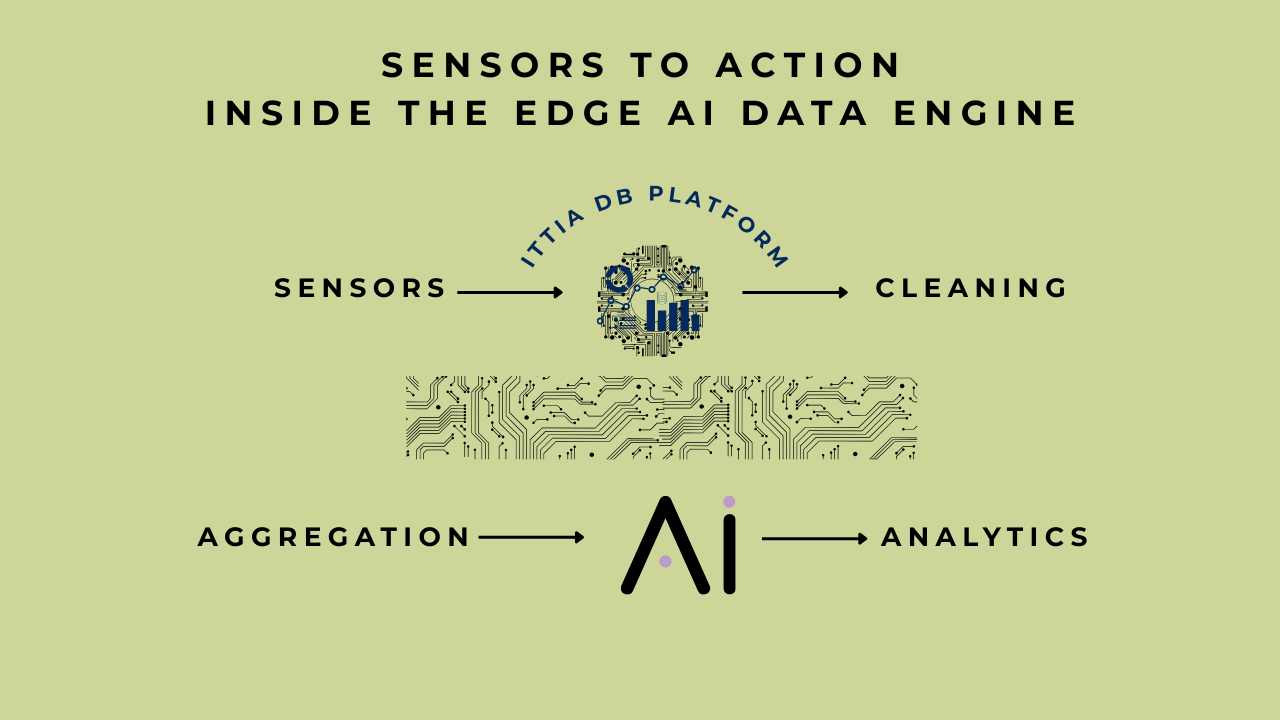 |
Close the Loop with Embedded Analytics
Production Edge AI doesn’t stop at inference. Data visualization on the PC plays a critical role in Edge AI by turning raw device data into clear, actionable insight for developers, operators, and product teams. By streaming structured time-series data, inference results, and health metrics from devices to a desktop dashboard, engineers can visually correlate sensor signals with AI predictions, validate model behavior, and diagnose issues in real time. Solutions like the ITTIA Analitica enable this workflow by securely synchronizing on-device data with PC-based tools for plotting, trend analysis, and explainability, without disrupting deterministic operation at the edge. The result is a powerful development and operations loop where Edge AI systems become observable and measurable, accelerating debugging, improving model accuracy, and shortening the path from prototype to production.
ITTIA Analitica is designed to offer developers closer look at important metrics such as:
- Local dashboards
- Health indicators
- Anomaly timelines
- Confidence scoring
- Remaining-useful-life estimates (i.e. batteries)
With ITTIA’s embedded analytics capabilities layered on top of the data foundation, raw predictions become actionable insight, directly on the device, even when offline.
This is how Edge AI evolves into operational intelligence.
Think Lifecycle, Not Demo
Production-ready Edge AI doesn’t stop at deployment, it must power the entire product lifecycle, from manufacturing validation and field diagnostics to model retraining, regulatory documentation, and long-term data retention. That’s where the ITTIA DB Platform makes the difference. By delivering deterministic, power-fail-safe, on-device data management, ITTIA DB Platform creates a single, trusted data foundation that spans prototype, production, and maintenance. Instead of disconnected tools and brittle pipelines, teams gain continuous visibility, explainable intelligence, and lifecycle-ready Edge AI, turning products into living systems that evolve, improve, and deliver value long after they leave the factory floor.
Conclusion
Learning to build production-grade Edge AI requires a fundamental shift in mindset, from model-first to data-first, from fragile RAM buffers and ad-hoc log files to deterministic embedded data management with the ITTIA DB Platform, and from one-off demos to lifecycle-ready systems. When structured on-device data management is combined with embedded analytics and Edge AI, you don’t just create smart devices, you build intelligent systems that continuously observe, learn, explain, and improve in real-world conditions. That’s what it truly means to deliver production-ready, data-centric Edge AI: a reliable foundation where data, analytics, and AI work together to power resilient products from prototype through deployment and beyond.
