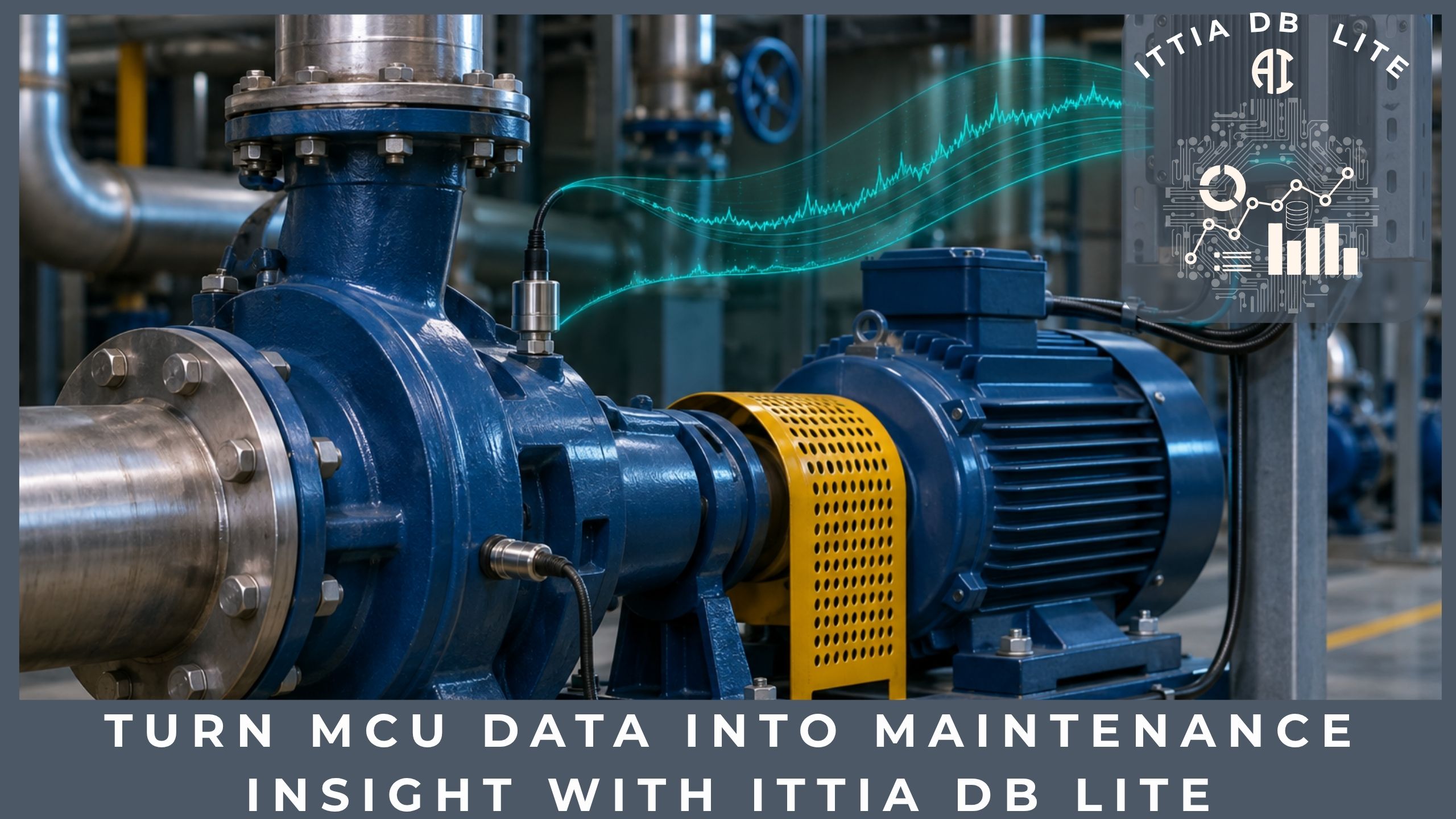
Turn MCU Data into Maintenance Insight with ITTIA DB Lite
Connect measurements, AI results, and service history to guide maintenance decisions
A vibration warning tells a maintenance team that something deserves attention. Understanding that warning requires context: Was the machine carrying a heavier load? Had its speed changed? Did the unusual behavior persist? Was a component recently replaced?
Microcontrollers often collect the measurements needed to answer these questions. They monitor vibration, current, temperature, pressure, and speed close to the equipment. With a deliberate local data strategy, they can also preserve the history needed to investigate what happened.
The ITTIA DB Lite product family provides an embedded data foundation for this work. ITTIA DB Lite supports streaming, time-series, and transactional data management on microcontrollers. ITTIA DB Lite AI extends that foundation with data preparation for edge AI workflows. Applications can use these capabilities to connect measurements, derived features, inference results, and operating events.
Give measurements their operating context
A measurement becomes more useful when engineers know the conditions under which it was collected. Consider a pump operating at different speeds and pressures throughout a shift. Higher vibration during heavy operation may be expected. The same vibration level under light load may deserve investigation. A microcontroller application can associate measurement windows with:
- Motor speed, load, and operating mode.
- Temperature, pressure, and current.
- Equipment identity and configuration revision.
- Sensor quality indicators and capture time.
Using ITTIA DB Lite to organize this history gives the application a basis for comparing similar operating conditions. Engineers can investigate whether a change reflects normal operation, a process disturbance, or a developing equipment issue.
A healthy baseline should come from identified, accepted operating conditions. Treating all historical measurements as healthy can allow an emerging fault to become part of the comparison baseline.
Turn sensor streams into useful AI inputs
Continuous sensor streams can produce more data than a resource-constrained device can retain indefinitely. A practical design combines compact summaries with selected detailed captures.
For example, a microcontroller may process a vibration window into measurements such as RMS, variance, and peak amplitude. These features summarize aspects of the signal that a rule or AI model can evaluate.
ITTIA DB Lite AI supports preparing sensor windows and statistical inputs for edge AI workflows. The application can associate those inputs with their source interval, processing settings, and operating conditions.
This connection matters after a firmware update. Changing a filter, window length, or scaling convention may change a feature value even when the equipment behaves the same way. Recording the processing revision helps engineers interpret trends correctly.
Preserve the evidence behind an alert
When an application detects unusual behavior, saving the warning alone leaves important questions unanswered. A useful event record connects the alert to the relevant sensor interval, calculated features, rule or model version, and application response. Where storage permits, the device can retain selected raw measurements from before and after the event. This creates inference lineage: a traceable connection from the original measurements through processing to the AI result.
For example, an engineer reviewing a “possible bearing issue” warning should be able to identify which vibration window was evaluated, which features were calculated, and which model version produced the assessment. That record supports investigation; it does not, by itself, prove the diagnosis or fully explain the model’s internal reasoning.
A practical pump-monitoring example
Imagine an industrial pump with a microcontroller monitoring vibration, motor current, and temperature. During normal operation, the application retains compact summaries associated with speed and pressure. An edge AI model evaluates prepared features for unusual patterns. If the model flags an anomaly, the application records the result and associates it with the feature values, model version, operating state, and selected sensor history.
A technician later discovers an alignment problem and records the adjustment as a service event. Subsequent measurements belong to a new comparison period, allowing engineers to assess whether the symptom returned under similar conditions.
The microcontroller collects sensor measurements, prepares features for AI assessment, and uses ITTIA DB Lite to preserve the connected history for maintenance review.
Illustrative C code
The following example calculates a vibration feature, runs an AI assessment, and saves the feature record and inference result as one transaction.
The database and AI functions are application-defined placeholders, not actual ITTIA API calls. Vibration samples are assumed to be calibrated and centered around zero. The model and alert threshold must be validated for the intended equipment and operating conditions.
#include <math.h>
#include <stddef.h>
#include <stdint.h>

#define MODEL_VERSION   3u
#define FEATURE_VERSION 1u

typedef struct {
    uint64_t window_id;
    uint64_t timestamp_ms;
    float vibration_rms;
    float motor_current_a;
    float temperature_c;
    uint32_t speed_rpm;
    uint32_t feature_version;
} FeatureRecord;

typedef struct {
    uint64_t window_id;       /* Links result to its input features */
    uint32_t model_version;
    float anomaly_score;     /* Model-defined score, not probability */
    uint8_t alert;
} InferenceRecord;

/* Application adapters implemented with the selected SDKs. */
extern float run_motor_model(const FeatureRecord *features);
extern float validated_alert_threshold(void);

/*
 * History adapters wrap ITTIA DB Lite operations.
 * A failed commit must leave the transaction available for rollback.
 */
extern int history_begin(void);
extern int history_insert_features(const FeatureRecord *record);
extern int history_insert_inference(const InferenceRecord *record);
extern int history_commit(void);
extern void history_rollback(void);

int record_pump_assessment(
    const float *vibration,
    size_t sample_count,
    uint64_t window_id,
    uint64_t timestamp_ms,
    float current_a,
    float temperature_c,
    uint32_t speed_rpm)
{
    if (vibration == NULL || sample_count == 0)
        return -1;

    float sum_squared = 0.0f;

    for (size_t i = 0; i < sample_count; ++i)
        sum_squared += vibration[i] * vibration[i];

    FeatureRecord features = {
        .window_id = window_id,
        .timestamp_ms = timestamp_ms,
        .vibration_rms = sqrtf(sum_squared / (float)sample_count),
        .motor_current_a = current_a,
        .temperature_c = temperature_c,
        .speed_rpm = speed_rpm,
        .feature_version = FEATURE_VERSION
    };

    float score = run_motor_model(&features);

    InferenceRecord inference = {
        .window_id = window_id,
        .model_version = MODEL_VERSION,
        .anomaly_score = score,
        .alert = (score >= validated_alert_threshold())
    };

    /* Save features and their AI result as one consistent unit. */
    if (history_begin() != 0)
        return -2;

    if (history_insert_features(&features) != 0 ||
        history_insert_inference(&inference) != 0) {
        history_rollback();
        return -3;
    }

    if (history_commit() != 0) {
        history_rollback();
        return -4;
    }

    return 0;
}
The shared window identifier connects the AI result to the feature record used to produce it. The application should assign identifiers that remain unique across restarts. Feature and model versions help engineers interpret results after software changes.
Saving both records in one transaction keeps their association consistent. For traceability to the original signal, the application would also retain selected raw samples and capture metadata linked to the same window identifier.
This example illustrates the data relationship. A production implementation also needs input-quality checks, error handling, retention policies, and integration with the selected AI runtime.
Design history around microcontroller resources
Memory, processing time, storage capacity, and flash endurance shape every MCU implementation. A practical retention strategy may keep compact feature history for longer periods while preserving detailed waveforms around selected events. Repeated alerts need a defined policy so that one persistent symptom does not consume all available storage.
Database activity also needs an explicit place in the application’s schedule. Acquisition buffers, database tasks, and diagnostic queries should have defined resource budgets. The design should specify what happens when a queue fills or storage reaches its limit.
Run the example’s processing and database work in an appropriately scheduled task. Timing and recovery behavior must be validated on the selected microcontroller, RTOS, storage medium, and workload. For applications with strict deadlines, measure data operations during peak acquisition, repeated alerts, queries, and storage maintenance.
Connect maintenance work to measurable outcomes
Replacing a bearing, adjusting alignment, or changing a sensor affects how later measurements should be interpreted. Recording those interventions alongside equipment history helps teams compare behavior before and after service. It also helps engineers evaluate whether an alert was useful, premature, or unrelated to the eventual finding.
Anomaly detection and remaining-life prediction require different evidence. Detecting an unusual pattern does not establish how long a component will continue operating. Remaining-life estimates require an appropriate, validated method.
Start with a specific maintenance question, then evaluate whether the retained data helps answer it. Useful measures can include investigation time, repeat symptoms after service, and the proportion of alerts that lead to confirmed findings.
Build maintenance intelligence close to the equipment
The ITTIA DB Lite product family helps developers give microcontroller applications a persistent, organized record of equipment behavior. ITTIA DB Lite provides streaming, time-series, and transactional data management for MCU applications. ITTIA DB Lite AI supports preparing data for edge AI workflows. An application can use this foundation to connect sensor history, AI inputs, inference results, and maintenance events while network connectivity is unavailable.
With connected equipment history, engineers can investigate warnings, compare equivalent operating conditions, and assess whether maintenance addressed the underlying symptom.
Contact ITTIA to discuss your microcontroller platform, sensor workload, and predictive maintenance goals. Request a demo and available demo source code to explore how the ITTIA DB Lite product family can support your application.
