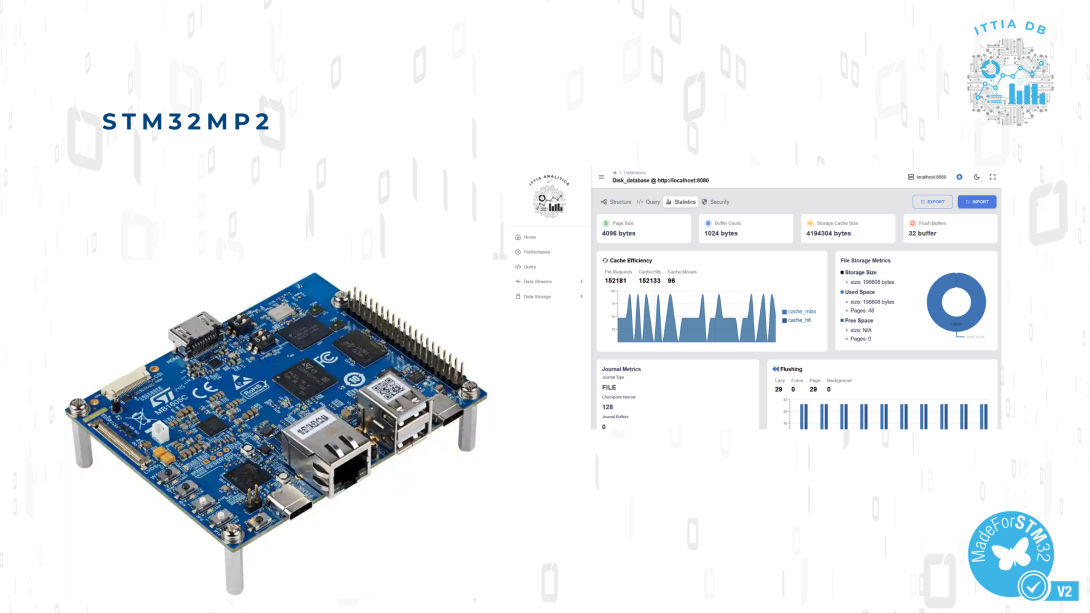
Unleash Real-Time Data Intelligence with Advanced Edge Computing
Overview
The STM32MP2 family combines powerful Cortex-A application cores, a Cortex-M real-time subsystem, and integrated AI acceleration, making it an ideal platform for connected edge systems. By integrating ITTIA DB, developers gain a secure, high-performance embedded database that enables the STM32MP2 to manage structured and time-series data efficiently across both Linux and RTOS domains. ITTIA DB ensures ACID-compliant transactions, concurrent multi-core access, and SQL query support, allowing applications to reliably collect sensor data, process it in real time, and share results across system components or with the cloud. For data-centric use cases such as industrial gateways, robotics, smart energy, and connected healthcare, ITTIA DB provides a foundation for local analytics, predictive maintenance, and AI-driven decision-making, reducing latency, ensuring data integrity, and conserving bandwidth by transmitting insights instead of raw data. Together, STM32MP2 and ITTIA DB empower developers to deliver intelligent, resilient, and future-proof embedded solutions.
Case Study
The STM32MP2 family builds upon the STM32MP1 by delivering enhanced performance, graphics acceleration, and security features, with multi-core Cortex-A processors, integrated AI capabilities, and real-time control through an Arm Cortex-M subsystem. This makes STM32MP2 an excellent choice for industrial gateways, human-machine interfaces (HMIs), robotics, and connected medical devices. ITTIA DB brings enterprise-grade database capabilities, ACID transactions, SQL, time-series management, and concurrency control, directly to the STM32MP2 platform, enabling secure, scalable, and intelligent embedded data solutions.
Use Case: Predictive Maintenance Gateway for Industrial Robotics
Challenge
A robotics integrator required a high-performance gateway based on STM32MP2 to:
- Collect continuous data streams from vibration and temperature sensors embedded in robotic joints.
- Execute real-time anomaly detection locally without cloud dependence.
- Provide secure multi-user access to data logs and live analytics.
- Support AI-enhanced predictive maintenance models for failure prevention.
System Architecture
- Hardware: STM32MP25 (Dual Cortex-A + Cortex-M core, AI accelerator, 3D graphics engine)
- Connectivity: Gigabit Ethernet, CAN-FD, RS485, Wi-Fi/BT module
- Software Stack (Cortex-A cores):
- Linux: ITTIA DB, AI runtime, cloud sync, web-based HMI
- Database: ITTIA DB (multi-threaded, ACID compliant)
- Visualization: ITTIA Analitica
- Data distribution: ITTIA Data Connect controller
- Software Stack (Cortex-M core):
- RTOS: Real-time sensor polling and preprocessing
- Database: ITTIA DB Lite
- Data distribution: ITTIA Data Connect agent
Implementation
Database Schema
CREATE TABLE robot_joint_data (
    sample_time   TIMESTAMP,
    joint_id      INTEGER,
    temperature_C FLOAT NOT NULL,
    vibration_RMS FLOAT NOT NULL,
    torque_Nm     FLOAT NOT NULL,
    PRIMARY KEY (sample_time, joint_id)
);

CREATE TABLE maintenance_alerts (
    alert_id    INTEGER GENERATED BY DEFAULT AS IDENTITY PRIMARY KEY,
    alert_time  TIMESTAMP NOT NULL,
    joint_id    INTEGER NOT NULL,
    issue_type  VARCHAR(32),
    severity    INTEGER
);
- Time-series storage of sensor telemetry for each robotic joint.
- Alerts table for logging AI-detected anomalies.
Data Flow
- Cortex-M core collects sensor readings every 10 ms and logs them into ITTIA DB.
- Cortex-A cores run ITTIA DB queries and AI inference to detect early signs of wear.
- HMI applications query the database to display live joint status and historical data.
Real-Time Queries
Operators use ITTIA DB to run real-time analytics directly on the device:
SELECT joint_id, AVG(vibration_RMS), MAX(temperature_C)
  FROM robot_joint_data
  WHERE sample_time >= utc_timestamp - interval '5' minute
GROUP BY joint_id;- Returns average vibration and peak temperature per joint for the last 5 minutes.
- If thresholds exceed safe limits, an entry is inserted into maintenance_alerts.
AI Integration
- An AI model, accelerated by STM32MP2’s built-in neural processing support, predicts time-to-failure for each robotic joint.
- Prediction results are logged in maintenance_alerts and synchronized with the cloud for fleet-level monitoring.
Results
Metric | Value |
| Insert latency (1 row) | ~40 µs (transactional) |
| Query latency (100k rows) | < 10 ms |
| ITTIA DB footprint | ~500 KB RAM, 800 KB Flash (config.) |
| Local retention | > 1 month of continuous sensor logs |
| Network bandwidth savings | ~85% (insight upload vs raw data) |
| AI inference speed | ~3× faster with MP2 acceleration |
Benefits
- High-performance edge analytics: fast queries over large datasets in real time.
- Hybrid data management: shared database access across Linux apps, AI workloads, and RTOS tasks.
- Enterprise-grade reliability: ACID transactions, concurrency, and data integrity.
- AI-driven predictive maintenance: reduces downtime and improves robot lifespan.
- Secure and scalable: ITTIA DB encryption and access control for industrial security requirements.
Conclusion
By combining STM32MP2’s heterogeneous processing power with ITTIA DB’s advanced embedded database features, developers can deliver intelligent, secure, and resilient edge computing platforms. This solution not only addresses predictive maintenance in industrial robotics but also applies to connected healthcare, energy systems, automotive gateways, and smart cities, where low-latency AI-enhanced data management is essential.
