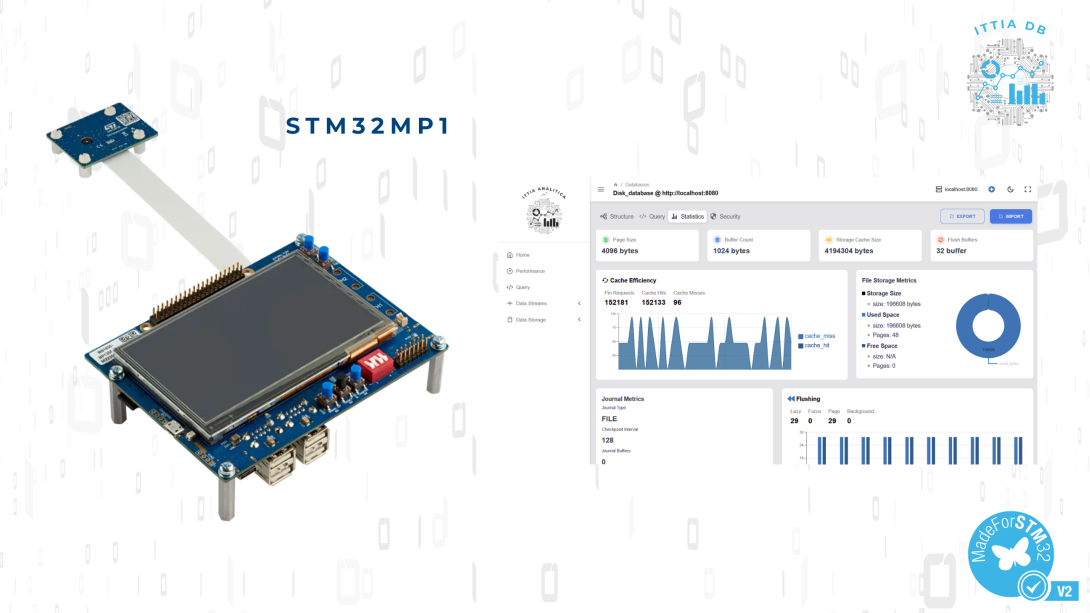
Multicore Processing, Rich Connectivity and Efficient Data Management
Overview
ITTIA DB adds robust and efficient data management to the STM32MP1 microprocessor, transforming it into a secure and intelligent edge computing platform. With dual Cortex-A7 cores running Linux and a Cortex-M4 real-time core, STM32MP1 can aggregate data from multiple industrial or IoT endpoints, while ITTIA DB provides structured relational and time-series storage, compression, and secure SQL access. This allows developers to reliably capture, query, and analyze large datasets locally, ensuring real-time responsiveness on the M4 side and advanced analytics or AI integration on the A7/Linux side. By transmitting only processed insights rather than raw data, systems built on STM32MP1 with ITTIA DB reduce bandwidth consumption, improve reliability in offline scenarios, and maintain strong data security. This combination is ideal for industrial gateways, medical equipment, robotics, and smart energy controllers where both real-time control and Linux-based services must work together with consistent, reliable data.
Case Study
The STM32MP1 series is a heterogeneous multiprocessor that integrates dual Cortex-A7 cores (Linux applications) with a Cortex-M4 core (real-time control). This unique combination makes it a strong fit for industrial gateways, robotics, smart energy systems, and medical devices where both high-level Linux services and deterministic MCU control are required. ITTIA DB complements this by offering a robust embedded relational and time-series database with secure transactions, SQL query support, concurrency control, and fault tolerance. Together, STM32MP1 and ITTIA DB form a complete edge data management solution, enabling real-time decision-making and scalable connectivity.
Use Case: Industrial Gateway with Secure Local Analytics
Challenge
An industrial automation vendor needed a gateway device capable of:
- Collecting and storing high-frequency sensor data from multiple PLCs, actuators, and wireless IoT sensors.
- Running deterministic queries and analytics locally, even during cloud outages.
- Providing secure multi-process access to data from both Linux applications and real-time tasks.
- Enabling predictive maintenance and anomaly detection with AI inference pipelines.
System Architecture
- Hardware: STM32MP157 (Dual A7 + Cortex-M4)
- Connectivity: Ethernet, CAN, RS485, Wi-Fi
- Software Stack (Cortex-A7 cores):
- Linux: ITTIA DB server, analytics applications, cloud integration
- Database: ITTIA DB (multi-core, multi-threaded, transactional)
- Visualization: ITTIA Analitica
- Data distribution: ITTIA Data Connect controller
- Software Stack (Cortex-M4 core):
- FreeRTOS: Real-time sensor acquisition and preprocessing
- Database: ITTIA DB Lite
- Data distribution: ITTIA Data Connect agent
Implementation
Schema & Data Model
CREATE TABLE ecg_data (
    sample_time TIMESTAMP,
    sensor_id   INTEGER,
    accel_x     FLOAT NOT NULL,
    accel_y     FLOAT NOT NULL,
    accel_z     FLOAT NOT NULL,
    vibration_RMS FLOAT NOT NULL,
    PRIMARY KEY (sample_time, sensor_id)
);

CREATE TABLE machine_events (
    event_id    INTEGER GENERATED BY DEFAULT AS IDENTITY PRIMARY KEY,
    event_time  TIMESTAMP NOT NULL,
    machine_id  INTEGER NOT NULL,
    event_type  VARCHAR(32),
    severity    INTEGER
);
- Time-series vibration data logged by the M4 core.
- Event logs for machine state transitions, recorded by Linux applications.
Real-Time Data Flow
- The M4 core continuously samples vibration sensors at 1 kHz.
- Raw readings are preprocessed (FFT → RMS calculation) and inserted into ITTIA DB.
- Transactional guarantees ensure data integrity across cores.
Querying & Analytics
On the A7/Linux side, operators run SQL queries for live monitoring:
SELECT sensor_id, AVG(vibration_RMS) AS avg_vibration_RMS
FROM vibration_data
WHERE sample_time >= utc_timestamp - interval '60' second
GROUP BY sensor_id;- Detects abnormal vibration levels over the last minute.
- Alerts are triggered when thresholds are exceeded.
AI Integration
- A lightweight AI inference engine running on Linux fetches query results from ITTIA DB.
- The AI model predicts machine failures (bearing wear, misalignment).
- Results are logged back into the machine_events table, and summaries are transmitted securely to the cloud.
Results
Metric | Value |
| Insert latency (transaction, 1 row) | ~50–70 µs |
| Query latency (50k rows) | < 10 ms |
| ITTIA DB footprint | ~400 KB RAM, 600 KB Flash (config.) |
| Local storage capacity | Weeks of sensor data |
| Data integrity | Full ACID compliance |
| Bandwidth reduction | ~85% (summaries vs raw data) |
Benefits
- Hybrid workload support: Linux applications and M4 real-time tasks share a common database.
- Robust data management: ACID transactions, secure storage, and concurrent multi-core access.
- Real-time and historical analytics: Enables both fast queries and long-term analysis.
- AI-ready datasets: Structured data pipelines for machine learning and inference.
- Resilience: Works offline during cloud or network interruptions.
Conclusion
With STM32MP1 and ITTIA DB, developers can build next-generation industrial gateways, robotics controllers, and smart energy devices that combine real-time responsiveness, Linux scalability, and secure, structured data management. This partnership transforms STM32MP1 into a complete embedded edge database platform, enabling predictive maintenance, intelligent automation, and long-term data reliability.
