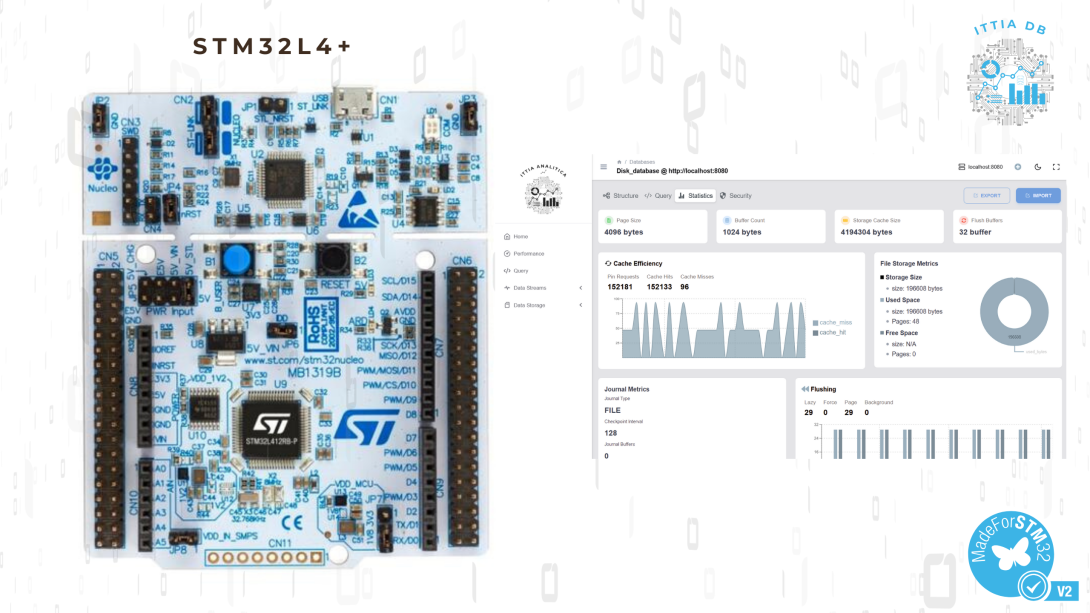
Maximize Efficiency With Ultra-Low Power For Edge Data Management
Overview
The STM32L4+ series, with its ultra-low power design, high memory capacity, and advanced Cortex-M4F core, is ideal for portable and energy-constrained devices. ITTIA DB Lite enhances these capabilities by providing structured storage, time-series logging, and local querying directly on the MCU. This allows developers to reliably collect and analyze sensor data in real time, while features like compression and batch commits reduce flash wear and extend device lifetime. By running analytics and even lightweight AI inference locally, STM32L4+ devices can make intelligent decisions without constant cloud connectivity, conserving bandwidth and power. The combination of STM32L4+ and ITTIA DB Lite transforms IoT nodes into self-sufficient, data-driven systems, well-suited for smart agriculture, medical devices, and environmental monitoring where long battery life, reliability, and real-time insight are critical.
Case Study
This case study demonstrates how STM32L4+ series microcontrollers combined with ITTIA DB Lite deliver energy-efficient, real-time, and reliable data management for remote sensing and portable IoT devices. The STM32L4+ integrates an Arm Cortex-M4F core up to 120 MHz, 2 MB Flash, and 640 KB SRAM, with enhanced graphics, DSP, and ultra-low power features. ITTIA DB Lite provides a lightweight relational database engine with time-series storage, compression, SQL queries, and deterministic transactions that fits within the limited footprint of MCUs. Together, they enable intelligent data logging, local analytics, and AI enablement directly at the edge.
Use Case: Smart Agriculture Sensor Node
Challenge
A precision agriculture company needs a solar-powered sensor hub that:
- Continuously records soil moisture, temperature, humidity, and light levels.
- Stores months of time-series history on-device.
- Analyzes trends locally to optimize irrigation.
- Transmits summaries and anomaly alerts over LoRaWAN to a central gateway.
- Operates under strict energy and memory constraints.
System Architecture
- MCU: STM32L4R9 (Cortex-M4F, 120 MHz, 2 MB Flash, 640 KB SRAM)
- Sensors: Soil moisture (ADC), temperature/humidity (I²C), light sensor (SPI)
- Comms: LoRaWAN module via UART
- Software Stack:
- OS: FreeRTOS/ Eclipse ThreadX RTOS /Zephyr
- Database: ITTIA DB Lite
- AI Model: NanoEdge AI Studio, LiteRT (TensorFlow Lite Micro) anomaly detection model for soil irrigation prediction
- Power: Energy harvesting with battery backup
- Visualization: ITTIA Analitica
- Data distribution to MPUs: ITTIA Data Connect
Implementation
Schema Design
CREATE TABLE soil_metrics (
    sample_time    TIMESTAMP PRIMARY KEY,
    soil_pct       FLOAT NOT NULL,
    temperature_C  FLOAT NOT NULL,
    humidity_kgpm3 FLOAT NOT NULL,
    light_lx       FLOAT NOT NULL
);

CREATE TABLE irrigation_events (
    event_time         TIMESTAMP PRIMARY KEY,
    action             VARCHAR(32) NOT NULL,
    confidence         FLOAT NOT NULL,
    start_time         TIMESTAMP NOT NULL,
    avg_soil_pct       FLOAT NOT NULL,
    avg_temperature_C  FLOAT NOT NULL,
    avg_humidity_kgpm3 FLOAT NOT NULL
);
Data Logging (C API Example)
#include "agriculture_sensor_database.h" // generated from schema

int main() {
   db_init_ex(DB_API_VER, NULL);
   open_agriculture_sensor_database("agriculture_sensor", NULL);
   // ...
}

void log_soil(uint32_t ts_ms, float soil, float temp, float hum, float lux) {
    db_t db;
    db_connect(&db, "agriculture_sensor", "ingestion", NULL, NULL);
    const soil_metrics_row_t row = {
        .sample_time    = ts_ms * 1000, // to microseconds
        .soil_pct       = soil,
        .temperature_C  = t,
        .humidity_kgpm3 = hum,
        .light_lx       = lux
    };
    put_soil_metrics(db, row);
    db_disconnect(db);
}- Records ingested every 10 seconds.
- Compression yields ~40% storage savings.
- Batch commits extend flash endurance.
Local Analytics
Each day, the device queries average soil, temperature, and humidity metrics to detect irrigation needs.
If soil moisture is below a threshold, an irrigation event is logged and a prediction model calculates confidence for irrigation action.
AI Integration
- ITTIA DB Lite retrieves the last N soil readings.
- TensorFlow Lite Micro model predicts water requirement.
- Results logged into irrigation_events.
- Alerts transmitted over LoRaWAN only when action required, saving bandwidth.
Results
Metric | Value |
| ITTIA DB Lite footprint | ~110 KB RAM + 170 KB Flash |
| Insert latency(1 row) | ~30 µs |
| Query last 24h (8,640 rows) | ~6 ms |
| Compression savings | ~40% |
| Battery autonomy (solar + backup) | > 12 months operation |
Benefits
- Ultra-low power efficiency: STM32L4+ Stop modes + ITTIA DB Lite batch writes maximize energy autonomy.
- Local intelligence: AI-assisted irrigation reduces water usage without cloud dependency.
- Data reliability: Transaction-safe storage ensures integrity during power loss.
- Efficient bandwidth use: Only critical events and summaries transmitted via LoRaWAN.
- Scalable architecture: Same database schema portable to STM32U5 (for enhanced security) or STM32H7 (for high-performance analytics).
Conclusion
By combining the energy-optimized STM32L4+ MCU with ITTIA DB Lite, developers can build intelligent, low-power, data-aware sensor systems that perform secure data management, local analytics and AI inference at the edge. This makes STM32L4+ with ITTIA DB Lite ideal for smart agriculture, portable healthcare, environmental monitoring, and energy metering, where battery life, reliability, and local decision-making are critical.
