Optimized Low-Power Data Processing & Management
Overview
ITTIA DB Lite brings significant advantages to STM32F4 microcontrollers, enabling them to move beyond simple control and signal processing toward true data-centric edge computing. With a Cortex-M4 core up to 180 MHz and ample peripherals, the STM32F4 is widely used in industrial automation, motor control, and IoT devices, yet applications often struggle with efficiently handling continuous streams of sensor data. ITTIA DB Lite solves this by offering structured storage, time-series logging, and on-device querying, so developers can reliably collect, filter, and analyze data locally with deterministic performance under tight memory budgets. Features like data compression reduce flash usage, while transactional integrity ensures data reliability even in harsh environments. By transmitting only processed results instead of raw data, STM32F4 devices save bandwidth and power, and with AI integration they can run predictive maintenance and anomaly detection models directly on the MCU. In short, ITTIA DB Lite transforms STM32F4 systems into intelligent edge devices with greater efficiency, reliability, and scalability.
Case Study
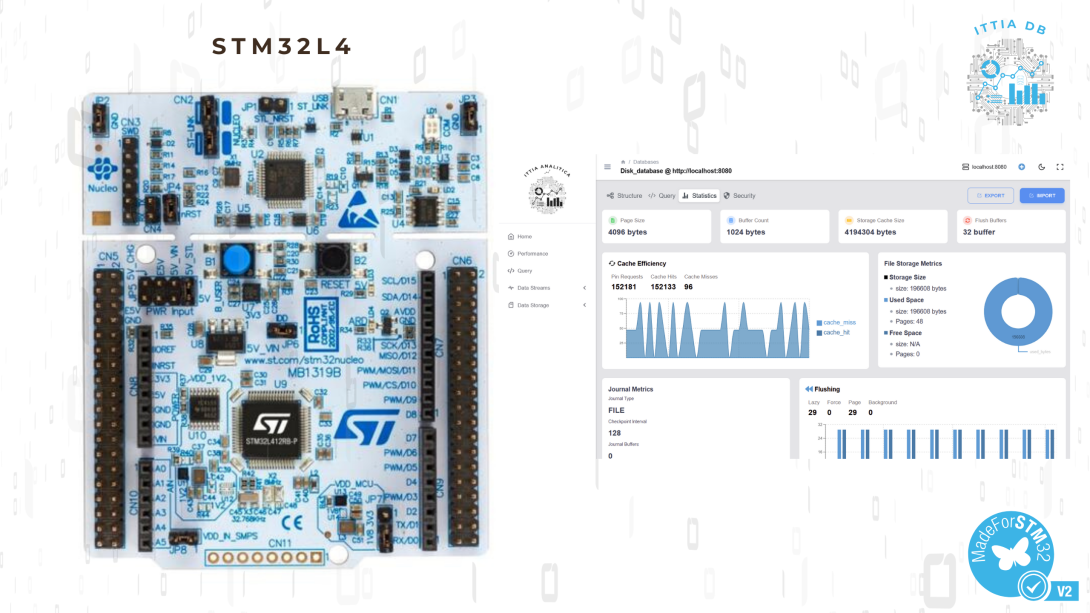
This case study explores how STM32L4 series MCUs combined with ITTIA DB Lite provide reliable, energy-efficient data management for remote IoT sensing and portable devices. STM32L4 offers an Arm Cortex-M4 core up to 120 MHz, ultra-low power operation, and up to 1 MB Flash / 320 KB SRAM, making it suitable for always-on sensing with strict energy budgets. ITTIA DB Lite complements this by enabling structured data collection, time-series storage, local queries, and compression, while fitting within the limited resources of the STM32L4. Together, they enable devices to securely log data, run lightweight analytics, and share only meaningful insights.
Use Case: Remote Environmental Monitoring Node
Challenge
An environmental monitoring company needs a battery-powered device that can:
- Continuously log temperature, humidity, and air quality data.
- Operate for months on a single battery pack.
- Support local queries and simple analytics without cloud dependence.
- Report periodic summaries and anomalies via LoRaWAN to a gateway.
System Architecture
- MCU: STM32L476 (Cortex-M4F, 120 MHz, low-power modes)
- Sensors: Temp/humidity (I²C), gas sensor (I²C/SPI), light sensor (ADC)
- Comms: LoRaWAN module (UART)
Software Stack:
- OS: FreeRTOS/ Eclipse ThreadX RTOS /Zephyr
- Database: ITTIA DB Lite
- AI Model: NanoEdge AI Studio, LiteRT (TensorFlow Lite Micro) anomaly detection model
- Visualization: ITTIA Analitica
- Data distribution to MPUs: ITTIA Data Connect
- Power Management: STM32 Stop 2 low-power mode with RTC wakeup
Implementation
Schema Design
CREATE TABLE env_data (
    sample_time    TIMESTAMP PRIMARY KEY,
    temperature_C  FLOAT NOT NULL,
    humidity_kgpm3 FLOAT NOT NULL,
    gas_ppm        FLOAT NOT NULL,
    light_lx       FLOAT NOT NULL
);

CREATE INDEX idx_temp ON env_data(temperature_C);
Data Logging (C API Example)
#include "environment_monitoring_database.h" // generated from schema int main() { db_init_ex(DB_API_VER, NULL); environment_monitoring_database("environment_monitoring", NULL); // ... } void log_env(uint32_t ts_ms, float t, float h, float g, float lux) { db_t db; db_connect(&db, "environment_monitoring", "ingestion", NULL, NULL); const env_data_row_t row = { .sample_time = ts_ms * 1000, // to microseconds .temperature_C = t, .humidity_kgpm3 = h, .gas_ppm = g, .light_lx = lux }; put_env_data(db, row); db_disconnect(db); }- Data collected every 5 seconds, stored in compressed form.
- Batch commit reduces flash writes → prolongs memory endurance.
Local Analytics
Every hour, the device generates average temperature, humidity, and gas summaries.
- If gas levels exceed thresholds, an event is flagged and transmitted.
- Otherwise, only hourly averages are sent over LoRaWAN.
Power & Security Considerations
- MCU spends >95% of time in Stop 2 mode, waking via RTC.
- ITTIA DB Lite uses secure storage APIs for data integrity across resets.
- Event-driven reporting keeps LoRaWAN duty cycle and battery consumption low.
Results
| Metric | Value |
| ITTIA DB Lite footprint | ~100 KB RAM + 160 KB Flash |
| Insert latency (1 row @ 5s interval) | ~35 µs |
| Query last 1 hr (720 rows) | < 4 ms |
| Compression savings | ~40% |
| Battery life (2xAA, LoRa reporting) | > 6 months estimated |
Benefits
- Ultra-low power logging: ITTIA DB Lite + STM32L4 sustain months of continuous operation on batteries.
- Data efficiency: Time-series compression reduces flash usage.
- Local intelligence: Simple queries and anomaly detection performed on-device.
- Bandwidth savings: Only summaries and alerts transmitted, not raw sensor streams.
- Scalable: Design can migrate seamlessly to STM32U5 (for higher security) or STM32H7 (for higher performance).
Conclusion
By combining STM32L4’s ultra-low power MCU platform with ITTIA DB Lite’s efficient embedded database engine, developers can build portable and remote IoT devices that are both data-aware and energy-efficient. This enables environmental monitoring, smart agriculture, wearables, and other sensing applications where long battery life, reliable data management, and secure local intelligence are critical.
