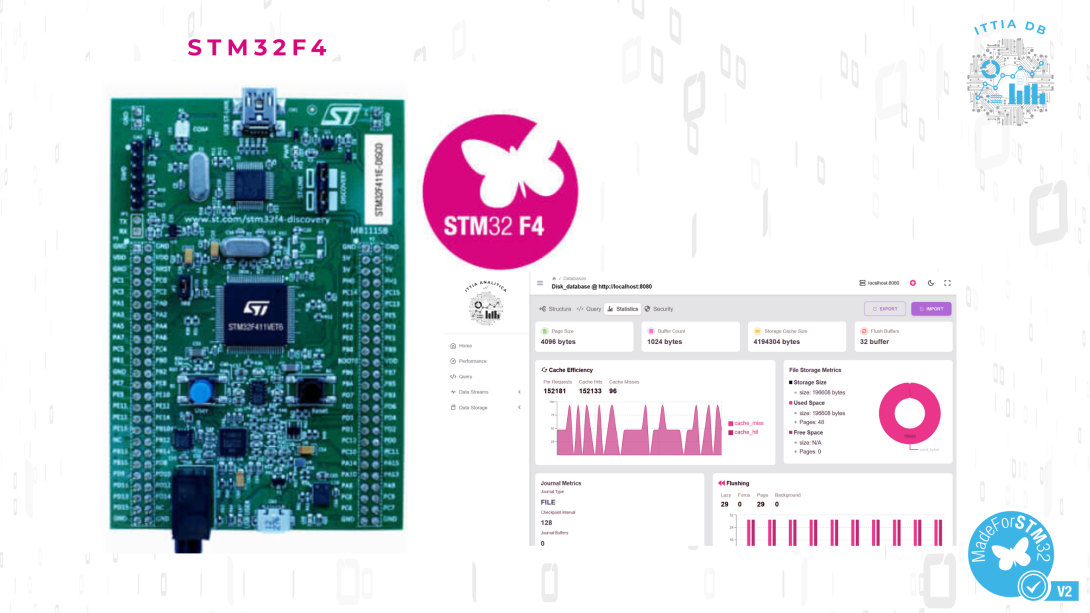
Real-Time Data Management with STM32F4 and ITTIA DB Lite
Overview
ITTIA DB Lite enables STM32F4 microcontrollers to transform from basic control units into intelligent, data-centric devices by providing efficient time-series storage, querying, and real-time analytics directly on the MCU. With the STM32F4’s Cortex-M4F core up to 180 MHz and rich peripheral set, ITTIA DB Lite allows developers to capture continuous streams of sensor data, organize it into structured tables, and run deterministic queries for filtering, aggregation, or anomaly detection, all while staying within tight RAM and Flash budgets. Features such as compression reduce memory footprint, while transactional integrity ensures data reliability in industrial environments. By transmitting only insights instead of raw sensor data, STM32F4 devices equipped with ITTIA DB Lite reduce bandwidth and power consumption, making them well-suited for industrial automation, motor control, robotics, and IoT applications that demand reliable, efficient, and scalable edge data management.
Case Study
The STM32F4 series combines high-performance Arm Cortex-M4 cores up to 180 MHz, DSP extensions, and a rich set of peripherals, making it one of the most popular MCU families for Industrial Automation & Control, Consumer & IoT Devices, Motor Control & Power Electronics and Medical Devices. While widely deployed in motor control, connected sensors, and HMI systems, STM32F4 applications often require efficient ways to manage continuous sensor streams and event-driven data. ITTIA DB Lite brings structured storage, time-series logging, querying, and compression to STM32F4 devices, enabling them to act as data-centric edge nodes with deterministic performance under tight memory constraints.
Use Case: Motor Vibration and Fault Detection
Challenge
An industrial automation company wants to deploy low-cost motor controllers that:
- Continuously capture vibration and temperature data from sensors.
- Detect early fault signatures locally without relying on the cloud.
- Store several days of historical data for local trend analysis.
- Communicate only anomalies and health summaries to a supervisory controller.
System Architecture
- MCU: STM32F407 (Cortex-M4F @ 168 MHz, 1 MB Flash, 192 KB SRAM)
- Sensors: Accelerometer (SPI), temperature sensor (ADC)
- Comms: CAN bus for machine-to-machine, UART to HMI
- Software Stack:
- OS: FreeRTOS/ Eclipse ThreadX RTOS /Zephyr
- Database: ITTIA DB Lite
- AI Model: NanoEdge AI Studio, LiteRT (TensorFlow Lite Micro) anomaly detection model (trained offline, deployed on MCU)
- Visualization: ITTIA Analitica
- Data distribution to MPUs: ITTIA Data Connect
Implementation
Schema Design
CREATE STREAM vibration_log (
    sample_time    TIMESTAMP PRIMARY KEY,
    accel_RMS      FLOAT NOT NULL,
    temperature_C  FLOAT NOT NULL
);

CREATE TABLE vibration_log_1minute (
    start_time        TIMESTAMP PRIMARY KEY,
    end_time          TIMESTAMP NOT NULL,
    avg_accel_RMS     FLOAT NOT NULL,
    avg_temperature_C FLOAT NOT NULL
);

CREATE TABLE fault_events (
    event_time TIMESTAMP PRIMARY KEY,
    event_type VARCHAR(32) NOT NULL,
    severity   VARCHAR(32) NOT NULL
);
Data Logging (C API Example)
void log_vibration(uint64_t ts, float accel, float temp) { db_t *db = db_open("vib.db", DB_OPEN_CREATE); stmt_t *stmt = db_prepare(db, "INSERT INTO vibration_log VALUES (?, ?, ?)"); stmt_bind_int64(stmt, 0, ts); stmt_bind_float(stmt, 1, accel); stmt_bind_float(stmt, 2, temp); stmt_execute(stmt); stmt_finalize(stmt); db_close(db); } #include "motor_vibration_database.h" // generated from schema int main() { db_init_ex(DB_API_VER, NULL); open_motor_vibration_database("motor_vibration", NULL); // ... } void log_vibration(uint64_t ts_ms, float accel, float temp) { db_t db; db_connect(&db, "motor_vibration", "ingestion", NULL, NULL); const motor_metrics_row_t row = { .sample_time = ts_ms * 1000, // to microseconds .accel_RMS = accel, .temperature_C = temp }; put_motor_metrics(db, row); db_disconnect(db); }- Data sampled at 200 Hz, with downsampling for storage.
- Compression further reduces flash usage by ~35%.
Local Analytics & AI
- Data stream queries calculate acceleration averages and temperature thresholds for anomaly detection.
- Results feed into a lightweight AI model to detect fault conditions.
- Faults logged in fault_events and transmitted over CAN bus.
Data Distribution
- Healthy state: only hourly summaries sent to supervisory controller.
- Fault detected: immediate alert sent with timestamp, type, severity.
- Reduces bandwidth by >90% compared to raw data streaming.
Results
Metric | Value |
| ITTIA DB Lite footprint | ~100 KB RAM + 150 KB Flash |
| Insert latency (per row) | ~40 µs |
| Query last 60 sec (12,000 rows) | < 4 ms |
| Compression savings | ~35% |
| Fault detection inference latency | ~6 ms (CMSIS-NN on Cortex-M4F) |
| Power overhead for DB ops | < 7% CPU load avg. |
Benefits
- Efficient local storage: ITTIA DB Lite manages high-frequency sensor data without exhausting Flash.
- Deterministic performance: Real-time queries and transactions under predictable latency.
- Local intelligence: On-device AI reduces downtime by detecting early anomalies.
- Reduced bandwidth: Transmits insights, not raw data.
- Cost-effective scalability: Same solution can migrate upward to STM32H7 or sideways to STM32L4/U5 for ultra-low power use cases.
Conclusion
The combination of STM32F4’s proven performance and ITTIA DB Lite’s efficient embedded database engine empowers developers to build data-driven, intelligent motor controllers and IoT devices. This enables predictive maintenance, data storage, real-time analytics, and fault-tolerant logging in industrial automation, consumer, robotics, and smart building systems, all while staying within the resource limits of an MCU.
