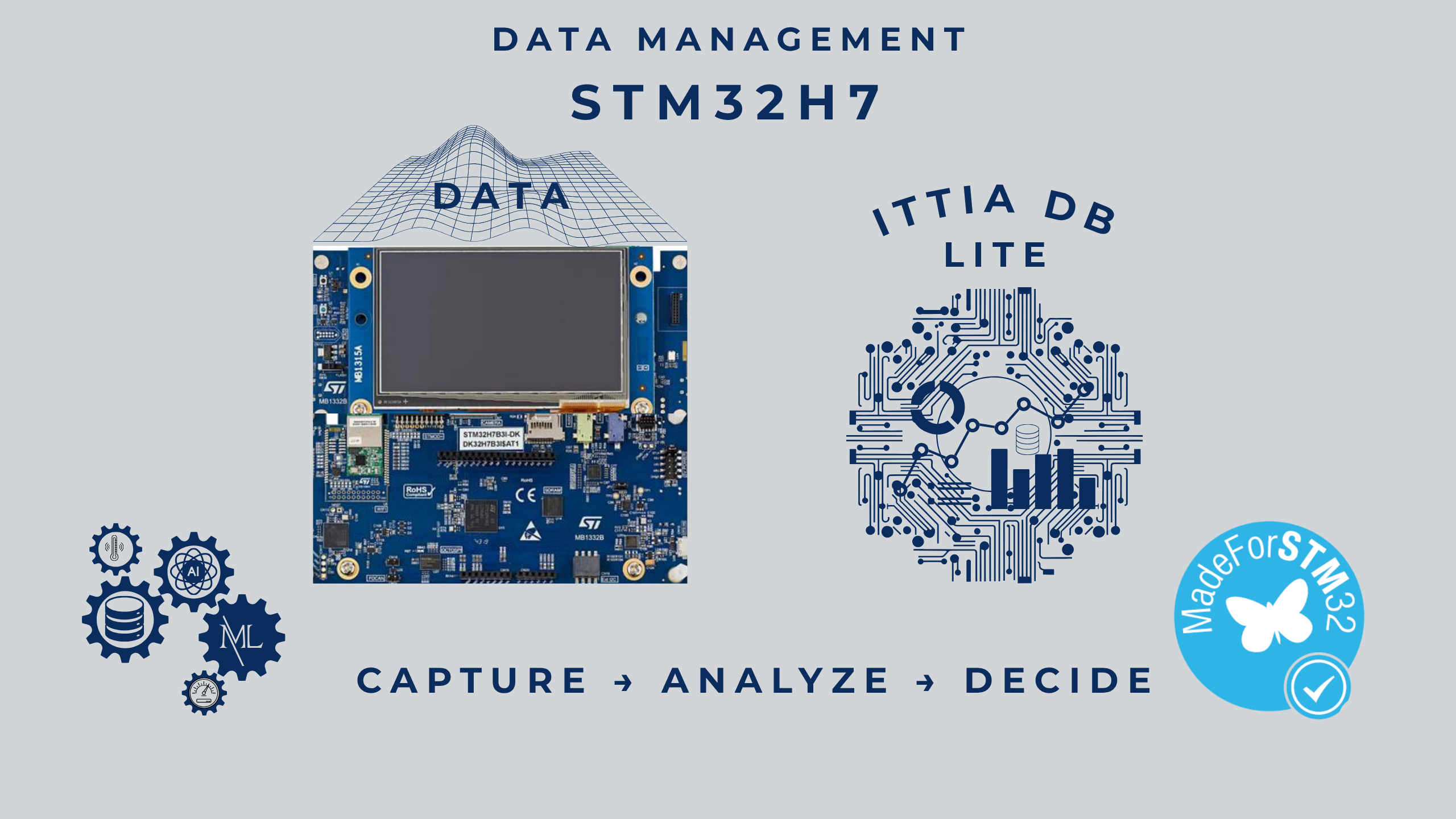
Unlocking Real-Time Data Management on STM32H7
ITTIA DB Platform Transforms Edge Systems
The STM32H7 family is one of the most powerful MCU series from STMicroelectronics combining high-performance ARM® Cortex-M7 processing, advanced peripherals, and low-latency real-time control. But as applications evolve from simple data logging to AI-ready, connected, and insight-driven devices, developers face a new challenge. How do you manage, process, distribute, and visualize device data, reliably, deterministically, and at scale, without outgrowing the MCU?
On STM32H7, and STM32 devices in general, data management is hard because you’re squeezing reliable storage and fast queries into tiny RAM/flash while meeting real-time deadlines. You must log high-rate sensor bursts without blocking control loops, survive power loss with no corrupt data, and respect flash realities: limited write endurance, erase-block alignment, and garbage collection that can spike latency. Space is tight, so schemas, indexes, and logs must be compact and wear-aware; ENOSPC must degrade gracefully. Concurrency adds pressure and needs deterministic reads/writes with minimal locking. Time matters too: fusing streams with different sampling rates require event-time alignment and clock-drift handling. Add in security (keys at rest, signed updates) without blowing the CPU budget, plus firmware updates, configuration/versioning, and audit trails, and you see why STM32 data paths need careful planning for durability, throughput, tail-latency, and maintainability.
Building your own database platform for STM32 devices often seems attractive at first, lean, customized, and “under full control”, but it quickly turns into a long-term technical and business liability. Power-fail safety, flash wear-leveling, deterministic latency, concurrency between ISRs and RTOS tasks, ENOSPC handling, recovery logic, and security hardening are not features you “add later,” they are entire engineering disciplines. Without a proven write-path, crash-recovery engine, and flash-aware storage layout, a single brown-out or full-flash event can corrupt data, brick devices in the field, or trigger costly recalls. Even if the first version works, the maintenance burden never stops: new STM32 families, new flash parts, new certifications, cybersecurity regulations, and customer audits all demand ongoing updates, tests, and evidence. What starts as a small internal project eventually consumes more time than the product it was supposed to support, turning “build” into technical debt instead of competitive advantage.
Using an open-source database on STM32 devices may seem attractive also because it avoids licensing fees, but it introduces significant long-term risks. Most open-source engines are designed for Linux-class systems, not MCUs with limited RAM, raw flash memory, real-time deadlines, and strict power-fail conditions. They typically lack built-in wear-leveling, deterministic latency guarantees, or crash-safe write paths, meaning a single brown-out can corrupt data or brick a device in the field. In addition, copyleft licenses such as GPL or AGPL can legally require you to disclose your firmware source code, which is unacceptable for commercial products. Finally, community projects provide no SLA, no indemnification, and no certification-ready evidence for regulated markets like medical, industrial, or automotive. What looks “free” on day one often becomes expensive technical debt when reliability, compliance, and long-term maintenance enter the picture.
Meanwhile, integrating a database, RTOS, file system, security stack, and other middleware on the STM32H7 is far more complex than simply “linking libraries.” Each layer competes for the same limited RAM, flash, CPU cycles, and interrupt budget, and small misalignments quickly turn into stability, timing, or corruption issues. The RTOS must schedule deterministic database writes without blocking ISRs, while the file system must align with flash erase-block sizes, wear-leveling, and ENOSPC behavior, otherwise power loss or fragmentation can destroy data. Security components add more pressure: secure boot, key storage, TLS, and crypto operations increase memory footprint, introduce latency, and may contend for hardware accelerators. Meanwhile, DMA, coaching, and MPU settings must stay synchronized across drivers, storage, and application tasks, or subtle race conditions appear that are nearly impossible to debug in the field. The real challenge is not “can it run?” but can it run deterministically, safely, and recoverably under worst-case conditions, brown-outs, full flash, high-rate sensor bursts, or concurrent firmware updates. On STM32H7, integration is a systems-engineering discipline, not just a build step.
This is exactly where the ITTIA DB Platform makes the STM32H7 not just a controller, but a complete smart data node. The ITTIA DB Platform turns the STM32H7 from a fast controller into a smart, self-reliant data node by combining three components: ITTIA DB Lite for MCU-grade, power-fail-safe data management with deterministic ingestion, compact time-series/indexed storage (even vector support) and tiny footprint; ITTIA Data Connect for secure, schema-aware, loss-free syncing between MCU, MPU, and cloud with offline buffering, selective/versioned replication, and guaranteed delivery; and ITTIA Analitica for real-time dashboards, trend analysis, and model-drift monitoring without custom ETL. Together they create a closed intelligence loop to collect, process, sync, visualize, optimize, and redeploy so devices can apply local rules/AI at the edge, stream only validated data upstream, and receive configurations and models back safely. Compared to ad-hoc buffers and CSV logs, you gain an ACID, flash-aware database; guaranteed data movement; and fleet-level observability. The result is production-grade reliability and insight for industrial automation, automotive ECUs, medical instruments, smart energy, and robotics, without changing your MCU, OS, or board.
Integrating ITTIA DB Lite with other STM32H7 firmware, RTOS tasks, drivers, file systems, and security modules, turns scattered buffers and ad-hoc logs into a coherent, power-fail-safe data layer with deterministic latency. Its tiny footprint and ISR/DMA-friendly ingest let you capture high-rate sensor data without stalling control loops, while flash-aware commits, wear-leveling discipline, and bounded write paths protect data through brown-outs and ENOSPC events. A clean C API, time-series schemas, and lightweight indexing make it easy to share data across tasks without copy storms, and to persist calibration, configs, and audit trails reliably. With optional hooks to security and to upstream pipelines (selective sync via Data Connect), ITTIA DB Lite becomes the single source of truth on the MCU, reducing integration risk, simplifying certification evidence, and accelerating time-to-market for complex STM32H7 applications.
In short, if you chose STM32H7 for performance, ITTIA DB Lite + Data Connect + Analitica unlock the reliability, intelligence, and scale to match.
