Robotics and Physical AI on Microcontrollers:
Deterministic Data Management
Introduction: Intelligent Robots Need More Than Real-Time Execution
Deterministic data management is essential for robotics and Physical AI on microcontrollers. Robotics is entering a new era of Physical AI, where machines do more than execute predefined instructions. Modern robots continuously sense their environments, analyze operating conditions, predict potential problems, make intelligent decisions, and translate those decisions into physical actions.
From industrial robotic arms and autonomous mobile robots to humanoid systems and intelligent medical devices, microcontrollers are becoming increasingly important in enabling intelligence directly at the point of control.
Yet building reliable Physical AI on resource-constrained microcontrollers introduces a fundamental challenge: How can robots process, manage, and preserve growing volumes of sensor data without compromising deterministic real-time performance?
Traditional real-time operating systems (RTOS) address task scheduling, interrupt handling, and execution priorities. However, predictable task scheduling alone does not guarantee that the data required for AI inference and robotic control will be available, processed, and retained within the required time.
This is where ITTIA DB Lite introduces a complementary data infrastructure. Designed for resource-constrained microcontrollers, ITTIA DB Lite combines deterministic data management, time-series processing, transactional persistence, and AI-ready feature engineering to help developers build reliable, intelligent robotic applications.
The RTOS manages when operations execute. ITTIA DB Lite manages the data those operations depend on. Together, they enable a more complete foundation for real-time Physical AI.
1. The Missing Data Foundation in Real-Time Robotics
Consider an industrial robotic arm performing precision assembly. Every movement depends on continuously changing information collected from multiple sources:
- Motor current, voltage, and temperature
- Encoder position and rotational velocity
- Vibration and acceleration
- Joint torque and mechanical load
- Force and proximity sensors
- Historical operating conditions and anomaly indicators
A traditional control system may process these measurements individually, responding to the latest sensor reading. Physical AI requires something more sophisticated. An intelligent robot must understand not only what is happening now, but also what happened previously, how conditions are changing, and whether current behavior indicates an emerging mechanical or operational problem.
For example, an increase in motor current may be normal during acceleration. However, the same increase combined with abnormal vibration, rising temperature, and declining rotational efficiency could indicate mechanical degradation.
Detecting this condition requires synchronized sensor measurements, historical context, statistical processing, and AI inference. Without a predictable data management infrastructure, these operations may introduce timing variability, inconsistent observations, unnecessary memory consumption, or unreliable storage behavior.
The challenge is no longer simply collecting sensor data. It is transforming time-sensitive information into trustworthy intelligence without disrupting the robot's real-time responsibilities.
2. Why Deterministic Data Management Matters
Deterministic computing is often misunderstood as simply performing operations quickly. In real-time robotics, what matters is not only how fast an operation executes, but whether it completes within a known and acceptable time boundary.
A database operation that typically completes in 20 microseconds but occasionally takes several milliseconds could disrupt a tightly scheduled robotic application if it runs directly in a critical control path. Consequently, deterministic data management must address several fundamental requirements.
Requirement | Importance for Physical AI |
Bounded execution latency | Data operations must fit within established timing budgets |
Predictable memory consumption | Avoid uncontrolled allocation and fragmentation |
Consistent sensor history | Preserve the relationship between measurements over time |
Reliable transactions | Protect critical recorded data against interruptions |
Efficient feature engineering | Produce AI-ready information with controlled computational overhead |
Flash endurance | Minimize unnecessary writes to embedded nonvolatile storage |
Data traceability | Connect sensor inputs with features, inference results, and actions |
The ROS 2 real-time programming guidance similarly emphasizes avoiding dynamic memory allocation, page faults, and indefinitely blocking synchronization within timing-critical operations.
ITTIA DB Lite addresses the data management side of this challenge by offering an embedded engine designed around controlled resource usage and predictable data operations.
Its contribution is particularly valuable when robotic applications need to combine real-time data acquisition with historical processing, AI inference, and persistent data recording.
Importantly, deterministic behavior must be validated for the selected hardware, storage medium, RTOS configuration, concurrency model, and workload. A database alone cannot guarantee that an entire control system meets hard real-time deadlines.
3. How ITTIA DB Lite Enables Physical AI on Microcontrollers
ITTIA DB Lite enables developers to build a structured pipeline connecting real-world sensing to intelligent robotic behavior.
Real-time sensor data management
Robots frequently collect measurements at different rates. Motor current may be sampled thousands of times per second, while temperature, joint position, and diagnostic information may arrive at lower frequencies.
ITTIA DB Lite provides time-series data management capabilities that can organize measurements by timestamp and preserve relevant operating history. This allows developers to investigate the relationships among different sensor signals rather than treating every measurement as an isolated event.
AI-ready feature engineering
Raw sensor values are rarely sufficient for reliable predictive intelligence.
AI models often need derived information describing how conditions evolve over time.
ITTIA DB Lite supports feature-engineering workflows involving:
- Rolling averages, minimums, and maximums
- Root mean square (RMS) calculations
- Variance and standard deviation
- Rate of change and time-series deltas
- Sliding and tumbling windows
- Normalization and signal conditioning
- Frequency-domain features using FFT-based processing
These features provide a foundation for embedded AI models to recognize abnormal behavior and identify potential failures.
Reliable data persistence
Unexpected power interruptions, resets, and communication failures are common design considerations in embedded robotic systems. A robot may need to preserve the operating conditions surrounding a critical event, including the sensor measurements that preceded a failure and the AI inference that triggered a protective action.
ITTIA DB Lite's transactional and power-fail-safe persistence mechanisms can help preserve committed records and support recovery after interruptions. For timing-critical systems, persistent writes should be isolated from control loops unless their worst-case execution time has been explicitly validated.
4. From Preventive Maintenance to AI-Driven Predictive Maintenance
One of the most practical opportunities for ITTIA DB Lite in robotics is AI-powered motor health monitoring.
Traditional preventive maintenance relies on scheduled inspections or operating-hour limits. Predictive maintenance instead uses sensor history and operating behavior to estimate when a component may begin to fail.
Consider a robotic joint driven by a brushless motor.
As mechanical wear increases, the motor may exhibit subtle changes in current consumption, vibration, temperature, or operating efficiency.
An embedded AI model can analyze these changes and detect conditions that would be difficult to identify from any single measurement.
The data-processing workflow begins with motor sensor measurements, which are captured and stored as time-series history, processed into statistical features such as RMS, variance, and FFT, and analyzed through AI inference to assess motor health and recommend predictive maintenance actions.
ITTIA DB Lite provides the data infrastructure necessary to organize historical measurements and generate or retain relevant features for the inference engine. For example, the application can evaluate a sliding window of motor-current and vibration measurements, calculate statistical features, and pass the resulting feature vector into an embedded anomaly-detection model.
If the model identifies an abnormal operating condition, the robot can generate a diagnostic event, notify a higher-level controller, or trigger an application-defined protective response.
The system can also preserve the measurements and features responsible for that decision. This creates an important advantage: engineers can investigate not only that an anomaly occurred, but also why the model reached its conclusion and which operating conditions contributed to it.
5. Deterministic Feature Engineering for Real-Time AI
In robotics, sensor processing and AI inference must coexist with demanding real-time control operations.
Consider a motor control application operating at 1 kHz, meaning each control cycle has a deadline of one millisecond.
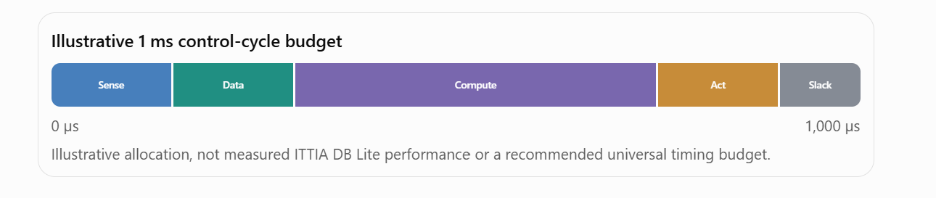
If feature engineering, data access, or flash persistence introduces unpredictable blocking, the controller may miss its deadline. A more effective architecture separates responsibilities according to their timing requirements.
The highest-priority control tasks operate on bounded, preallocated data structures. Sensor processing and feature calculations execute using predictable workloads, while historical persistence and diagnostic reporting can run in lower-priority tasks.
ITTIA DB Lite can support this approach by separating short, time-sensitive data operations from longer-lived historical storage and analysis. In this architecture, the database becomes part of the robot's data foundation without requiring every persistent transaction to execute inside the hard real-time control loop.
6. AI Decision Traceability: Understanding Why a Robot Acted
As robotics becomes more autonomous, understanding how a decision was made becomes increasingly important. Suppose an intelligent robotic arm unexpectedly reduces its operating speed.
An engineer needs more than a log entry stating that the AI detected an anomaly.
The engineer may want to answer several questions: Which sensor measurements triggered the inference? What historical window was used? Which features were calculated? Which model version produced the result? What action followed, and did the control system execute it within the required deadline?
ITTIA DB Lite can provide the data management foundation for capturing and correlating this information. A traceable Physical AI workflow can record the relationships between:
Sensor – Feature – Inference – Decision – Execution
This information can help developers reproduce failures, evaluate model behavior, compare inference results across software versions, and investigate unexpected robotic actions.
Traceability does not automatically prove that an AI decision was correct. However, retaining the input data, model identity, execution context, and observed outcome provides the evidence needed to evaluate and validate the decision.
For safety-related robotics, these records may also support broader verification and engineering documentation activities.
7. Bringing ITTIA DB Lite to STM32 and NXP Microcontrollers
A major advantage of a dedicated MCU data management platform is its ability to bring structured data processing and AI enablement into environments with limited CPU resources, RAM, and flash.
ITTIA DB Lite is positioned for microcontrollers used in industrial automation, robotic actuators, intelligent sensors, motor controllers, and other embedded applications.
Potential targets include Arm Cortex-M-based devices within STM32 and NXP microcontroller families. Depending on the selected implementation, ITTIA DB Lite can complement FreeRTOS, Zephyr, ThreadX, or bare-metal application architectures.
The broader robotic system may also include a more powerful application processor running Linux and ROS 2. In this architecture, MCU-based real-time control and data processing can coexist with higher-level planning, perception, visualization, and fleet management.
micro-ROS provides an example of how ROS 2 concepts can extend into microcontroller environments using RTOS-based implementations.
8. A Practical ITTIA DB Lite Robotics Demonstration
Consider a demonstration that uses an STM32 or NXP microcontroller to monitor the health of a robotic motor. Synchronized current, vibration, and temperature measurements enter an ITTIA DB Lite stream. A lower-priority monitoring task preserves timestamped sensor history, calculates one-second feature windows, runs an application-supplied anomaly model, and records the result with its window, model version, inference latency, and action-request status.
Input and feature contract
Before starting the monitor, the device firmware must initialize the library and database and register robot_motor_samples. An ingestion task validates and aligns sensor readings, computes the two squared values, and publishes samples. Ingestion only starts after the monitor signals readiness.
The ITTIA DB Lite average aggregate calculates mean-square current and vibration. A callback takes square roots to obtain RMS and calculates population vibration variance as E[v²] − E[v]². The AI model receives current RMS, vibration RMS, vibration variance, and mean temperature, in that order. Incomplete windows are counted and excluded from inference.
static const db_aggregate_field_t features[] = {
    { MOTOR,        DB_AGGREGATE_GROUP_BY,      "motor_id" },
    { -1,           DB_AGGREGATE_END_TIMESTAMP, "window_end" },
    { -1,           DB_AGGREGATE_COUNT,         "sample_count" },
    { CURRENT_SQ,   DB_AGGREGATE_AVERAGE,       "mean_current_squared" },
    { VIBRATION,    DB_AGGREGATE_AVERAGE,       "mean_vibration" },
    { VIBRATION_SQ, DB_AGGREGATE_AVERAGE,       "mean_vibration_squared" },
    { TEMPERATURE,  DB_AGGREGATE_AVERAGE,       "mean_temperature" }
};
Build and run the monitoring pipeline
The monitor subscribes through a 256-row queue, appends raw readings to robot_sensor_history, and uses a one-second tumbling window with a 1,024-row capacity. A separate graph appends decisions to robot_decision_history. These are timestamped history tables.
dbstatus_t robotics_monitor(db_stream_environment_t env, db_t db,
                            db_stream_graph_t *worker)
{
    db_stream_graph_t trace = NULL;
    db_stream_node_t input, window, aggregate, output;
    db_table_output_policy_t policy = {0};
    policy.materialization_policy = DB_MATERIALIZE_APPEND;
    dbstatus_t status;
    *worker = NULL;
    trace_status = DB_NOERROR;
    incomplete_windows = model_failures = 0;
#define CHECK(call) do { status = (call); \
    if (DB_FAILED(status)) goto cleanup; } while (0)

    CHECK(db_stream_create_graph(&trace, trace_memory, sizeof trace_memory));
    CHECK(db_stream_create_row_input(&trace_input, trace, trace_fields,
        DB_ARRAY_DIM(trace_fields), T_END, -1));
    CHECK(db_stream_create_table_output(&output, trace_input, db,
        "robot_decision_history", DB_CREATE_NEW, &policy, 1));

    CHECK(db_stream_create_graph(worker, worker_memory, sizeof worker_memory));
    CHECK(db_stream_create_queued_input(&input, *worker, env,
        "robot_motor_samples", DB_FOR_SYSTEM_TIME_ALL, 256));
    CHECK(db_stream_create_table_output(&output, input, db,
        "robot_sensor_history", DB_CREATE_NEW, &policy, 1));
    CHECK(db_stream_create_time_interval_window(&window, input,
        1000000, 1000000, 1024)); /* One-second tumbling windows. */
    CHECK(db_stream_create_aggregates(&aggregate, window,
        features, DB_ARRAY_DIM(features)));
    CHECK(db_stream_create_row_output(&output, aggregate,
        on_feature_window, worker));

    /* Signal application readiness here; only then start sensor ingestion.
     * This is a long-running worker call, NOT a motor-control tick function. */
    app_monitor_ready(*worker);
    CHECK(db_stream_process_queued_input(*worker));
    if (DB_FAILED(trace_status)) status = trace_status;
cleanup:
    if (*worker) db_stream_free_graph(*worker, NULL);
    if (trace) db_stream_free_graph(trace, NULL);
    *worker = NULL;
    trace_input = NULL;
    return status;
#undef CHECK
}
Run inference and retain the decision context
The following callback invokes the AI model, requests derating through a nonblocking command queue when the anomaly score reaches 80%, and writes a trace row. In this example, the model score ranges from zero to one, with higher values indicating anomalies.
static void on_feature_window(db_stream_node_t node, void *unused)
{
    db_stream_graph_t worker = *(db_stream_graph_t *)unused;
    if (DB_FAILED(trace_status)) return;
    if (db_stream_get_tag(node) == '-') return;
    int32_t count = db_stream_get_sint32(node, F_COUNT);
    if (count != 1000) { ++incomplete_windows; return; }

    double mean = db_stream_get_float64(node, F_VIBRATION);
    double ms = db_stream_get_float64(node, F_VIBRATION_SQ);
    float x[4] = {
        (float)sqrt(fmax(0.0, db_stream_get_float64(node, F_CURRENT_SQ))),
        (float)sqrt(fmax(0.0, ms)),
        (float)fmax(0.0, ms - mean * mean),
        (float)db_stream_get_float64(node, F_TEMPERATURE)
    };
    float score;
    uint64_t begin = app_monotonic_us();
    bool valid = app_model_predict(x, &score);
    uint64_t latency = app_monotonic_us() - begin;
    if (!valid || !isfinite(score) || score < 0 || score > 1) {
        ++model_failures;
        return;
    }

    uint32_t motor = db_stream_get_uint32(node, F_MOTOR);
    db_timestamp_usec_t end = db_stream_get_timestamp_usec(node, F_END);
    /* 0=no request, 1=command queued, 2=queue rejected the request. */
    uint32_t action = score < 0.8f ? 0 :
        (app_try_queue_derate(motor) ? 1 : 2);
#define SET(call) do { trace_status = (call); \
    if (DB_FAILED(trace_status)) { \
        db_stream_finish_processing(worker); return; } } while (0)
    SET(db_stream_set_uint32(trace_input, T_MOTOR, motor));
    SET(db_stream_set_timestamp_usec(trace_input, T_START, end - 1000000));
    SET(db_stream_set_timestamp_usec(trace_input, T_END, end));
    SET(db_stream_set_sint32(trace_input, T_COUNT, count));
    SET(db_stream_set_float64(trace_input, T_CURRENT_RMS, x[0]));
    SET(db_stream_set_float64(trace_input, T_VIBRATION_RMS, x[1]));
    SET(db_stream_set_float64(trace_input, T_VIBRATION_VAR, x[2]));
    SET(db_stream_set_float64(trace_input, T_TEMPERATURE, x[3]));
    SET(db_stream_set_float64(trace_input, T_SCORE, score));
    SET(db_stream_set_uint32(trace_input, T_MODEL_VERSION, 1));
    SET(db_stream_set_uint64(trace_input, T_INFERENCE_US, latency));
    SET(db_stream_set_uint32(trace_input, T_ACTION, action));
    SET(db_stream_process(trace_input));
#undef SET
}
The trace stores the motor ID, window start and end timestamps, sample count, feature vector, score, model version, inference duration, and action-request status. Engineers can correlate each decision with its raw measurements by motor and time window. A queued command records a request; the control task must separately report execution and its completion time. Failed model calls and incomplete windows increment diagnostics, while trace-write failures stop the monitoring graph and are returned to the caller.
9. The Future of Robotics Is Data-Centric Physical AI
The next generation of robotics will not be defined solely by more powerful processors or larger AI models. It will also depend on how reliably robots acquire, process, preserve, and interpret information while interacting with the physical world.
A real-time operating system provides the scheduling foundation required to coordinate embedded software activities. An AI inference engine provides the computational capabilities needed to recognize patterns, classify conditions, and generate predictions.
ITTIA DB Lite provides the data management foundation connecting real-time sensing, historical context, feature engineering, AI inference, and physical actions. This combination can enable robots to move beyond reactive operation toward intelligent, predictive, and increasingly autonomous behavior.
By introducing deterministic data management into resource-constrained microcontrollers, ITTIA DB Lite helps developers address the growing intersection of embedded systems, real-time computing, and Physical AI.
Conclusion: Reliable Physical AI Starts with Reliable Data
Robotics manufacturers are being challenged to deliver more intelligence, greater autonomy, and improved reliability while operating within strict hardware and real-time constraints.
Achieving these goals requires more than an RTOS and more than an AI model. It requires a data infrastructure capable of supporting predictable data access, efficient historical processing, reliable persistence, and traceable decisions.
ITTIA DB Lite brings these capabilities closer to the sensors, motors, and controllers where physical intelligence begins. The RTOS provides deterministic execution. The AI engine provides intelligence. ITTIA DB Lite provides the deterministic data foundation that connects sensing, history, inference, and action. Together, they establish a practical architecture for building the next generation of intelligent robots and Physical AI systems.
