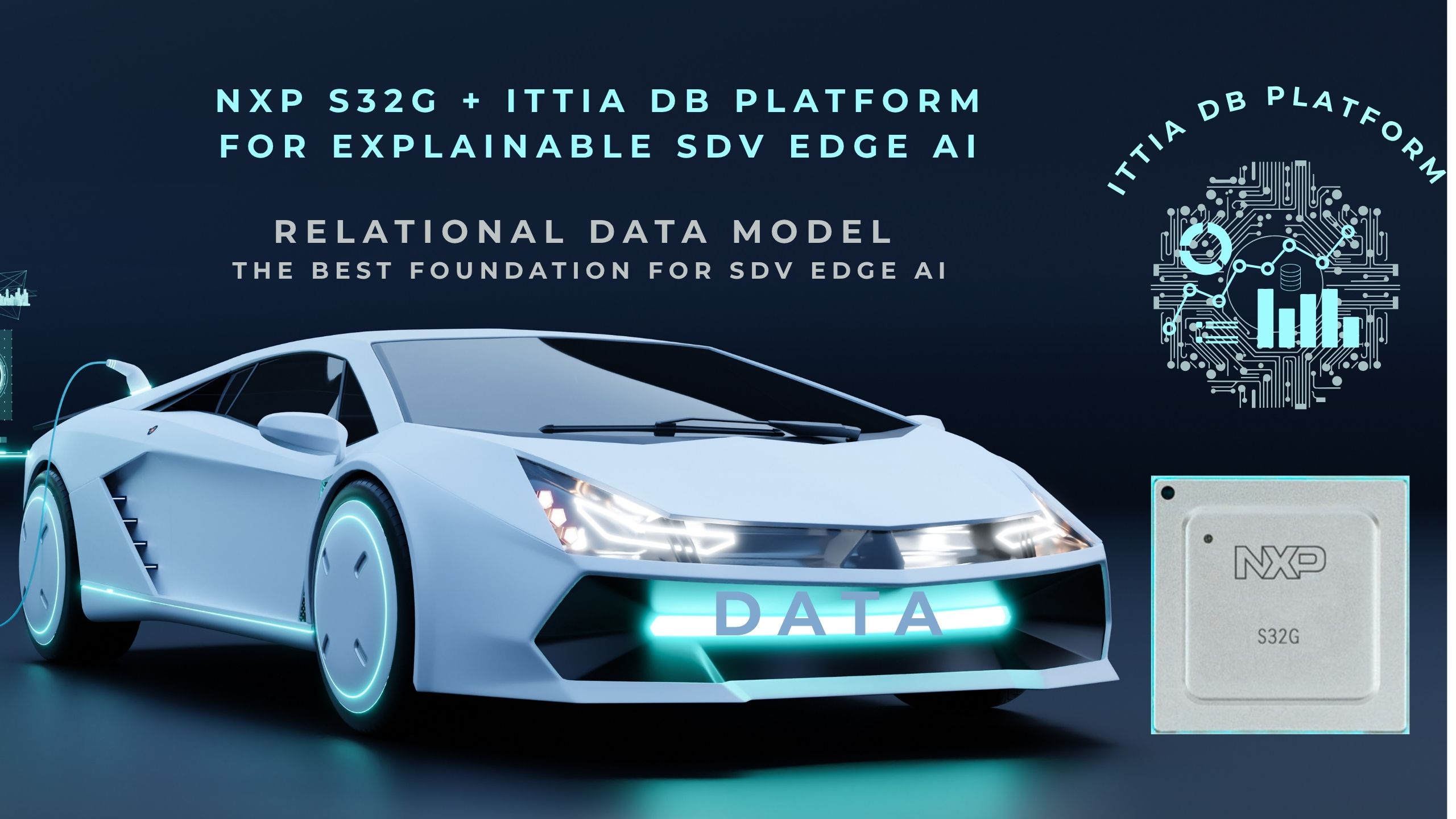
NXP S32G + ITTIA DB Platform for Explainable SDV Edge AI
Relational Data Model: The Best Foundation for SDV Edge AI
Software-defined vehicles are transforming automotive systems from isolated electronic control units into connected, intelligent, and data-driven platforms. Modern vehicles continuously generate operational data from CAN networks, sensors, ECUs, battery systems, motor controllers, gateways, and edge processors. To turn this data into real-time intelligence, automotive developers need more than compute power and AI models. They need a structured, deterministic, and reliable data foundation inside the vehicle.
This is where the integration of NXP S32G and the ITTIA DB Platform creates significant value. NXP S32G provides a powerful automotive processing platform for vehicle networking, gateways, service-oriented architecture, and software-defined vehicle applications. ITTIA DB Platform adds the embedded data infrastructure required to collect, organize, preserve, process, query, and move vehicle data across the edge. Together, they enable developers to build SDV systems that are not only connected and intelligent but also explainable, traceable, and production-ready.
Meanwhile, relational data management is important for software-defined vehicle systems because SDV devices must manage far more than isolated signals or temporary logs. They must organize vehicle data into meaningful relationships that connect sensor measurements, CAN messages, ECU states, battery conditions, motor behavior, diagnostic events, software configurations, AI features, inference results, alerts, and system actions. This structure gives automotive developers a trusted operational history that can be queried, validated, and explained. In SDV environments, where Edge AI, predictive maintenance, safety analysis, and continuous software improvement are becoming essential, relational data management helps transform raw vehicle signals into structured intelligence. Instead of relying on disconnected buffers, flat files, or cloud-only pipelines, SDV devices can preserve context locally, support faster edge decisions, improve traceability, and provide the data foundation needed for explainable and reliable vehicle intelligence.
Why SDV Edge AI Depends on Structured Data
Edge AI is becoming an important part of software-defined vehicle architecture. Instead of sending every signal to the cloud, vehicles can process data locally, detect abnormal behavior, estimate system health, predict failures, and support real-time decisions directly at the edge.
However, AI inside the vehicle depends on the quality and structure of the data behind it. A model output alone is not enough. Engineers must be able to understand what data was used, which features were calculated, what operating conditions existed, what confidence score was produced, and how the system responded.
For SDV applications, the data chain must be connected:
vehicle signal → time-series history → feature window → AI inference → confidence score → alert → action → diagnostic record
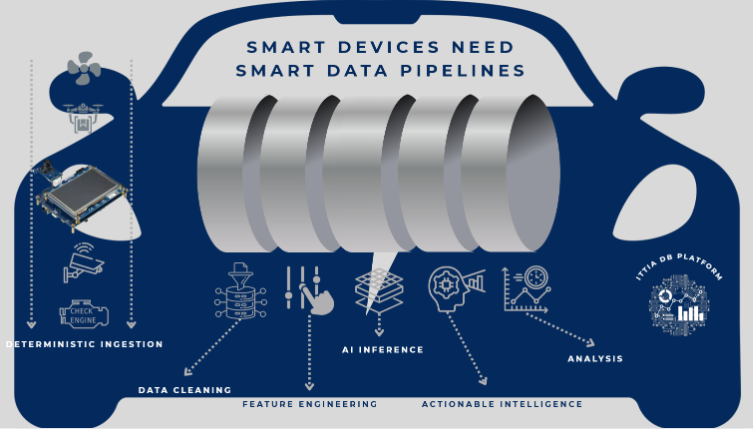
The SDV Data Chain: From Signal to Diagnostic Record
Without a structured data foundation, this information can become fragmented across memory buffers, flat files, temporary logs, cloud-dependent pipelines, or application-specific storage. This makes it difficult to answer critical engineering questions such as what happened, when it happened, what caused it, and whether the system responded correctly.
The Value of NXP S32G and ITTIA DB Platform Integration
NXP S32G is designed for advanced vehicle networking, domain and zonal gateways, secure communication, and high-performance automotive edge processing. In SDV architectures, S32G can serve as a central point where vehicle signals, network traffic, safety-related information, diagnostics, and application data converge.
ITTIA DB Platform complements this architecture by providing the embedded data management layer needed to make that information useful. It allows vehicle data to be captured, structured, stored, processed, queried, and distributed across MCU, MPU, gateway, and cloud systems.
Together, NXP S32G and ITTIA DB Platform help developers build integrated data pipelines for SDV Edge AI, including:
- Deterministic data acquisition from vehicle networks and sensors
- Time-series storage for operational history
- Relational organization of vehicle signals, events, features, and inference results
AI-ready feature engineering at the edge - Persistent logging of inference outputs, alerts, and actions
Traceability from raw data to AI decisions - Reliable embedded storage under automotive constraints
- Secure data movement between edge nodes, gateways, engineering tools, and cloud systems
- Visualization and analytics for validation, diagnostics, and continuous improvement
This integration allows the S32G platform to become more than a high-performance automotive gateway. It becomes a data-aware intelligence platform for software-defined vehicles.
Relational Data Model: The Best Foundation for Explainable SDV Edge AI
The relational data model is especially valuable for SDV Edge AI because it organizes vehicle information into meaningful and traceable relationships. Instead of treating data as disconnected samples, isolated logs, or temporary records, relational data management allows developers to connect operating conditions, system states, sensor measurements, AI features, inference results, alerts, diagnostics, firmware versions, and corrective actions.
For example, an SDV application may need to relate sensor measurements to a specific ECU, battery voltage, and temperature to a time window, motor vibration to operating speed and load, AI inference results to the features that produced them, alerts to diagnostic events and corrective actions, firmware versions to system behavior before and after an update, and vehicle operating conditions to predictive maintenance results. This structure is essential because AI decisions must be understood in context. When an AI model detects an anomaly, predicts battery degradation, or recommends maintenance, engineers need to know which signals changed, which features were calculated, what time window was used, what confidence score was generated, and what action followed. ITTIA DB Platform enables this structured operational history directly at the edge, helping developers build explainable AI systems that can be reviewed, validated, improved, and trusted.
ITTIA DB Platform as the SDV Data Foundation on NXP S32G
The ITTIA DB Platform provides the data infrastructure needed for intelligent vehicle applications running across embedded systems, gateways, and edge processors. When integrated with NXP S32G, it helps developers manage vehicle data where it is created and where it is needed for real-time decision-making.
In an SDV system, ITTIA DB Platform can manage data from:
- CAN and automotive network signals
- Battery management systems
- Motor and inverter systems
- Thermal systems
- Sensor and actuator data
- ECU status and diagnostic events
- Software state and configuration records
- AI features and inference results
- Alerts, actions, and maintenance records
By using ITTIA DB Platform on NXP S32G, developers can replace fragmented data handling with a structured, queryable, and reliable data foundation. This reduces the need for custom logging systems, temporary buffers, and application-specific data pipelines. It also creates a stronger foundation for diagnostics, predictive maintenance, AI validation, safety analysis, and lifecycle management.
From Vehicle Signals to AI-Ready Intelligence
Raw vehicle data alone is not enough to support reliable and explainable Edge AI. AI models require clean, structured, and meaningful features that reflect the vehicle’s operating conditions over time. ITTIA DB Platform helps transform vehicle signals into AI-ready intelligence by supporting time-series processing, structured data organization, and feature engineering workflows such as sliding windows, rolling statistics, lag values, delta calculations, thresholds, normalization, event context, historical operating conditions, inference result logging, and confidence score tracking. By preserving the relationship between raw data, processed features, AI inference, alerts, and system actions, ITTIA DB Platform enables developers to build AI systems that do more than generate predictions. It helps them explain how each prediction was created, which data supported it, and what operational history led to the final decision.
Explainability, Traceability, and Engineering Confidence
Explainability is critical in automotive systems. When a vehicle detects abnormal behavior, predicts component degradation, or recommends service, engineers need to trace the decision back to the data.
With the integration of NXP S32G and ITTIA DB Platform, automotive teams can answer important questions such as:
- Which signal changed first?
- Was the anomaly caused by current, voltage, vibration, temperature, or load?
- What time window was used for the AI inference?
- What features were calculated?
- What was the confidence score?
- Was an alert generated?
- What action did the system take?
- What changed after a software update?
This level of traceability is important for debugging, validation, compliance preparation, safety analysis, predictive maintenance, and customer trust. It also helps engineering teams continuously improve vehicle software and AI models over time.
Why Cloud Alone Is Not Enough for SDV Edge AI
Cloud platforms remain valuable for fleet analytics, dashboards, reporting, model improvement, and long-term trend analysis, but software-defined vehicles cannot rely on the cloud for every decision. Connectivity may be unavailable, latency may be too high, bandwidth may be limited, and safety-related decisions may need to happen immediately inside the vehicle.
Operational context must also be preserved locally, especially when communication is interrupted. This is why SDV systems require a strong edge data foundation. ITTIA DB Platform enables NXP S32G-based systems to manage, process, preserve, and use vehicle data at the edge while still supporting secure data movement to engineering systems, fleet platforms, and cloud services when appropriate. The result is a balanced SDV architecture: real-time intelligence at the edge, structured operational history inside the vehicle, and scalable data integration beyond the vehicle.
Building the Data Pipeline for Software-Defined Vehicles
The integration of NXP S32G and ITTIA DB Platform enables a complete SDV data pipeline, from vehicle signal capture to explainable Edge AI decisions. Vehicle data from networks, sensors, ECUs, and control systems can be collected, organized into structured operational history, transformed into AI-ready features, evaluated by Edge AI models, and preserved for diagnostics, visualization, and continuous improvement. This foundation supports the full lifecycle of SDV intelligence: during development, engineers can validate algorithms and tune feature pipelines; during testing, teams can analyze system behavior before and after critical events; during deployment, vehicles can make faster local decisions without depending entirely on cloud connectivity; during maintenance, service teams can access meaningful historical context instead of isolated fault codes; and during continuous improvement, engineering teams can use preserved operational history to refine software and AI models. By combining NXP S32G with ITTIA DB Platform, automotive developers gain an integrated foundation for data collection, data processing, Edge AI enablement, explainability, and edge-to-cloud intelligence.
Conclusion
The future of software-defined vehicles depends on data that is structured, preserved, trusted, and available at the edge. AI models alone cannot deliver explainable vehicle intelligence unless they are supported by reliable operational history and traceable data pipelines.
NXP S32G provides the automotive processing and gateway platform for modern SDV architectures. ITTIA DB Platform provides the embedded data infrastructure needed to manage, process, query, and move vehicle data across edge systems. Together, they enable developers to build SDV applications that are intelligent, explainable, and ready for long-term operation.
With NXP S32G and ITTIA DB Platform, vehicle data can move from raw signals to structured history, from structured history to AI-ready features, and from AI inference to explainable decisions. This integration creates the foundation for safer, smarter, and more data-aware software-defined vehicles.
A shorter LinkedIn version can also be created from this, with a stronger opening hook and fewer technical sections.
