Not All Flash Is Equal: The Hidden Data Challenges of NOR, NAND, and SD
One of the biggest, and most costly, mistakes in embedded system design is choosing the wrong hardware from the start. In particular, your MCU/SoC platform and storage choices directly determine whether you can meet critical data-management, performance, and reliability metrics. While many teams understand that a complete solution must come together across software, analytics, and AI, they often underestimate how deeply a poor hardware decision can complicate everything downstream. NOR, NAND, SD card, or something else? Each behaves very differently once real workloads arrive.
This blog cuts through the confusion, introduces your options, and distills hard-earned lessons from real deployments, so you can avoid painful surprises and quickly converge on what truly works best for production-grade embedded systems.
NOR flash, NAND flash, and SD cards all look like “storage,” but from a data-management perspective they behave very differently. On embedded and Edge AI systems, these differences create real engineering challenges.
The key insight for embedded data management
Although NOR, NAND, and SD all appear to be simple storage, they behave very differently once you begin building real data pipelines, continuous sensor ingestion, feature windowing, anomaly logging, model telemetry, Remaining Useful Life (RUL) history, inference traces, and OTA-safe updates. At that point, storage characteristics directly impact determinism, reliability, and system integrity.
NOR Flash excels at deterministic access and small, critical data. It’s ideal for device state, schemas, indexes, configuration, and transactional metadata, essentially the control backbone of an embedded system. However, NOR is not designed for large datasets or sustained high-volume logging.
NAND Flash shines when it comes to capacity. It’s well suited for time-series sensor history, vibration/audio/image logs, and Edge AI training buffers. But NAND is not plug-and-play: it requires serious software infrastructure, including wear leveling, bad-block management, journaling, crash recovery, and indexing. Without these layers, data pipelines quickly become fragile and unreliable in real-world deployments.
SD cards, while convenient, are risky for production systems. Their hidden controllers introduce unpredictable latency, uncontrolled wear behavior, and undefined power-loss recovery. They’re perfectly acceptable for demos and removable logging—but they are not appropriate for deterministic, production-grade Edge AI systems.
A simple mental model helps clarify roles:
In practice, real products typically require both NOR and NAND, plus a proper embedded data layer, to transform raw storage into something far more valuable: | 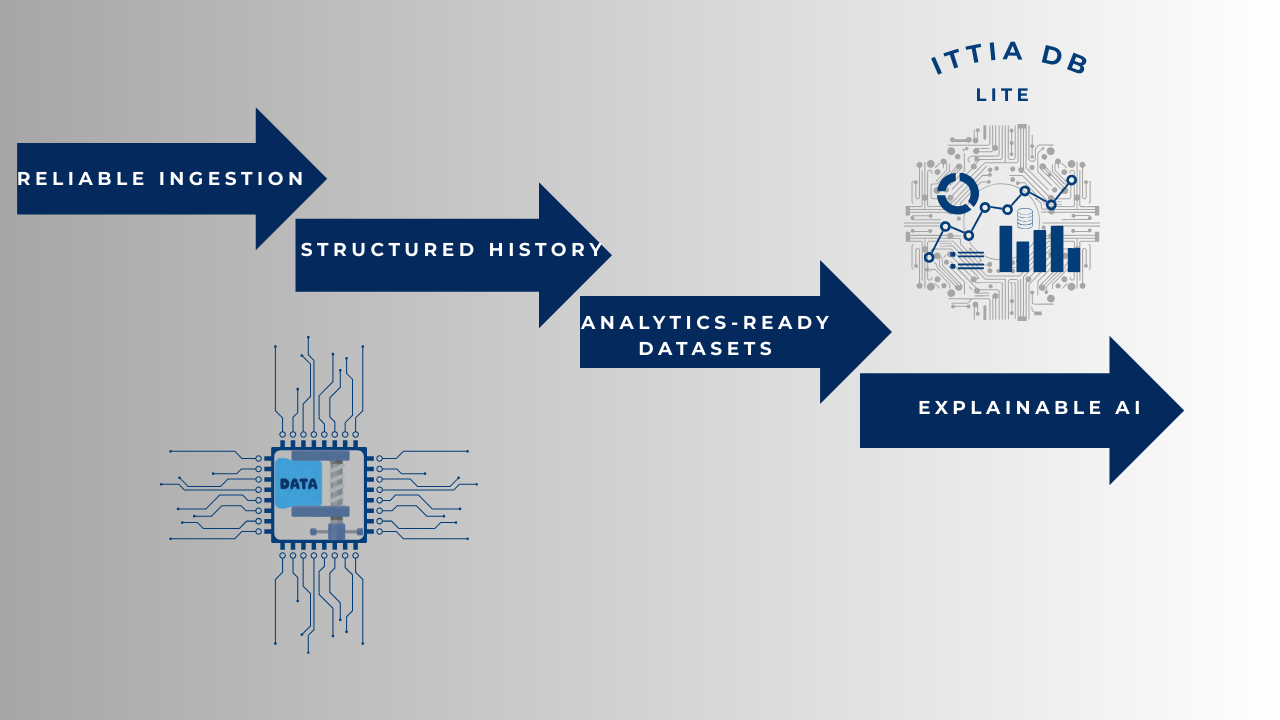 |
| Dimension | NOR Flash | NAND Flash | SD Card |
Typical role Capacity Read/write access Latency determinism Internal controller Wear leveling ECC Power-fail behavior Transaction safety Consistent write latency Streaming ingest Small updates / metadata Data recovery control File system friendliness Real-time suitability Lifecycle predictability Typical failures Best used for | Firmware + metadata + small logs KB → 100s MB Random (byte/word) Excellent None External (your software) External Application-defined Must be implemented High Limited by size Excellent Full Limited Yes High Sector wear Boot + configs + indexes + state | Bulk sensor & historical data GB → TB Page/block only Medium None External (your software) External Application-defined Must be implemented Variable Good Inefficient Full Moderate Partial Medium Block wear, bad blocks Large time-series datasets | Removable mass storage GB → TB Block only Poor / opaque Yes (hidden FTL) Internal (not visible) Internal (hidden) Undefined / controller-dependent Not guaranteed Highly variable Bursty Inefficient None High No Low Sudden corruption Convenience logging |
Table 1 - NOR vs NAND vs SD, from a Data Management perspective
Core Data Management Challenges on Flash Storage
- Limited Write Endurance (All Flash Types)
Flash memory wears out. NOR typically supports around 100,000 erase cycles, good, but far from infinite. NAND is much more limited, often in the range of 3,000 to 10,000 cycles. SD cards are even less predictable, with endurance that varies widely and is frequently worse than raw NAND due to opaque internal controllers.
The real challenge emerges when systems repeatedly write to the same sectors, common with logs, time-series data, AI features, and telemetry. These “hot spots” accelerate wear dramatically, causing portions of flash to fail long before the rest of the device reaches its expected lifetime.
To build production-grade systems, proper flash management is essential. This includes wear leveling, write spreading, append-only or log-structured layouts, and deliberate avoidance of hot spots. These techniques distribute writes evenly across the media and protect against premature failure.
Without these safeguards, embedded devices don’t fail gracefully, they fail early, unpredictably, and expensively.
Therefore, to build production-grade systems, proper flash management is essential. This includes wear leveling, write spreading, append-only or log-structured layouts, and deliberate avoidance of hot spots, techniques that distribute writes evenly across the media and protect against premature failure. ITTIA DB Lite adds critical value here by delivering these capabilities out of the box. Its flash-aware, log-structured architecture automatically spreads writes, eliminates hot spots, and coordinates mixed workloads, extending media lifetime while maintaining deterministic performance. Instead of fragile custom firmware, teams get a proven data layer that protects flash health while supporting continuous ingestion and Edge AI pipelines.
Without these safeguards, embedded devices don’t fail gracefully, they fail early, unpredictably, and expensively. With ITTIA DB Lite, flash becomes a durable, production-ready data foundation rather than a silent reliability risk.
- Erase-Before-Write Granularity
Flash memory does not allow direct byte overwrites. Instead, entire erase blocks must be cleared before pages can be rewritten, typically 4 KB to 64 KB for NOR, 128 KB to 2 MB for NAND, and in SD cards this process is hidden inside the controller and largely unpredictable. The challenge is that even a tiny update, such as a single sensor value, can trigger large internal erase-and-write cycles. This leads to write amplification, sudden latency spikes, and accelerated media wear. Without a data-aware storage layer that batches updates and uses append-only layouts, embedded systems quickly suffer from performance instability and reduced device lifetime.
ITTIA DB Lite adds value by eliminating write amplification at the source through flash-aware data management. Instead of forcing small updates to trigger expensive erase-and-rewrite cycles, ITTIA DB Lite batches changes, appends new records, and avoids in-place updates to the storage media entirely. This dramatically reduces unnecessary block erases, smooths latency spikes, and minimizes wear on NOR and NAND. By coordinating writes across sensor data, AI features, and configuration updates, ITTIA DB Lite transforms random, destructive I/O patterns into efficient sequential flows, delivering predictable performance and extending flash lifetime. The result is stable real-time behavior and durable storage, even under continuous Edge AI workloads, without requiring developers to engineer complex flash logic themselves.
- Power-Fail Corruption
Power loss during an erase, page program, or metadata update can have catastrophic consequences, ranging from losing the most recent write to corrupting the filesystem or even the entire volume. SD cards are especially dangerous in this regard because their internal controllers hide what’s actually happening on the media, making failures unpredictable and hard to recover from. The core challenge is that traditional filesystems assume stable power, while embedded systems routinely experience brownouts, resets, and hard power cuts. Production devices therefore require atomic commits, journaling or write-ahead logging (WAL), copy-on-write updates, and crash-consistent metadata. Without these safeguards, a single power interruption can brick a device in the field.
ITTIA DB Lite adds critical value by making embedded storage power-fail safe by design. Instead of relying on traditional filesystems that assume stable power, ITTIA DB Lite ensures that every transaction either completes fully or is safely rolled back after a reset or brownout. Even if power is lost during an erase or page program, the database recovers automatically to a consistent state at the next boot, without corrupting application data or schemas. By exposing deterministic behavior on raw flash and shielding applications from opaque SD controller failures, ITTIA DB Lite prevents field bricking and transforms unpredictable storage into a reliable foundation for continuous sensor ingestion, AI pipelines, configuration, and OTA in real-world embedded systems.
- Bad Blocks (Mostly NAND + SD)
NAND flash often ships with bad blocks from the factory, and more inevitably appear over time. SD cards hide this reality behind internal controllers, but the bad blocks still exist and still impact reliability. The challenge in software that accesses NAND directly is to actively detect failing blocks, remap data, and preserve integrity as the media degrades. Filesystem-only approaches usually aren’t enough, because they lack visibility into flash health and don’t provide the fine-grained control needed for recovery and wear management. Without a flash-aware data layer, silent corruption and premature device failure become very real risks in production systems.
ITTIA DB Lite adds value by providing a flash-aware, self-healing data layer that actively manages bad blocks while preserving data integrity over the device lifetime. ITTIA DB Lite uses transactional updates to isolate failing blocks, safely remap data, and maintain consistency as NAND degrades. Writes are appended rather than overwritten, minimizing exposure to bad regions, while built-in recovery ensures corrupted pages are never propagated into application state. This fine-grained control allows ITTIA DB Lite to tolerate factory bad blocks and aging media without silent data loss, turning imperfect NAND into a reliable foundation for continuous sensor ingestion, Edge AI pipelines, and long-lived embedded products.
- Unbounded Latency (NAND + SD)
Writes to flash can suddenly stall due to garbage collection, block relocation, or internal controller housekeeping. What normally takes around 200 microseconds can unexpectedly balloon to 200 milliseconds or more. The challenge is that real-time embedded systems depend on bounded, predictable latency, and these pauses break that assumption. SD cards are especially problematic because all of these decisions happen inside opaque firmware, leaving developers blind to when or why delays occur. Without a data layer designed for deterministic behavior, these latency spikes can ripple through control loops, sensor pipelines, and AI workloads, undermining system reliability in the field.
ITTIA DB Lite adds value by enforcing deterministic I/O behavior on top of inherently unpredictable flash media. Through append-only writes, bounded commit paths, and flash-aware allocation, ITTIA DB Lite absorbs latency spikes caused by garbage collection, block relocation, and media housekeeping, preventing them from propagating into real-time control loops and sensor pipelines. Instead of allowing storage stalls to disrupt application timing, ITTIA DB Lite decouples ingestion from persistence using lightweight buffering and transactional commits, delivering predictable response even when underlying flash pauses. By replacing opaque SD behavior and fragile filesystem logic with a deterministic data layer, ITTIA DB Lite keeps Edge AI workloads stable, responsive, and production-ready in the field.
- Memory Constraints (NOR + MCUs)
On microcontrollers using NOR flash, resources are extremely constrained: RAM is tiny and flash bandwidth is limited. You simply can’t afford big caches, large buffers, or heavyweight filesystems. Data management must be lightweight, deterministic, and carefully engineered for real-time behavior, otherwise storage quickly becomes the bottleneck.
Modern devices also run mixed workloads on the same flash: continuous sensor streams, AI features, configuration data, firmware updates, and diagnostics. Each has very different access patterns, logs prefer sequential writes, configurations require small random updates, and OTA updates demand large contiguous regions. Without coordination, these workloads compete with each other, causing fragmentation, latency spikes, and collapsing performance.
SD cards make this even harder. They introduce hidden Flash Translation Layers (FTLs), unknown wear-leveling policies, vendor-specific behavior, and zero guarantees around latency or atomicity. While convenient, they are fundamentally non-deterministic. For safety-critical systems or Edge AI pipelines that depend on predictable timing and reliable persistence, this unpredictability represents a serious production risk.
ITTIA DB Lite adds value by bringing deterministic, coordinated data management to resource-constrained MCUs running mixed workloads. Designed specifically for NOR- and NAND-based microcontrollers with tiny RAM and limited flash bandwidth, ITTIA DB Lite operates without large caches or heavyweight filesystems, delivering bounded latency and transactional commits. It intelligently orchestrates competing workloads, sensor streams, AI features, configuration updates, diagnostics, and OTA, so sequential logging, random metadata updates, and large firmware writes coexist without fragmentation or performance collapse. By replacing opaque SD behavior and ad-hoc firmware logic with a flash-aware data layer, ITTIA DB Lite ensures predictable timing, crash-safe persistence, and long-term media health, turning constrained embedded platforms into production-ready foundations for Edge AI and safety-critical applications.
Summary
Flash storage media is essential for data storage in embedded systems. However, the most popular types of flash media, NOR, NAND, and SD cards, suffer from limited endurance, erase-before-write constraints, power-fail corruption, bad blocks, write amplification, and unpredictable latency. Production embedded systems must handle wear leveling, crash consistency, bounded I/O, and mixed workloads explicitly, or risk data loss, performance collapse, and premature device failure. ITTIA DB Lite adds critical value by providing a lightweight, deterministic, flash-aware data layer that delivers atomic commits for coordinated mixed-workload data management out of the box. Instead of fragile custom firmware, teams get a production-ready foundation for continuous sensor ingestion, AI pipelines, configuration, OTA, and more, turning raw flash into reliable, analytics-ready data while protecting device lifetime and real-time behavior.
