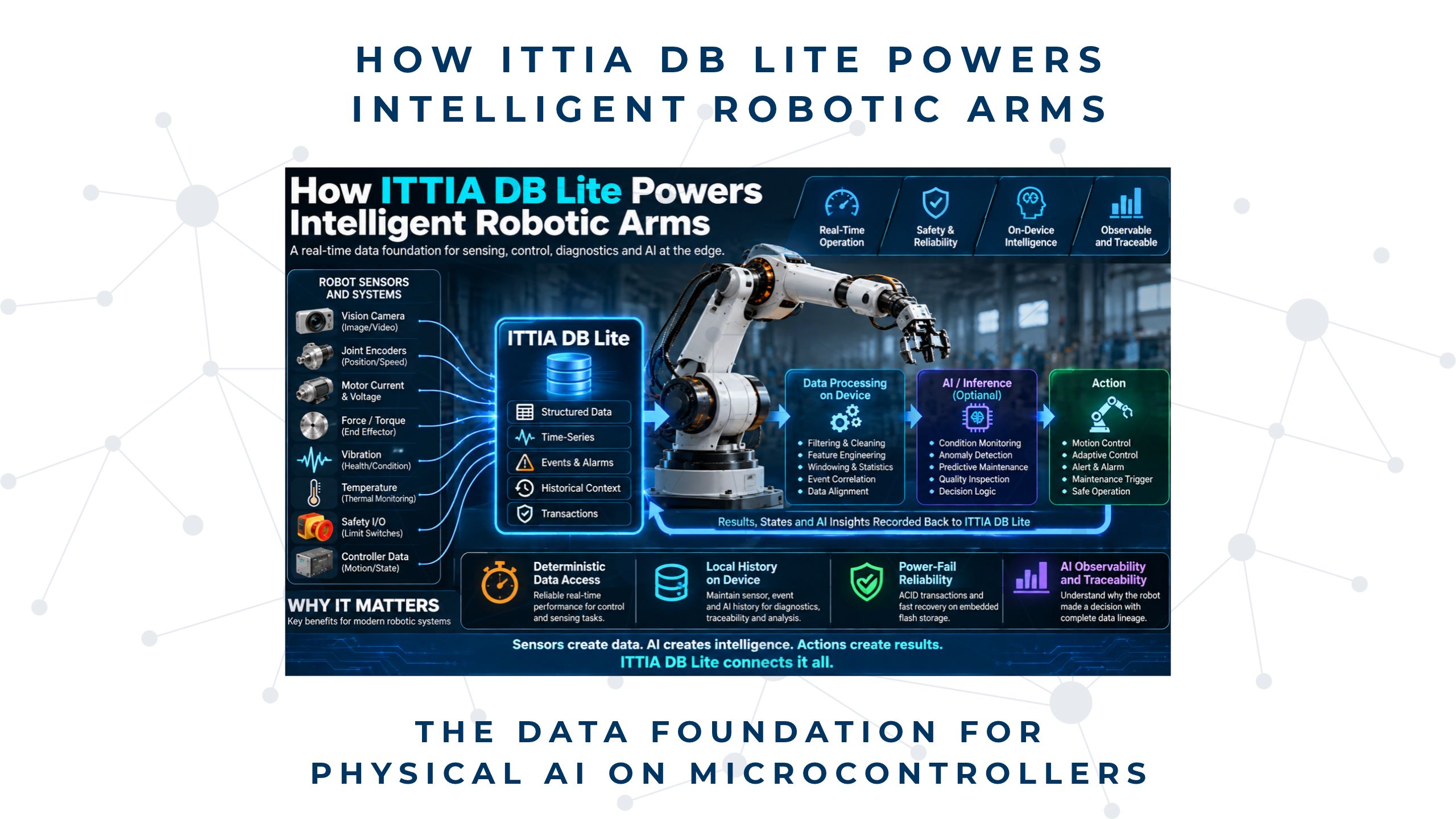
How ITTIA DB Lite Powers Intelligent Robotic Arms
The Data Foundation for Physical AI on Microcontrollers
Industrial robotic arms are becoming far more intelligent than the machines of the past. Traditional robots were primarily designed to execute predefined motion sequences. Modern robotic systems increasingly combine precision motion control with sensing, diagnostics, predictive maintenance, machine vision, and on-device AI. They do not simply move; they continuously observe their environment, evaluate operating conditions, make decisions, and respond to changing situations.
Behind this intelligence is a growing amount of data. Joint encoders continuously report position and speed. Force and torque sensors measure interaction with objects. Motor current and voltage provide insight into actuator behavior. Vibration and temperature measurements reveal mechanical health. Vision cameras capture information about objects and the surrounding environment. Safety I/O, motion controllers, and other subsystems contribute additional events and operational states.
The challenge is no longer simply collecting this information. The challenge is managing it, processing it, preserving its history, and turning it into useful intelligence within the robotic system itself.
This is where ITTIA DB Lite becomes an important part of the robotics architecture.
The Robotic Arm Is Becoming a Data System
Consider a modern industrial robotic arm operating on a manufacturing line. Every movement can generate multiple streams of information:
- Joint Encoders: Position and Speed
- Force/Torque Sensors → Mechanical Interaction
- Motor Current → Motor Load and Health
- Vibration Sensors → Mechanical Condition
- Temperature Sensors → Thermal Condition
- Vision Camera → Images and Inspection Data
- Safety I/O → Operational and Safety Events
- Motion Controller → Commands, States, and Results
Individually, these measurements provide useful information. Their real value, however, comes when they can be connected by time, machine state, event, operation, and historical context.
A sudden increase in motor current may have little meaning by itself. When correlated with increasing vibration, a particular joint position, rising temperature, and previous maintenance history, it can become an important indicator of mechanical degradation.
Robotics therefore requires more than sensor acquisition. It requires a structured data foundation.
ITTIA DB Lite at the Center of Robotic Data
ITTIA DB Lite provides embedded applications with a way to organize different categories of robotic information instead of leaving each subsystem to manage isolated buffers, files, and custom flash structures.
The architecture becomes: Sensors to ITTIA DB Lite to Data Processing to Analytics/AI to Robotic Decision and Physical Action. And critically: Decision and Action to Recorded Results and ITTIA DB Lite. This creates a continuous information loop.
ITTIA DB Lite can organize robotic information such as structured data, time-series measurements, events, alarms, historical context, and transactional records.
Instead of treating data as a collection of disconnected sensor values, the robot can maintain a meaningful operational history. For example, the system can associate:
Robot → Joint → Operation → Sensor Measurements → Event → Decision → Action → Result
That structure becomes increasingly important as robots become more autonomous.
Structured Data Meets High-Frequency Sensor Data
Robotic systems contain several fundamentally different types of data. Configuration information may describe the robot, tool, joint limits, calibration information, or work-cell configuration. Time-series information may include vibration, motor current, temperature, speed, position, and force measurements. Events may represent alarms, emergency stops, maintenance actions, overload conditions, or completed operations.
Images may be captured during inspections. Diagnostics may describe equipment health. AI inference results may indicate anomalies, classifications, object recognition, or predicted maintenance conditions.
ITTIA DB Lite provides a common data-management layer that can connect these different categories of information without forcing the application to build a separate custom storage mechanism for each one.
Local History Gives Robots Memory
A sensor tells the robot what is happening now. History tells the robot what has been happening. That distinction is extremely important. Suppose a robotic joint normally operates with a motor current of one level, but that current gradually increases over several weeks. A single measurement may still fall within an acceptable operating range.
The trend, however, may indicate increasing friction, bearing wear, alignment problems, or another developing mechanical condition. By maintaining historical information locally, the system can examine current conditions against recent history and long-term trends. This supports diagnostics and predictive maintenance even when a cloud connection is unavailable.
Local history can also help developers answer questions such as:
- What happened immediately before a fault?
- Which joint was operating?
- What were the motor current and vibration levels?
- What command was being executed?
- What did the controller decide?
- Did a similar condition occur previously?
That transforms the embedded database into part of the robot's operational memory.
Processing Data Where It Is Generated
Moving every raw sensor measurement to the cloud is not always practical. Robotic control systems frequently require immediate local response, and continuous transmission of high-frequency data can introduce bandwidth, latency, availability, and privacy concerns.
ITTIA DB Lite can provide the data foundation for processing information directly at the edge. A robotics application may perform operations such as: filtering, windowing, statistical processing, event Correlation, feature generation and analysis.
For example, raw vibration measurements may be processed into RMS, variance, frequency-domain information, or other health indicators. Motor-current information can be examined over windows rather than as individual samples. Force measurements can be correlated with joint positions and specific operations.
The important architectural shift is that the device moves from simply storing measurements to maintaining information that can be immediately used by applications and analytics.
From Diagnostics to Predictive Maintenance
One of the strongest opportunities for intelligent robotic systems is predictive maintenance. A robotic arm contains motors, bearings, gearboxes, joints, actuators, cables, and end effectors that experience continuous mechanical stress. Data from these components can reveal signs of deterioration before a complete failure occurs. A useful pipeline can be:
Motor Current + Vibration + Temperature + Position History
↓
ITTIA DB Lite
↓
Local Processing and Feature Engineering
↓
Health Indicators / Anomaly Detection
↓
Maintenance Decision
Instead of waiting for a component to fail, the robot can provide evidence that its operating characteristics are changing. This can help manufacturers reduce unplanned downtime and better understand the health of robotic equipment.
AI Becomes More Valuable When It Has Context
AI inference can add another level of intelligence to robotic systems by detecting unusual vibration signatures, identifying objects through machine vision, recognizing equipment degradation, or classifying the quality of a manufacturing operation. However, inference alone does not provide the complete picture.
More valuable architecture connects sensor data to historical context to processed features to AI inference to decision and then action, while ITTIA DB Lite preserves the information surrounding each step. This allows developers to understand which measurements were used, the state of the robot at the time, the relevant historical conditions, the result produced by the AI model, the action taken by the controller, and what happened afterward.
By maintaining this context, ITTIA DB Lite creates a foundation for AI observability and traceability, helping developers move beyond simply knowing what the AI decided to understanding the data and operational circumstances that led to that decision.
AI Is Optional - The Data Foundation Is Not
An important distinction is that architecture does not require AI. A robotic arm can benefit from structured data management, local history, transactional integrity, diagnostics, and event correlation even when no machine-learning model is present. The same architecture can begin with:
Sensors → ITTIA DB Lite → Processing → Diagnostics → Action
and later evolve into:
Sensors → ITTIA DB Lite → Processing → AI → Decision → Action
This allows manufacturers to establish a strong data infrastructure first and introduce additional intelligence when the application requires it.
Reliable Data Matters in Physical Systems
Robots operate in the physical world. If power is interrupted, equipment is restarted, or an unexpected event occurs, the information stored by the system may be important for diagnostics and recovery.
For that reason, embedded robotic data management must consider more than database functionality. It must also consider: transaction integrity, flash behavior, recovery, memory limitations, predictable access, and embedded-resource constraints.
ITTIA DB Lite is designed for embedded environments where data management must coexist with sensing, communication, control, and other time-sensitive workloads rather than consuming the resources of a traditional server-class database.
Deterministic Data Access for Time-Sensitive Robotics
Robotics applications cannot allow supporting data infrastructure to interfere unpredictably with control workloads. Motion control, safety functions, communications, and sensor acquisition may all have timing requirements.
The database therefore needs to operate as a cooperative component of the embedded architecture. A well-designed robotic data system should minimize unpredictable background activity, control memory consumption, and allow developers to understand how database operations interact with the rest of the embedded application.
For robotics, this predictability can be just as important as raw database performance.
Building an Observable Robotic System
As robotic systems become more sophisticated, observability becomes increasingly valuable. A robot manufacturer may want visibility into:
Sensor conditions → Device state → Processing → AI result → Decision → Action → Outcome
ITTIA DB Lite provides the underlying data history that can make such analysis possible.
Rather than treating AI or control decisions as isolated events, developers can preserve the information surrounding those decisions. This becomes particularly useful for: manufacturing diagnostics, predictive maintenance, quality control, autonomous robotics, field service, warranty analysis, and fleet management.
One Data Foundation, Many Robotic Applications
The same architecture can support many robotic applications:
- Pick-and-Place Robotics
Maintain movement history, cycle information, object handling events, and equipment condition. - Assembly Robots
Correlate torque, force, position, and process results with individual assembly operations. - Welding Robots
Record movement, current, temperature, process parameters, and quality-related measurements. - Inspection Robots
Connect images and sensor measurements with timestamps, machine position, inspection results, and events. - Collaborative Robots
Maintain force, motion, safety, and interaction information that provides context around human-machine operations. - Predictive Maintenance
Analyze motor current, vibration, temperature, operating hours, and historical trends to identify developing mechanical problems.
From Motion to Intelligence
The evolution of robotics is not simply about faster processors or increasingly sophisticated AI models. It is also about creating machines that can understand and use the information generated by their own operation.
A modern robotic arm may generate thousands or millions of measurements while performing its work. Without an effective data architecture, much of that information becomes temporary, fragmented, or difficult to correlate.
With a structured embedded data foundation, those measurements become history, context, diagnostics, features, evidence, and ultimately intelligence. The complete architecture becomes: Sensors to ITTIA DB Lite to Data Processing to AI/Analytics to Robotic Decision to Physical Action and then Recorded Results.
And that creates an increasingly important distinction between a machine that simply executes commands and a machine that can understand its own operation.
The robotic arm provides the motion. Sensors provide awareness. AI provides intelligence. ITTIA DB Lite provides the data foundation connecting them all.
Discover the Possibilities with ITTIA
Are you developing industrial robotic arms, collaborative robots, automated assembly systems, or intelligent motion-control equipment that requires reliable embedded data management, real-time processing, and AI enablement?
We invite you to connect with ITTIA experts to explore how ITTIA DB Lite can help transform your robotic application into an intelligent, data-centric system capable of managing sensor information, operational history, diagnostics, predictive maintenance data, and AI results directly on the device.
Our team can review your robot architecture, motor and joint sensors, force/torque measurements, vibration and current data, motion-control requirements, data-processing objectives, and AI integration plans, and demonstrate how ITTIA technology can support a complete pipeline from sensor data and historical context to processing, inference, robotic decision-making, physical action, and recorded results.
