Edge Data Cleaning on STM32 Devices
Building Reliable Edge AI with ITTIA DB Lite
Edge AI doesn’t fail because of models. It fails because of dirty data. On STM32 microcontrollers, sensor data arrives fast, noisy, misaligned, and often under harsh real-world conditions, electrical noise, vibration, temperature drift, power interruptions, and real-time scheduling pressure. Before any AI model can deliver value, that data must be cleaned, structured, and made deterministic on the device itself.
That’s exactly where ITTIA DB Lite, running on STMicroelectronics STM32 devices, becomes a critical foundation for production-grade Edge AI.
Why Data Cleaning at the Edge Matters
Data cleaning is the foundation of any reliable Edge AI system. Before analytics or machine learning can deliver meaningful results, raw sensor data must be filtered, normalized, time-aligned, and validated to remove noise, spikes, gaps, and inconsistencies introduced by real-world operating conditions. On embedded and edge devices, this process must be deterministic, real-time safe, and resilient to power loss. Proper data cleaning transforms unstable sensor streams into trustworthy, AI-ready features, enabling accurate inference, explainable results, and long-term system learning, turning Edge AI from a fragile prototype into a production-grade system.
STM32-based systems power:
- Motor drives and predictive maintenance
- Medical and wearable devices
- Industrial automation and robotics
- Energy and battery management systems
These applications depend on time-series sensor data such as current, vibration, temperature, voltage, and speed. Raw sensor streams typically suffer from:
- Noise and spikes
- Missing or delayed samples
- Clock drift between sensors
- Inconsistent sampling rates
- Power-loss corruption
If this data is fed directly into AI pipelines, the result is unstable inference, false positives, and unexplainable behavior.
Edge data cleaning is not optional, it is foundational.
At the edge, sensor data is noisy, incomplete, time-skewed, and shaped by real-world conditions such as vibration, temperature drift, EMI, power interruptions, and real-time scheduling constraints. Without filtering, normalization, alignment, and validation performed directly on the device, analytics and AI models are fed unreliable inputs, leading to unstable inference, false alarms, and unexplainable behavior. Proper edge data cleaning transforms raw sensor streams into deterministic, trustworthy, AI-ready features, enabling accurate decisions, long-term learning, and production-grade Edge AI systems that can operate safely and reliably over their full lifecycle.
ITTIA DB Lite: Data Cleaning Where the Data Is Born
ITTIA DB Lite is a deterministic, embedded database designed specifically for MCUs like STM32. Unlike ad-hoc buffers or file-based logging, it provides a structured, persistent, and real-time-safe data layer that enables reliable data cleaning on the device.
What makes ITTIA DB Lite different is that it is purpose-built for real embedded systems, not adapted from desktop or cloud technologies. It runs entirely on STM32 MCUs, operating safely and efficiently on flash storage with built-in power-fail protection. Its RTOS-friendly design delivers bounded, deterministic latency that coexists with real-time control and interrupt-driven workloads. Most importantly, ITTIA DB Lite is engineered for long-running, production systems, providing the reliability, predictability, and resilience required for Edge AI and mission-critical embedded applications.
Core Edge Data Cleaning Functions on STM32
1. Deterministic Ingestion
Deterministic ingestion is the backbone of reliable Edge AI and real-time embedded systems. It guarantees that sensor data is captured in order, with known and bounded latency, regardless of system load, storage state, or power events. Unlike best-effort buffering or file-based logging, deterministic ingestion ensures no samples are silently dropped, reordered, or delayed by background activity. By providing predictable worst-case execution time and power-fail-safe persistence, deterministic ingestion creates a trustworthy time-series foundation on the device, one that enables accurate data cleaning, repeatable analytics, and explainable Edge AI behavior in production systems.
ITTIA DB Lite ensures sensor samples are ingested:
- In order
- With timestamps
- Without loss, even under load
This creates a trustworthy time base for all downstream processing.
2. Noise Filtering and Signal Conditioning
Noise filtering and signal conditioning are essential steps in turning raw edge sensor data into meaningful, AI-ready information. Real-world signals are often distorted by electrical noise, vibration, environmental interference, and sensor imperfections, producing spikes, drift, and high-frequency artifacts that obscure true system behavior. By applying filtering, smoothing, outlier rejection, and conditioning directly at the edge, these unwanted effects are removed before data reaches analytics or AI models. This process preserves the true dynamics of the signal while improving stability, accuracy, and repeatability, ensuring that downstream inference reflects real physical behavior rather than noise-induced artifacts.
Using structured time-series stream processing, STM32 firmware can apply:
- Moving averages
- Outlier rejection
Cleaned signals are stored alongside raw data, preserving traceability for debugging and validation.
3. Normalization and Scaling
Normalization and scaling are critical for ensuring consistent and reliable Edge AI behavior across changing operating conditions. Raw sensor values often vary widely due to differences in sensor ranges, units, temperature effects, aging, and load profiles, making direct comparison or model input unstable. By normalizing and scaling data at the edge, signals are transformed into consistent ranges and distributions that AI models can reliably interpret. This improves model convergence, reduces sensitivity to environmental variation, and enables accurate inference across devices, time, and operating modes, turning diverse raw measurements into stable, comparable, AI-ready features.
At the edge, normalization is critical because data is generated directly from real-world sensors operating under changing environmental and system conditions. Edge devices must handle variations caused by temperature, load, aging, and manufacturing differences, all while running under tight real-time and resource constraints. By normalizing sensor data on the device, edge systems ensure that AI models receive stable, consistent inputs regardless of operating mode or hardware variation. This on-device normalization enables reliable inference, reduces false positives, and allows Edge AI systems to scale across devices and deployments without constant retraining or cloud dependence.
AI models require consistent input ranges. ITTIA DB Lite enables:
- Scalar transform and lag calculation for per-sensor normalization
- Adaptive scaling based on historical baselines
This dramatically improves model stability across operating conditions.
4. Time Alignment and Windowing
Time alignment and windowing are fundamental to extracting meaningful insight from edge sensor data. In real-world systems, multiple sensors often operate at different sampling rates, experience clock drift, or deliver data asynchronously, making raw samples difficult to interpret together. Time alignment synchronizes these streams into a common timeline, while windowing groups aligned samples into fixed or sliding intervals that capture system behavior over time. This process enables consistent feature extraction, preserves temporal context, and ensures deterministic input to analytics and AI models, forming the basis for accurate inference, anomaly detection, and predictive analysis at the edge.
Edge AI depends on feature windows, not single samples.
ITTIA DB Lite enables:
- Time-aligned multi-sensor windows
- Sliding and rolling time windows
- Deterministic extraction for real-time inference
This is critical for vibration analysis, motor health, and battery analytics on STM32.
5. Persistence and Power-Fail Safety
Persistence and power-fail safety are essential for reliable Edge AI systems operating in real-world conditions. Edge devices frequently experience resets, brownouts, and unexpected power loss, and without safe persistence, valuable data and system context can be silently lost. By ensuring that data is stored atomically and recovered consistently after interruptions, power-fail-safe persistence preserves historical sensor records, cleaned signals, and inference results. This continuity enables long-term trend analysis, model stability, and explainable behavior, allowing Edge AI systems to resume operation predictably after power events rather than restarting as fragile, memory-less devices.
Unlike RAM-only pipelines, ITTIA DB Lite:
- Persists cleaned data in flash media
- Recovers safely after reset or power loss
- Preserves historical context
This enables trend analysis, drift detection, and Remaining Useful Life (RUL) estimation directly on STM32 devices.
A Production-Grade STM32 Edge AI Pipeline
ITTIA DB Lite brings production-grade, deterministic data management to STM32 devices, enabling microcontrollers to reliably ingest, store, and process real-time sensor data for Edge AI applications. Designed specifically for resource-constrained MCUs, ITTIA DB Lite operates safely on flash storage, delivers bounded latency, and remains resilient to power loss and long runtimes. When combined with STM32’s rich peripheral set and real-time capabilities, it transforms STM32 devices from simple control nodes into data-centric, intelligent systems—capable of supporting edge data cleaning, analytics, and AI workflows directly on the device.
With ITTIA DB Lite, a typical STM32 Edge AI flow looks like this:
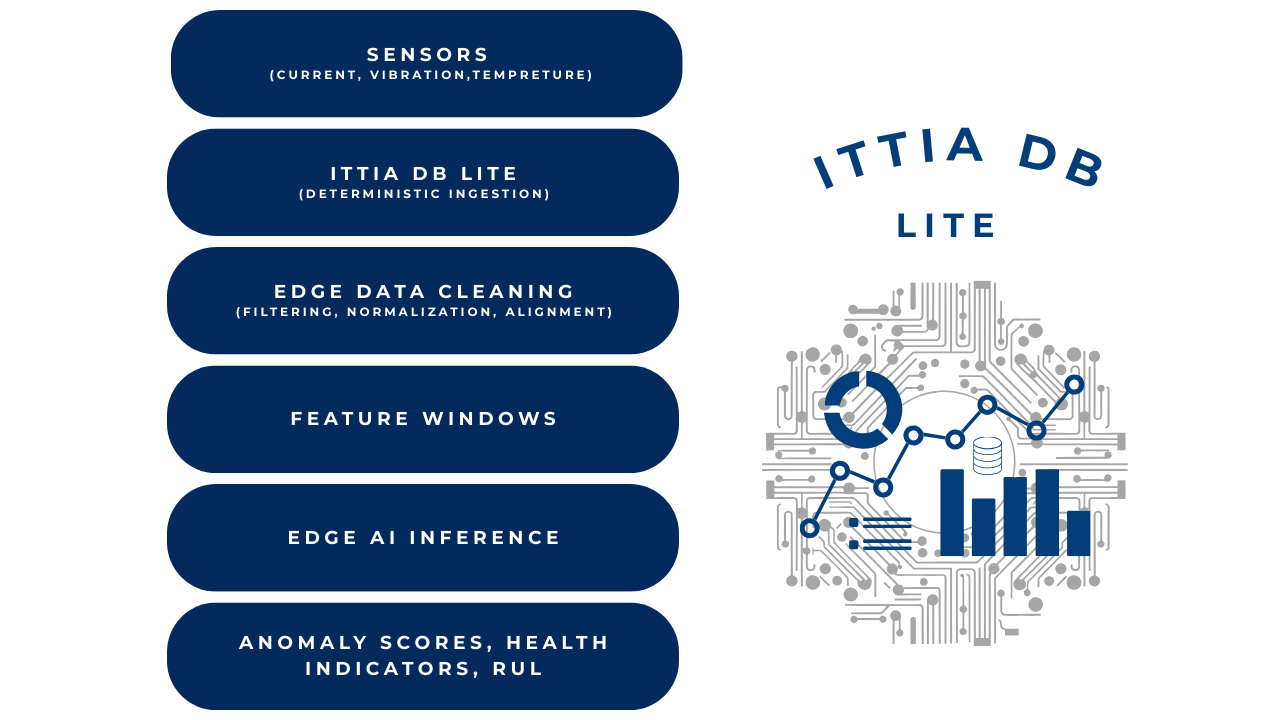
This pipeline is deterministic, explainable, and resilient, not a demo.
Why This Matters for Real Products
Predictive Maintenance
Clean, persistent data enables early fault detection instead of reactive alarms. In predictive maintenance applications, clean and persistent data is what enables systems to detect early signs of degradation rather than reacting to failures after they occur.
On STM32 devices, ITTIA DB Lite provides a deterministic, power-fail-safe data foundation that continuously captures and preserves high-quality time-series sensor data over long periods. By ensuring that data is filtered, normalized, and stored reliably on the device, subtle trends and anomalies can be identified early, allowing predictive maintenance algorithms to act proactively, reducing downtime, avoiding false alarms, and extending the operational life of equipment.
Explainable Edge AI
Engineers can correlate inference results back to raw and cleaned signals—critical for safety and certification. Explainable Edge AI depends on the ability to trace every inference back to the data that produced it.
On STM32 devices, ITTIA DB Lite enables this traceability by persistently storing raw sensor data alongside cleaned signals, feature windows, and inference outputs in a deterministic and power-fail-safe manner. This structured data foundation allows engineers to correlate AI decisions with the underlying measurements, making system behavior transparent and verifiable. Such explainability is critical for debugging, validation, and meeting safety and certification requirements in regulated and mission-critical edge applications.
Long-Term Learning
STM32 devices can observe degradation over weeks or months, not just seconds. Long-term learning at the edge requires the ability to observe and retain system behavior over extended periods, not just short, transient windows.
On STM32 devices, ITTIA DB Lite provides persistent, deterministic storage that allows sensor data, cleaned signals, and derived features to be accumulated safely over weeks or months. This historical continuity enables Edge AI algorithms to identify slow degradation, drift, and aging effects that are invisible in short time frames. By maintaining long-term context directly on the device, STM32 systems can evolve from reactive monitoring to true predictive intelligence throughout their operational lifecycle.
Production Reliability
No data loss. No long-tail latency. No mysterious resets. Production reliability at the edge depends on predictable behavior under all operating conditions.
On STM32 devices, ITTIA DB Lite delivers this reliability by ensuring deterministic data ingestion, bounded latency, and power-fail-safe persistence. Data is never silently lost, latency remains predictable without long-tail spikes, and the system recovers cleanly from resets without corruption or undefined state. This combination eliminates the “mysterious resets” and unpredictable behavior common in ad-hoc data pipelines, allowing STM32-based systems to run continuously and confidently in demanding, production environments.
Edge AI Starts with Data Discipline
Most Edge AI toolchains focus on:
- Models
- Inference speed
- Accelerators
Very few address the data reality of embedded systems. Most Edge AI toolchains concentrate on models, inference speed, and hardware accelerators, assuming that data will somehow be available and well behaved.
In real embedded systems, especially on STM32 devices, the true challenge lies in managing noisy, continuous sensor data under real-time constraints, limited resources, and frequent power events. ITTIA DB Lite addresses this data reality by providing deterministic ingestion, persistent time-series storage, and bounded latency directly on the microcontroller. By solving the data problem at the source, it enables Edge AI systems on STM32 to move beyond demos and deliver reliable, explainable intelligence in production.
ITTIA DB Lite brings database-grade data discipline to STM32 microcontrollers, turning raw sensor streams into AI-ready, production-quality data, directly at the edge.
Final Takeaway
Clean data is the real intelligence behind Edge AI. Without trustworthy, well-structured data, even the most advanced models become fragile and unreliable in real-world conditions. On STM32 devices, where real-time constraints, limited resources, and long operational lifetimes are the norm, data must be deterministic, persistent, and power-fail safe from the moment it is created. ITTIA DB Lite provides this foundation by enabling structured ingestion, edge data cleaning, and reliable storage directly on STM32 microcontrollers. Together, STM32 and ITTIA DB Lite turn raw sensor streams into consistent, AI-ready information—allowing Edge AI systems to move beyond prototypes and deliver explainable, production-grade intelligence at the edge. Clean data is the real intelligence behind Edge AI. On STM32 devices, ITTIA DB Lite makes data deterministic, persistent, and explainable—so Edge AI can finally move from prototype to production.
