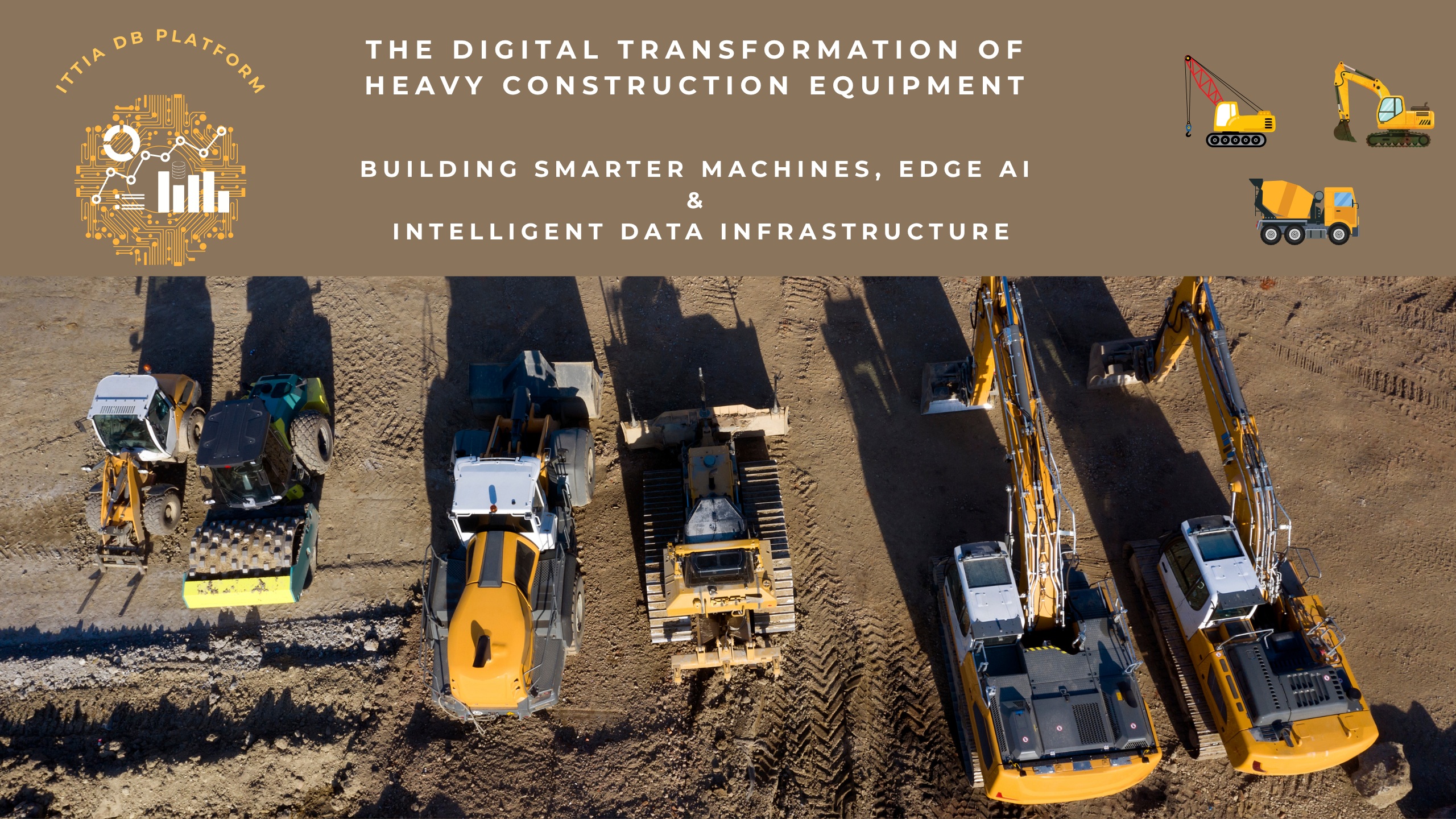
The Digital Transformation of Heavy Construction Equipment
Building Smarter Machines, Edge AI, and Intelligent Data Infrastructure
Heavy construction equipment is undergoing a profound transformation. Machines that once relied primarily on hydraulics, mechanical systems, and operator experience are evolving into intelligent, connected, software-defined platforms capable of monitoring their own health, optimizing performance, and supporting autonomous operation.
As heavy construction equipment evolves toward autonomous and software-defined architectures, much like Software-Defined Vehicles (SDVs), data becomes the foundation that enables intelligence, safety, efficiency, and continuous improvement.
Modern excavators, loaders, haul trucks, and cranes increasingly rely on networks of sensors, electronic control units (ECUs), connectivity, and Edge AI to optimize operations and support predictive maintenance. To function effectively, these machines must continuously acquire, store, process, and analyze massive volumes of operational data from engines, hydraulics, drivetrains, GPS, IMUs, and machine health systems.
Deterministic data management is therefore essential to ensure reliable decision-making, explainable AI, historical analysis, and secure synchronization across equipment fleets. Just as SDVs require a robust data infrastructure to transform raw data into actionable intelligence, the next generation of intelligent construction equipment depends on advanced data management platforms such as the ITTIA DB Platform to enable autonomous operation, predictive maintenance, fleet optimization, and software-driven innovation.
Modern equipment manufacturers are increasingly integrating sensors, embedded processors, connectivity, and Artificial Intelligence (AI) to improve productivity, reduce downtime, enhance safety, and lower operating costs. However, as these machines become more intelligent, a new challenge emerges: How can massive volumes of real-time machine data be collected, managed, processed, and transformed into actionable intelligence directly at the edge?
The answer lies in combining Edge AI with a robust data infrastructure platform such as the ITTIA DB Platform.
The Machines Building Our World
Heavy construction equipment encompasses a broad range of specialized machines used in infrastructure development, mining, earthmoving, road construction, and material handling. Equipment such as excavators, bulldozers, wheel loaders, backhoes, graders, dump trucks, pavers, cranes, mining haul trucks, concrete equipment, compactors, and skid steer loaders form the backbone of modern construction projects around the world. These machines operate under extreme conditions that include heavy loads, constant vibration, dust, mud, temperature fluctuations, and demanding duty cycles. As a result, reliability, uptime, operational efficiency, and safety are mission-critical requirements, making intelligent monitoring, predictive maintenance, and data-driven decision-making essential for maximizing productivity and minimizing costly downtime.
The Sensor Revolution Inside Construction Equipment
Today's heavy construction equipment contains dozens or even hundreds of interconnected sensors that continuously generate operational and diagnostic data. Powertrain sensors monitor engine RPM, fuel consumption, oil pressure, oil temperature, coolant temperature, and exhaust emissions, while hydraulic system sensors track pressure, flow rates, valve positions, and pump efficiency.
Mechanical health sensors measure vibration, bearing condition, gearbox performance, and motor temperatures to identify early signs of wear and failure. Motion and positioning systems leverage GPS, accelerometers, gyroscopes, inertial measurement units (IMUs), and encoders to track machine location, orientation, and movement. Environmental sensors further monitor ambient temperature, dust levels, humidity, and terrain conditions. Together, these sensors create a constant stream of valuable data that can be analyzed in real time to optimize performance, improve fuel efficiency, enhance operator safety, support predictive maintenance, and detect potential failures before they result in costly downtime.
Why Edge AI Matters
Effective data management combined with Edge AI enables heavy construction equipment and industrial devices to make intelligent decisions directly where data is generated, eliminating the delays, bandwidth costs, and connectivity challenges associated with cloud-only architectures. By storing, processing, and analyzing data on-device, Edge AI systems can continuously monitor machine health, detect anomalies, predict failures, and optimize operations in real time, even in remote environments with limited network access.
Local data management also enables historical retention, feature engineering, explainable AI, and deterministic performance while maintaining data ownership, privacy, and security. Instead of transmitting massive volumes of raw sensor data to the cloud, only meaningful insights, alerts, and aggregated information need to be shared, reducing communication costs and improving scalability. The result is faster response times, greater reliability, improved safety, and more autonomous operation of intelligent equipment in the field.
Traditionally, machine data was transmitted to centralized servers or cloud platforms for storage and analysis. While effective for fleet-wide reporting, this approach introduces challenges including network latency, limited connectivity, bandwidth costs, cybersecurity concerns, and delays in critical decision-making. These issues are particularly significant in construction, mining, and remote industrial environments where reliable communication infrastructure may not always be available. Edge AI addresses these limitations by enabling equipment to process and analyze data directly on the machine, allowing real-time decisions without relying on cloud connectivity. This enables predictive maintenance by detecting bearing wear, hydraulic leaks, and engine anomalies before costly failures occur; operator assistance through real-time recommendations that improve productivity and fuel efficiency; safety monitoring that identifies hazardous conditions and helps prevent accidents; and autonomous operation through machine guidance, navigation, and obstacle detection. By bringing intelligence closer to the source of data, Edge AI improves responsiveness, reliability, safety, and operational efficiency.
Data: The Missing Piece of Edge AI
Many AI initiatives focus primarily on developing and optimizing machine learning models, yet the success of any AI system ultimately depends on the quality of the data that feeds it. Reliable, structured, and traceable data is the foundation of accurate and trustworthy AI. Before an AI model can produce meaningful predictions, data must be acquired from sensors, cleaned to remove errors and noise, normalized for consistency, stored for historical analysis, indexed for efficient access, processed into meaningful information, transformed into AI-ready features, and delivered reliably to the inference engine. Without a robust data management foundation, AI models operate on incomplete or inconsistent information, resulting in unreliable outcomes, reduced accuracy, limited explainability, and significant challenges in validation, maintenance, and long-term deployment.
Challenges of Construction Equipment Data
Modern connected devices generate enormous volumes of data from sensors, controllers, communications interfaces, and user interactions, creating significant challenges in how that data is acquired, stored, organized, processed, protected, and transformed into actionable information. Traditional approaches often struggle with data fragmentation, inconsistent formats, limited storage capacity, unreliable connectivity, security concerns, and the need to retain historical information for analysis and compliance. These challenges become even greater in Edge AI systems, where real-time decisions depend on continuous streams of high-quality data. Before AI models can generate accurate and trustworthy results, data must be collected, cleaned, normalized, timestamped, stored, indexed, and converted into meaningful features while maintaining traceability and integrity. Edge AI applications further require deterministic performance, low latency, explainable decision-making, local data ownership, and the ability to operate autonomously even when disconnected from the cloud. As a result, modern intelligent devices increasingly require robust data infrastructure capable of managing the complete lifecycle of data, from sensor acquisition to AI inference and actionable outcomes.
Heavy construction equipment presents unique data management challenges due to the scale, complexity, and operating conditions of modern machines. A single excavator, haul truck, or bulldozer can generate thousands of sensor measurements per second from powertrain, hydraulic, positioning, environmental, and machine health systems. These machines operate in harsh environments characterized by constant vibration, shock, dust, moisture, extreme temperatures, and intermittent power conditions that can impact data integrity and system reliability. Additionally, construction and mining equipment often remain in service for 10 to 20 years or more, requiring long-term data retention and support for evolving software and analytics capabilities. Connectivity can also be limited or unavailable on remote job sites, making cloud-dependent architectures impractical. At the same time, maintenance teams and operators increasingly require explainable AI and transparent analytics that clearly demonstrate why a machine generated a warning, anomaly, or maintenance prediction. Addressing these challenges requires a robust edge data infrastructure capable of deterministic data collection, historical storage, local analytics, reliable recovery, and traceable AI decision-making.
The ITTIA DB Platform Advantage
The ITTIA DB Platform provides the data infrastructure needed to support intelligent construction equipment throughout its lifecycle.
The platform includes:
- ITTIA DB Lite AI
- ITTIA DB
- ITTIA Analitica
- ITTIA Data Connect
Together they create a complete edge-to-enterprise data ecosystem.
ITTIA DB Lite AI: Intelligence at the Edge
ITTIA DB Lite AI provides deterministic data management directly on microcontrollers and embedded controllers. Capabilities include:
Embedded Time-Series Management
Store and manage:
- Engine data
- Hydraulic pressures
- Vibration signals
- Temperature measurements
- GPS coordinates
- Operational events
Real-Time Feature Engineering
ITTIA DB Lite AI enables real-time feature engineering directly on embedded devices by transforming raw sensor data into AI-ready information that improves model accuracy and reliability. The platform can automatically generate statistical, temporal, and frequency-domain features such as RMS, variance, rolling averages, peak detection, frequency-domain analysis, lag functions, and delta calculations. By performing feature extraction at the edge, devices can reduce the amount of raw data that must be transmitted or stored while providing AI models with meaningful representations of machine behavior. This approach improves anomaly detection, predictive maintenance, condition monitoring, and autonomous decision-making while enabling deterministic, explainable, and efficient Edge AI pipelines directly on microcontrollers and intelligent equipment.
Explainable AI
Maintain complete data lineage:
Sensor → Signal → Feature → Inference → Action
This enables engineers to understand how and why a machine generated a prediction.
Historical Retention
Store machine history locally to support:
- Trend analysis
- Failure investigation
- Long-term learning
- Operational optimization
ITTIA DB: Data Management for Intelligent Vehicle Controllers
As construction equipment evolves toward centralized computing architectures, powerful controllers and gateways require sophisticated data management.
ITTIA DB provides:
- Relational data management
- Embedded SQL
- Time-series analytics
- Secure storage
- Transactional integrity
- Long-term historical retention
This allows fleet operators and OEMs to manage machine data efficiently while maintaining reliability.
ITTIA Analitica: Operational Intelligence
ITTIA Analitica transforms machine data into actionable insights.
Users can visualize:
- Machine utilization
- Health scores
- Fuel efficiency
- Predictive maintenance alerts
- Sensor trends
- AI confidence levels
- Fleet performance metrics
This provides a real-time operational cockpit for equipment operators and fleet managers.
ITTIA Data Connect: Secure Data Distribution
Not all data should leave the machine.
ITTIA Data Connect enables selective synchronization of meaningful information rather than transmitting massive amounts of raw sensor data.
Capabilities include:
- Secure communication
- Change Data Capture (CDC)
- Edge-to-cloud synchronization
- Fleet-wide data aggregation
- Bandwidth optimization
This reduces communication costs while preserving critical insights.
The Future: Autonomous Construction Equipment
The future of heavy construction equipment is increasingly autonomous, with excavators, haul trucks, loaders, and earthmoving systems evolving into intelligent, software-defined machines. These advanced systems depend on real-time sensor fusion, deterministic data pipelines, AI-ready feature engineering, historical learning, explainable decision-making, and secure data management to operate safely and efficiently. However, these capabilities cannot be delivered by AI models alone, they require a robust data infrastructure foundation capable of managing the complete lifecycle of machine data. As construction equipment becomes smarter, the ability to collect, store, process, analyze, and operationalize data at the edge becomes just as critical as the AI itself.
The ITTIA DB Platform provides the deterministic data infrastructure needed to support predictive maintenance, autonomous operation, fleet intelligence, and real-time decision-making. By combining embedded time-series management, AI-ready feature engineering, explainable data lineage, secure synchronization, and advanced analytics, ITTIA enables equipment manufacturers to transform traditional machines into intelligent, data-driven assets that operate reliably in the world's most demanding environments. The future of construction is not simply automated, it is data-driven, and with the ITTIA DB Platform, intelligent machines begin with intelligent data.
