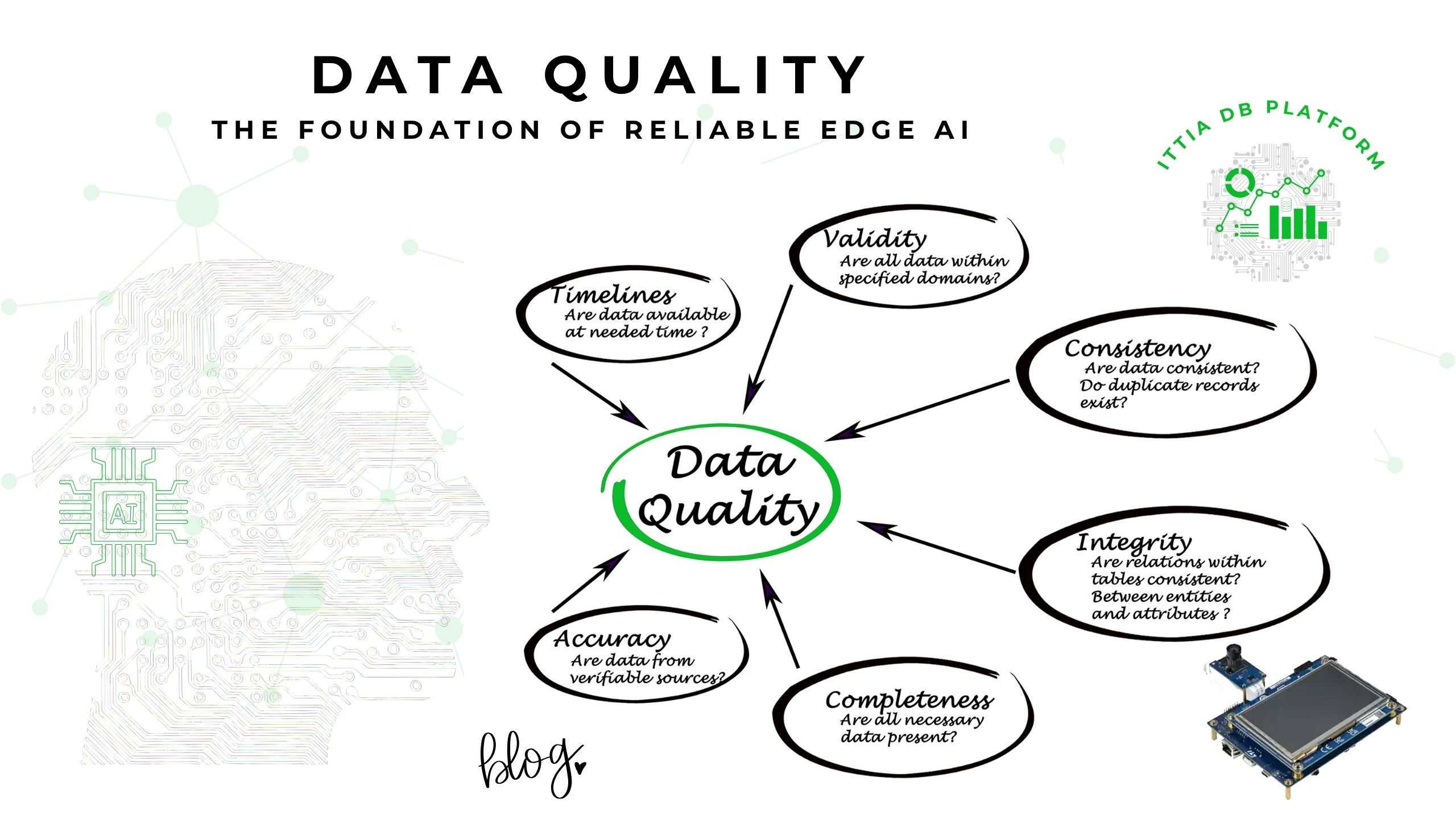
Data Quality: The Foundation of Reliable Edge AI
The Most Important Element of Device Data Management for Edge AI
Artificial Intelligence is transforming embedded systems, enabling devices to detect anomalies, predict failures, optimize operations, and make intelligent decisions directly at the edge. From industrial equipment and medical devices to battery management systems and Software-Defined Vehicles (SDVs), Edge AI is becoming a critical component of modern products.
Yet, despite the excitement surrounding AI models and inference engines, many developers overlook the most important factor determining the success of an Edge AI system: data quality.
Data quality can quickly degrade on edge devices when sensor readings are lost, corrupted, delayed, improperly timestamped, or stored without sufficient historical context. Limited memory, intermittent connectivity, power failures, noisy signals, and inconsistent processing pipelines can all introduce errors that propagate through the system.
Poor data management may lead to missing records, duplicate events, or unreliable operational history, while inadequate data processing can generate inaccurate features and analytics. As a result, AI models receive low-quality inputs, producing unreliable predictions, false alarms, missed anomalies, and poor decision-making. Successful Edge AI therefore depends on a trusted data foundation that ensures deterministic data acquisition, management, processing, and feature engineering before AI inference occurs.
The ITTIA DB Platform addresses these challenges by providing a deterministic and trusted data infrastructure for embedded and Edge AI systems. It enables devices to reliably acquire, validate, timestamp, store, and manage sensor data while maintaining data integrity even during power failures or connectivity disruptions. Through built-in time-series management, streaming data processing, feature engineering, and AI-ready data pipelines, ITTIA ensures that raw sensor data is transformed into accurate, consistent, and high-quality information before it reaches analytics or AI models.
By preserving operational history, maintaining data lineage, and delivering predictable performance across Cortex-M, Cortex-R and Cortex-A processors, the ITTIA DB Platform helps developers build Edge AI applications that generate reliable insights, explainable predictions, and confident decisions from trusted data.
AI Is Only as Good as the Data It Receives
An AI model can only learn from and act upon the data it is given. If sensor data is incomplete, inconsistent, delayed, corrupted, or lacking historical context, even the most sophisticated AI model will produce unreliable results.
This challenge becomes even more significant at the edge, where devices operate with limited memory, storage, bandwidth, and processing resources. Unlike cloud environments, embedded systems must collect, manage, process, and utilize data in real time while maintaining deterministic behavior.
As a result, the true foundation of Edge AI is not the AI model itself, it is the quality of the underlying data.
What Data Quality Means for Edge AI
High-quality Edge AI data requires far more than simply capturing sensor readings. To build reliable and intelligent devices, developers must ensure deterministic data acquisition, accurate timestamps and temporal ordering, consistent and complete sensor records, power-fail-safe data persistence, noise filtering, signal validation, reliable historical data retention, traceability from sensor to inference, explainable AI decisions, and efficient feature engineering. Without these capabilities, Edge AI systems often suffer from false positives, poor prediction accuracy, inconsistent behavior, and difficult troubleshooting.
The ITTIA DB Platform addresses these challenges by providing a trusted data foundation that enables devices to acquire, manage, process, and transform data deterministically. Through robust time-series management, streaming data processing, power-fail-safe storage, feature engineering, and AI-ready data pipelines, ITTIA ensures that only high-quality, contextualized data reaches analytics and AI models. The result is more accurate predictions, improved reliability, greater explainability, and faster development of intelligent automotive, medical, industrial, robotics, and IoT applications.
The Edge AI Data Pipeline
Successful Edge AI applications follow a structured data pipeline:
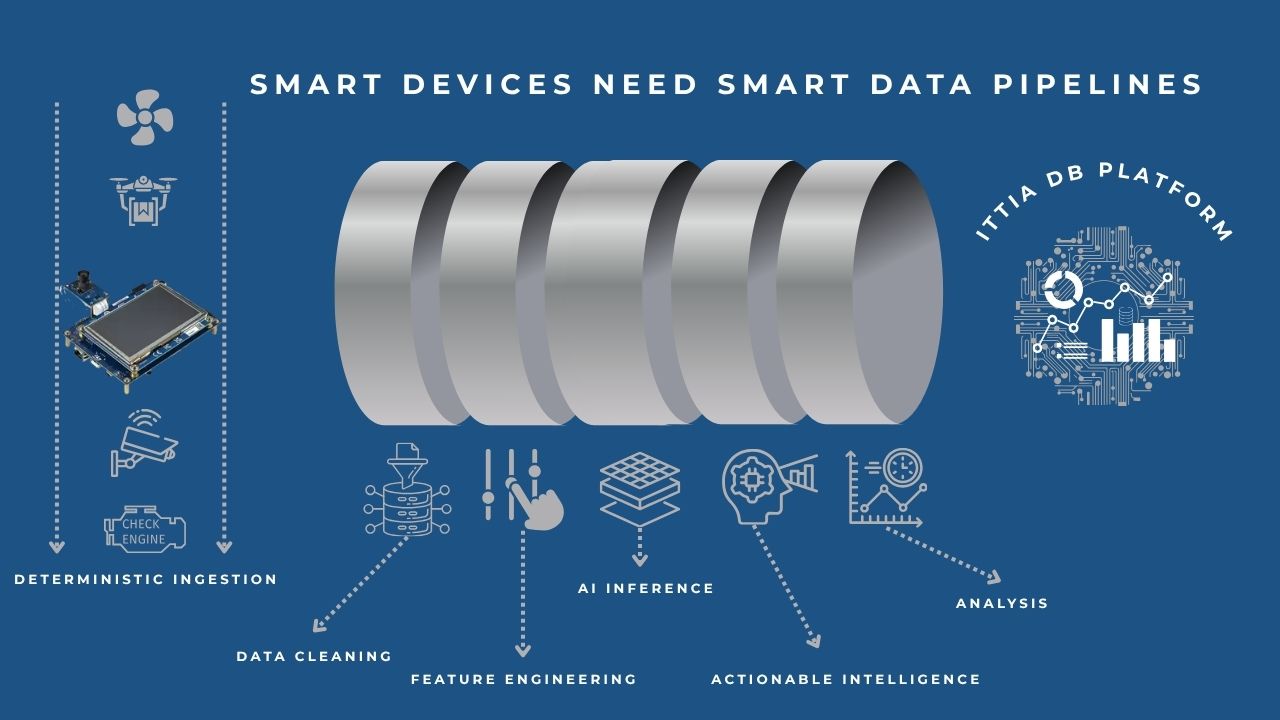
Each stage depends on the quality and integrity of the previous stage. If the data foundation is weak, the entire pipeline suffers.
This is why data management has become a strategic component of Edge AI system design.
How the ITTIA DB Platform Adds Value Across the Edge AI Data Pipeline
Successful Edge AI systems are built on a structured data pipeline that transforms raw sensor signals into intelligent actions. The ITTIA DB Platform provides value at every stage of this process, ensuring that data remains accurate, consistent, traceable, and AI-ready from acquisition through decision-making.
1. Data Acquisition
The ITTIA DB Platform enables deterministic acquisition of sensor, control, telemetry, and operational data directly on embedded devices. It provides accurate timestamping, temporal ordering, buffering, and reliable ingestion of high-frequency data streams while maintaining predictable performance on resource-constrained systems. This ensures that critical data is captured completely and consistently, even during intermittent connectivity or power disruptions.
2. Data Management
Once acquired, data must be organized, stored, and protected. ITTIA provides time-series management, transactional storage, power-fail-safe persistence, and efficient indexing for both MCU and MPU environments. Developers can maintain complete operational histories, device logs, events, alarms, and state information while ensuring data integrity and rapid access to historical records.
3. Data Processing
Raw sensor data often contains noise, inconsistencies, and redundant information. The ITTIA DB Platform supports real-time data processing through filtering, aggregation, windowing, normalization, and signal conditioning functions. This transforms raw measurements into trusted operational data that can be reliably analyzed and utilized by downstream applications.
4. Feature Engineering
Feature engineering is where raw data becomes AI-ready. ITTIA DB Platform enables developers to generate rolling averages, RMS values, statistical summaries, deltas, trends, anomaly indicators, FFT-derived features, and other domain-specific attributes directly on the device. By performing feature engineering at the edge, developers reduce bandwidth requirements while improving AI model quality and explainability.
5. AI Inference
AI models depend on high-quality inputs. The ITTIA DB Platform provides deterministic delivery of engineered features to inference engines such as STM32Cube.AI, CMSIS-NN, NanoEdge AI Studio, and NXP eIQ Auto. By ensuring consistent data quality, complete context, and reliable historical information, ITTIA helps improve prediction accuracy while reducing false positives and missed detections.
6. Intelligent Action
The ultimate goal of Edge AI is intelligent action. Once an inference is generated, ITTIA preserves the complete decision context, including sensor inputs, engineered features, inference results, and resulting actions. This traceability enables explainable AI, supports diagnostics and compliance requirements, and allows systems to automate maintenance requests, optimize operations, trigger alerts, or adjust device behavior with confidence.
The ITTIA Advantage
The ITTIA DB Platform delivers value across the entire Edge AI lifecycle by providing a deterministic data foundation that connects data acquisition, management, processing, feature engineering, AI inference, and intelligent action into a single, trusted workflow. The result is higher data quality, improved AI accuracy, greater system reliability, and faster development of intelligent automotive, industrial, medical, robotics, and IoT devices.
Why Historical Data Matters
Many embedded applications focus only on current sensor readings, but Edge AI systems often achieve their greatest value from historical context. Battery management systems rely on charge and discharge history to assess battery health, predictive maintenance applications analyze long-term vibration and temperature trends to detect emerging failures, medical devices evaluate changes over time to identify meaningful conditions, and Software-Defined Vehicles use operational history to improve diagnostics and decision-making. Persistent data transforms isolated sensor readings into actionable insights by providing the context needed for accurate analytics and AI.
The ITTIA DB Platform adds value by enabling deterministic acquisition, management, and retention of historical device data, allowing developers to build AI-ready data pipelines that deliver more accurate predictions, improved explainability, and smarter decisions across automotive, medical, industrial, robotics, and IoT applications.
Building Trusted Data Foundations with ITTIA DB Platform
Modern embedded devices generate massive amounts of operational and sensor data, but the value of that data depends on how effectively it is acquired, managed, processed, and transformed into intelligence. The ITTIA DB Platform is designed to address the growing need for deterministic data management and AI enablement in Edge AI systems. It enables embedded devices to reliably acquire and store sensor data, manage time-series and streaming data, preserve power-fail-safe operational history, and process data in real time directly on resource-constrained MCUs and embedded processors. By performing feature engineering at the edge, ITTIA transforms raw sensor signals into AI-ready datasets that can be consumed by machine learning and inference engines for anomaly detection, predictive maintenance, battery management, medical monitoring, and other intelligent applications. The platform also maintains data lineage and operational context, supporting explainable AI workflows and improving the accuracy and reliability of AI-driven decisions. Rather than treating data management as an afterthought, the ITTIA DB Platform places data quality, data processing, and AI readiness at the center of embedded system architecture, enabling developers to build smarter, more reliable, and more intelligent devices.
Conclusion: Trusted Data Powers Reliable Edge AI
As Edge AI continues to evolve, one fundamental truth is becoming increasingly clear: AI models create intelligence, but trusted data creates reliable intelligence. The success of intelligent embedded systems depends not only on inference engines and neural networks, but also on the ability to acquire, manage, process, and preserve high-quality operational data throughout the device lifecycle. Whether powering industrial automation, medical devices, robotics, battery management systems, or Software-Defined Vehicles, organizations that prioritize data quality and deterministic data management will be best positioned to unlock the full value of AI. With the ITTIA DB Platform, developers gain the data infrastructure needed to transform raw sensor data into AI-ready insights, enabling reliable, explainable, and actionable intelligence directly at the edge.
