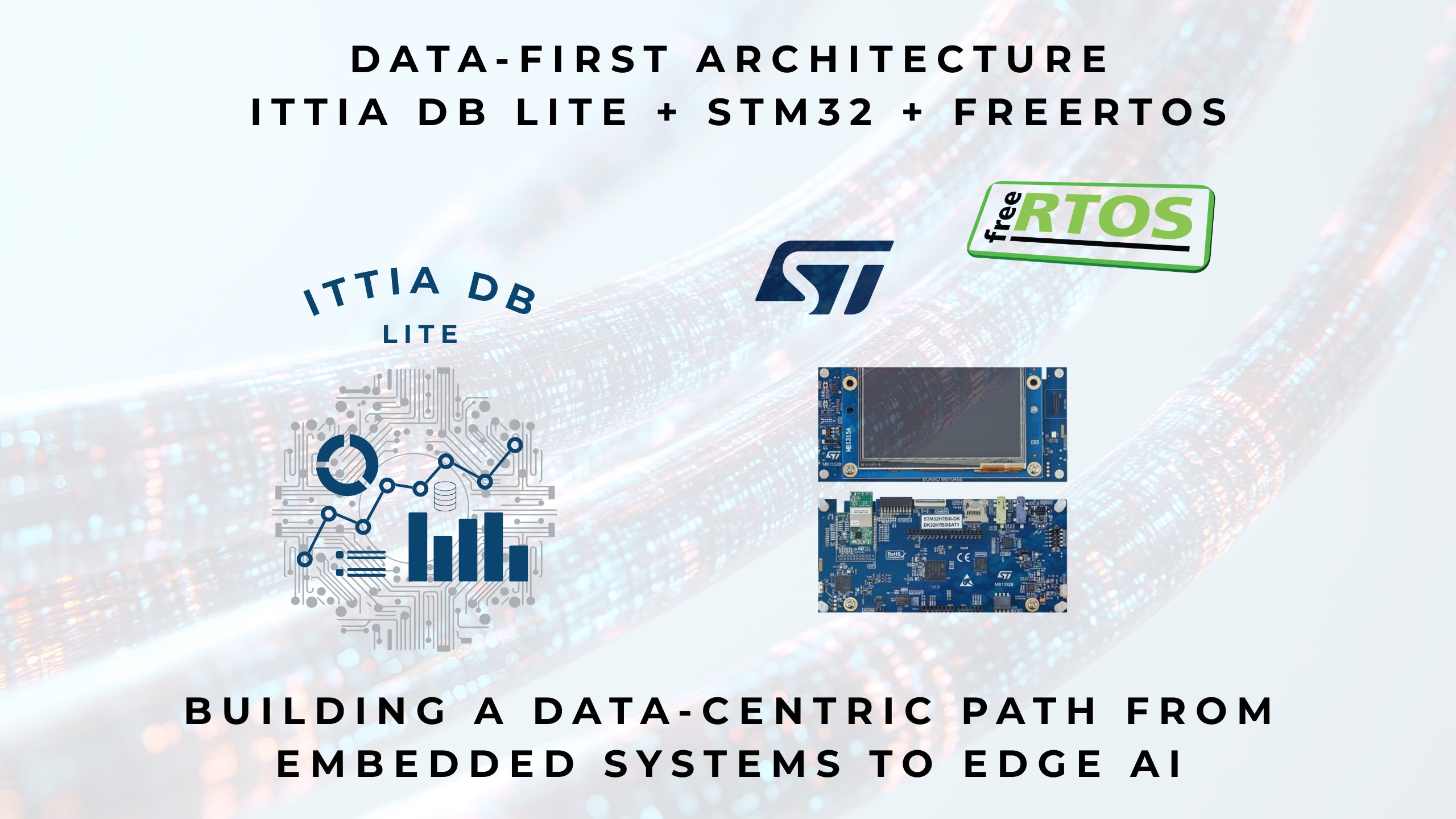
Data-First Architecture = ITTIA DB Lite + STM32 + FreeRTOS
Building a Data-Centric Path from Embedded Systems to Edge AI
The combination of FreeRTOS, STMicroelectronics STM32 microcontrollers, and ITTIA DB Lite provides a strong, production-ready foundation for building embedded systems that require reliable data management, processing, and analytics. FreeRTOS delivers deterministic real-time scheduling, ensuring predictable data acquisition and processing under tight timing constraints. STM32 devices offer scalable, power-efficient hardware with rich peripherals, DSP capabilities, and acceleration features that support real-time signal processing and analytics at the device. ITTIA DB Lite complements this stack with deterministic, power-fail-safe data persistence and native time-series handling, enabling structured storage, querying, and on-device analytics without fragile file systems or ad hoc buffers. Together, these technologies allow developers to build embedded systems that not only control and monitor the physical world in real time, but also safely capture, process, analyze, and reuse data throughout the product lifecycle, reducing development risk and increasing long-term system value.
Now for Edge AI, this is no longer just about running inference on a microcontroller. Real value comes when device data is captured deterministically, processed reliably, analyzed locally, and reused over time. Predictive maintenance, anomaly detection, adaptive control, and condition monitoring all depend on a tight integration between real-time execution, hardware-aware data handling, and AI-ready analytics.
This is where the combination of FreeRTOS, STMicroelectronics STM32 microcontrollers, and ITTIA DB Lite creates a powerful, production-ready foundation for embedded systems and Edge AI.
FreeRTOS: Deterministic Control for AI-Driven Devices
MCU-based applications need an RTOS when they must handle multiple concurrent activities with predictable timing and reliability. An RTOS provides deterministic task scheduling, prioritization, and interrupt handling, allowing time-critical functions, such as sensor acquisition, control loops, communication, and data processing, to run with bounded latency. As embedded systems grow in complexity, an RTOS replaces fragile super-loop designs with a structured execution model that improves responsiveness, scalability, and maintainability. This is especially important for data-centric and Edge AI applications, where data ingestion, preprocessing, storage, and inference must coexist without interfering with real-time behavior, power management, or safety-critical functions.
FreeRTOS provides the real-time backbone required by Edge AI and other embedded systems applications. With its preemptive scheduling, task prioritization, and predictable interrupt handling, FreeRTOS ensures that data acquisition, control loops, and AI inference execute with bounded latency.
For Edge AI, this determinism is critical:
- Sensor sampling and feature windows must align precisely with control cycles
- AI inference must never starve safety-critical tasks
- Data ingestion must remain predictable even under peak load
FreeRTOS enables developers to architect clean task separation, data capture, preprocessing, AI inference, storage, and communication, without compromising real-time behavior.
STM32: Scalable Hardware for Edge Intelligence
MCU-based applications benefit from using STMicroelectronics STM32 microcontrollers because they provide a scalable, reliable, and well-supported hardware foundation for real-world embedded systems. STM32 devices offer a broad range of performance, power, and cost options, along with rich peripherals, advanced timers, DMA, and DSP capabilities that simplify interfacing with sensors, motors, and communication interfaces. Combined with long product lifecycles, strong ecosystem support, and mature development tools, STM32 allows developers to build robust MCU-based applications that can scale from simple control tasks to data-intensive and Edge-AI-ready systems without changing platforms.
STM32 microcontrollers offer a broad, scalable hardware portfolio well suited for data-centric Edge AI and more. From ultra-low-power devices to high-performance MCUs with DSP and AI acceleration, STM32 platforms provide:
- Rich peripheral sets for real-world data (ADC, timers, DMA, sensors, communications)
- DSP and math acceleration for signal processing and feature extraction
- Strong ecosystem support for Edge AI frameworks and tools
This hardware flexibility allows developers to move from prototype to production without changing architectural assumptions, an essential requirement for long-lived Edge AI products.
ITTIA DB Lite: Deterministic Data Management on MCUs
MCU-based applications need the ITTIA DB Platform when data must be managed, processed, and reused reliably, not just logged and discarded. As embedded systems evolve to support diagnostics, analytics, and Edge AI, MCUs must capture sensor data, events, configurations, and inference results deterministically and safely under tight real-time and power constraints. ITTIA DB Platform provides power-fail-safe, deterministic data management with native time-series support, while ITTIA Analitica enables on-device analytics and visualization for explainability and operational insight. ITTIA Data Connect extends this architecture by securely and selectively distributing device data to external systems, fleets, or cloud services when needed. Together, these components allow MCU-based applications to turn raw data into actionable intelligence, support long-term data reuse and lifecycle analytics, and reduce development risk while building reliable, data-centric embedded systems.
Also, AI at the edge lives and dies by its data. ITTIA DB Lite provides embedded-grade, deterministic data management designed specifically for microcontrollers running real-time operating systems.
Key benefits for Edge AI and other embedded applications include:
- Deterministic ingestion and queries suitable for real-time systems
- Power-fail-safe persistence, protecting data during unexpected shutdowns
- Native handling of time-series data from sensors and events
- Built-in support for on-device preprocessing, aggregation, and analytics
Instead of relying on fragile files or ad-hoc buffers, developers gain a structured, queryable, and reusable data layer that AI pipelines can trust.
End-to-End Data Processing and Analytics at the Edge
Benefits of Combining FreeRTOS, STM32, and ITTIA DB Lite for Embedded Developers
For embedded developers, the combination of FreeRTOS, STMicroelectronics STM32, and ITTIA DB Lite delivers a balanced, production-ready foundation that simplifies development while increasing system reliability and long-term value. FreeRTOS provides deterministic task scheduling and predictable real-time behavior, ensuring that sensing, control, communication, and data handling coexist without timing conflicts. STM32 microcontrollers add scalable, power-efficient hardware with rich peripherals, DMA, timers, and DSP support, making it easier to acquire and process real-world data efficiently. ITTIA DB Lite completes the stack with deterministic, power-fail-safe data management and native time-series support, eliminating fragile file systems and custom storage code. Together, this combination allows developers to build embedded systems that not only run reliably in real time, but also safely store, process, analyze, and reuse data, enabling features such as diagnostics, analytics, and Edge AI while reducing integration risk and accelerating time to market.
On the other hand, when combined, FreeRTOS, STM32, and ITTIA DB Lite enable a clean, end-to-end Edge AI data flow:
- Real-time sensor data is acquired deterministically under FreeRTOS
- STM32 hardware accelerates signal processing and feature extraction
- ITTIA DB Lite persists raw data, features, and inference results safely
- On-device analytics and queries enable explainability and trend analysis
- AI models consume consistent, well-structured data for inference
This approach allows Edge AI systems to detect anomalies, predict failures, and adapt behavior locally, without constant cloud connectivity.
Explainability, Traceability, and Lifecycle Value
Explainability, traceability, and lifecycle value are critical pillars of embedded data processing and management, especially as devices evolve beyond simple control into analytics- and AI-enabled systems. Explainability ensures that system behavior, analytics results, and AI decisions can be understood and justified by correlating outputs with the underlying raw and processed data. Traceability enables developers to track how data is acquired, transformed, stored, and used across the system, supporting debugging, validation, certification, and compliance requirements. Lifecycle value comes from preserving and reusing data over time, allowing trends to be analyzed, models to be refined, firmware to be improved, and issues to be diagnosed long after deployment. Together, these capabilities transform embedded data from short-lived signals into a long-term asset, increasing system trust, reducing maintenance costs, and enabling continuous improvement throughout the product’s operational life.
A major advantage of a data-centric Edge AI architecture is explainability. By retaining raw sensor data alongside processed features and AI outputs, developers can:
- Correlate AI decisions with real signals
- Support certification and regulatory requirements
- Enable long-term trend analysis and retraining
- Improve models over the product lifecycle
This transforms Edge AI from a black box into a trustworthy, auditable system.
Conclusion: A Production-Ready Stack for Embedded Systems and Edge AI
A production-ready embedded system requires more than just functional firmware, it demands determinism, reliability, and a data architecture that can scale with system complexity over time. By combining a real-time operating system, robust and scalable hardware, and deterministic data management, developers gain a solid foundation for building systems that operate predictably in real-world conditions. This stack enables embedded applications not only to sense and control the physical world in real time, but also to safely capture, process, analyze, and reuse data throughout the product lifecycle. The result is reduced development risk, faster time to market, and embedded systems that are easier to maintain, certify, and evolve as new features, analytics, and AI capabilities are introduced.
FreeRTOS, STM32, and ITTIA DB Lite together form a production-grade platform for Edge AI data management, processing, and analytics. FreeRTOS guarantees real-time determinism, STM32 delivers scalable and capable hardware, and ITTIA DB Lite provides the reliable data foundation that AI systems require.
For developers building intelligent embedded products, whether in industrial automation, automotive, medical, energy, or aerospace, this combination enables faster development, lower risk, and long-term system value. It’s not just about running AI at the edge; it’s about managing data correctly so AI can succeed.
