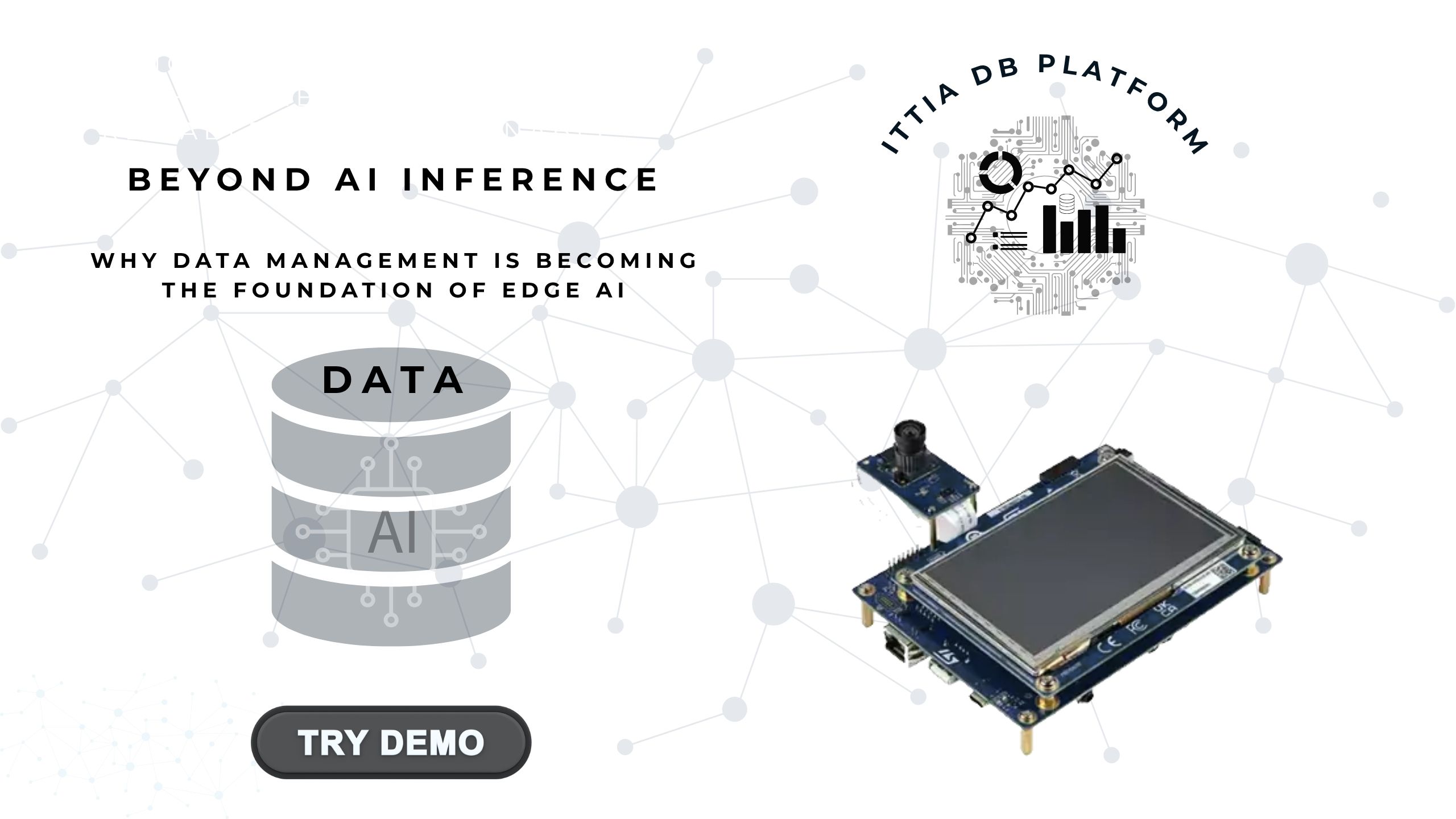
Beyond AI Inference: Why Data Management Is Becoming the Foundation of Edge AI
Can MCUs Manage the Data Edge AI Needs to Be Useful, Reliable, and Explainable?
Edge AI is entering a new phase. For several years, much of the industry conversation focused on one question: Can we run an AI model on the device? Today, the more important question is becoming: Can the device continuously manage the data required to make that AI useful, reliable, and explainable?
Running inference is only one part of an intelligent embedded system. Real-world Edge AI applications must continuously collect sensor data, preserve historical context, process and prepare that data, generate features, execute inference, make decisions, and maintain a trace of what happened. The real challenge is no longer just the model. It is the complete data pipeline around the model.
A modern Edge AI system increasingly depends on a complete data pipeline that begins with sensor data ingestion, followed by structured data management and processing to organize, clean, and contextualize information. That data is then transformed through feature engineering into AI-ready inputs for inference. Once the AI model produces a result, the system must convert it into a timely decision or action while maintaining a reliable trace of the data, features, inference, and outcome for validation, observability, and continuous improvement.
This is especially important on microcontrollers, where memory, flash, CPU resources, and power are limited. Unlike servers or multicore application processors, MCUs cannot simply dedicate additional cores or large amounts of memory to storage, analytics, and AI processing. Data ingestion, real-time control, communications, feature generation, and inference often compete for the same resources. That makes efficient data management essential.
Edge AI Needs More Than the Latest Sensor Reading
Many useful AI applications depend on historical context. A predictive-maintenance system may need vibration trends, temperature history, motor current, previous anomalies, and rolling statistical windows. A battery-management system may need charge cycles, cell temperature history, voltage variation, and previous state-of-health calculations. An agricultural system may need environmental conditions, image data, soil information, and previous observations before it can identify a meaningful change.
The AI model therefore needs more than a single value at a single point in time. It needs organized and trustworthy data.
This means the embedded system must manage time-series information, synchronize different sensor streams, retain relevant history, clean noisy inputs, calculate features, and provide the AI model with the right information at the right time.
Without this foundation, even a powerful AI model can struggle to deliver dependable results in production.
Data-Centric Edge AI
This is why data-centric Edge AI is becoming increasingly important. A data-centric architecture treats device data as a strategic asset throughout the entire lifecycle of an intelligent system. Instead of simply collecting data and immediately passing it to an AI model, the system organizes, contextualizes, processes, and preserves that information. This creates several important advantages.
The AI model can use historical context rather than isolated samples. Developers can improve data quality before inference. Applications can operate without constant cloud connectivity. Device behavior can be reconstructed after an event. AI decisions can be traced back to the information that produced them. The result is a more reliable and understandable intelligent system.
Why MCU Data Management Is Different
Edge AI on MCUs introduces another level of complexity. Microcontrollers often have limited RAM, constrained flash, strict real-time deadlines, and only one or a few CPU cores. Storage operations cannot interfere with control loops. Feature processing cannot consume unpredictable amounts of memory. Flash writes must be carefully managed. Recovery after unexpected power loss must be dependable.
Traditional data-management approaches designed for servers or powerful application processors are often poorly suited to this environment. MCUs require a data architecture that is small, deterministic, flash-aware, and tightly integrated with the real-time application.
This becomes even more important as semiconductor manufacturers continue adding AI accelerators, DSP capabilities, and neural-network libraries to increasingly capable microcontrollers. Faster inference alone does not solve the complete Edge AI problem. Developers still need to manage the data feeding those AI engines.
The Value of Historical Context
Historical data can significantly improve the value of Edge AI. Consider a vibration sensor monitoring an industrial motor. A single vibration reading may not mean very much. But comparing that reading with the previous ten minutes, previous operating cycles, motor speed, temperature, and earlier anomaly scores can provide much richer context.
Similarly, a battery-management application may identify degradation not from one voltage measurement, but from gradual changes observed across hundreds of charge and discharge cycles. Historical context transforms sensor readings into information.
That information becomes the foundation for better features, better inference, and better decisions.
From Raw Data to AI-Ready Features
Before AI inference can occur, raw device data often needs significant processing. Noise may need to be filtered. Values may need to be normalized. Signals may need to be aligned. Rolling averages, RMS values, deltas, trends, FFT results, or other statistical features may need to be calculated.
These steps are often described as feature engineering, but in embedded systems they are also a data-management problem. The application must know which data belongs to which time window, how long information should be retained, how different sensor streams relate to one another, and how the resulting features can be delivered predictably to the inference engine. This is where a structured data layer becomes particularly valuable.
ITTIA DB Lite: A Data Foundation for Intelligent MCUs
The ITTIA DB Lite product family is designed to provide this foundation for resource-constrained embedded systems.
ITTIA DB Lite enables developers to manage operational and historical device data directly on microcontrollers. Instead of building custom storage formats, circular buffers, indexes, recovery logic, and data structures for every application, developers can use a structured data-management layer designed specifically for embedded environments.
ITTIA DB Lite can help applications organize sensor data, maintain historical information, support time-series workloads, and provide efficient access to data while operating within MCU resource constraints.
This allows developers to focus more of their effort on the intelligence of the application rather than repeatedly rebuilding the underlying data infrastructure.
ITTIA DB Lite AI: Connecting Data and Inference
ITTIA DB Lite AI extends this foundation into the Edge AI pipeline. It can help developers manage the data required before, during, and after inference, including historical context, windowed data, feature preparation, and AI traceability.
A complete embedded AI data path can combine sensor data, ITTIA DB Lite, historical context, data processing, feature engineering, AI inference, and action into one structured pipeline. This gives AI models organized, relevant, and timely information rather than isolated raw inputs, improving the quality and reliability of on-device intelligence. ITTIA also provides a strong data foundation for technologies such as Arm CMSIS-DSP, CMSIS-NN, STM32Cube.AI, NanoEdge AI, NXP eIQ, and other TinyML frameworks, complementing their compute and inference capabilities with the data management needed for real-world production systems.
Traceability Is Becoming Part of Edge AI
As intelligent devices take on greater responsibility, AI traceability becomes increasingly important. A structured data foundation can preserve the complete path from sensor input to raw data, processed data, feature generation, inference, decision, and action, giving engineering teams the ability to understand how and why a particular outcome occurred. This visibility supports system validation, failure analysis, AI performance monitoring, quality assurance, and compliance, making traceability especially critical for automotive, industrial, medical, energy, and other mission-critical applications.
Less Cloud, More Intelligence on the Device
Another major Edge AI trend is reducing dependence on the cloud.
Sending every raw sensor value to the cloud can increase bandwidth costs, latency, privacy concerns, and dependence on network availability. A data-centric embedded architecture allows the device to process information locally, retain useful history, generate features, perform inference, and transmit only the information that is valuable.
Instead of sending everything, the device can send an anomaly, a summary, a selected historical window, or an AI result. This makes Edge AI more efficient, responsive, private, and resilient.
The Next Competitive Advantage in Edge AI
Semiconductor manufacturers are rapidly improving MCU processing capabilities. AI accelerators, NPUs, DSP engines, and inference libraries are becoming increasingly available across embedded platforms.
As these technologies mature, the competitive advantage will move beyond simply being able to run an AI model.
The next level of differentiation will come from how effectively the device can manage the data surrounding that model.
Can it retain historical context? Can it prepare features in real time? Can it recover reliably after power interruption? Can it trace an AI decision? Can it operate independently from the cloud? Can it perform all of this without interfering with the real-time application?
These are fundamentally data-management questions.
Data Is the Foundation of Edge Intelligence
Edge AI is evolving from model-centric experimentation toward production-ready intelligent systems. The AI model remains important, but it is only one component of the architecture.
The real value comes from transforming continuous streams of device data into meaningful, timely, and trustworthy intelligence. The ITTIA DB Lite product family provides a data foundation designed for this new generation of MCU-based intelligent systems, helping developers move from raw sensor information to historical context, feature engineering, AI inference, traceability, and intelligent action.
The future of Edge AI will not be defined only by where the model runs. It will be defined by how effectively the device manages and understands its data.
